
Before They Knock at the Door Compliance is not about surviving the crisis. It is about building value before it happens
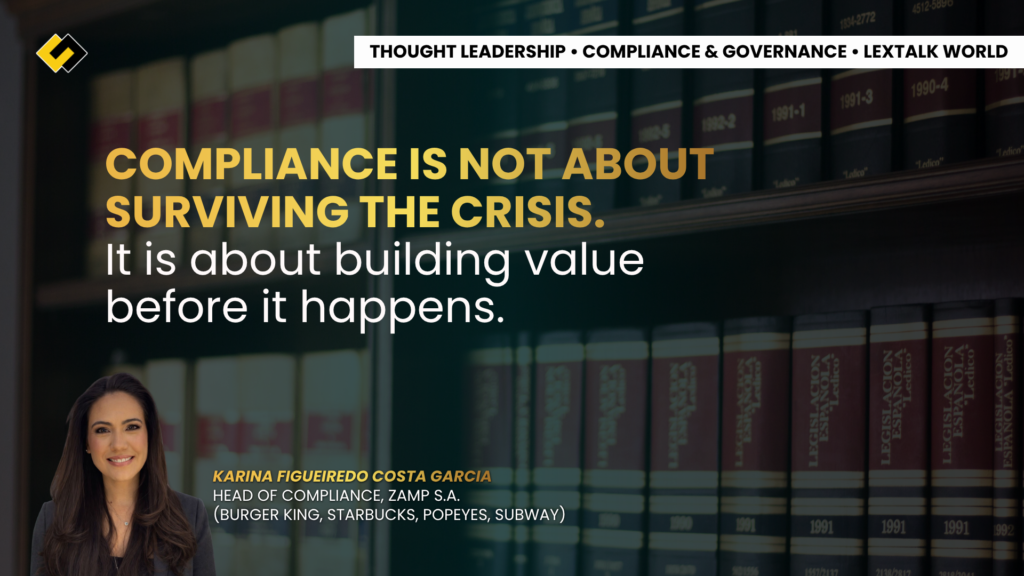
By Karina Figueiredo For the past ten years, compliance leaders have been judged by a single question: “Will we survive the next crisis?” The next decade will demand a different question: “Are we helping to build value before the next crisis even exists?” I remember a room, years ago, where an audit surfaced a risk the organization itself had already known about for months. No one had lied. No one had hidden anything on purpose. The risk simply hadn’t reached the right table in time. Do you know why? Back then, compliance was still seen as the function called in after the decision had already been made — the function that showed up to put out the fire. That was when I understood, with clarity I still carry today, that the problem is rarely a lack of information. It is the decision-making architecture that keeps that information away from those who could act on it. This article makes a simple argument: governance and risk-culture shortcomings are not isolated technical failures, but latent liabilities that become acute at exactly the moment an organization can least afford to improvise. The question is not whether compliance should have a seat at the decision-making table. It is how long an organization can afford to keep it out of the room. Over more than a decade of my career, I have taken part in some of the most complex corporate transformations in Latin America. I went through post-Lava Jato remediation alongside regulators such as the U.S. Department of Justice, the World Bank, and the IDB. I faced socio-environmental crises that permanently changed how I see operational risk. I built integrity programs across sectors as different as construction, mining, and petrochemicals, and today I continue that path leading Compliance at Zamp S.A., the House of Brands of Mubadala Capital, responsible for brands such as Burger King, Starbucks, Popeyes, and Subway. The main lesson I learned from these experiences was not about corruption. It was not about investigations. It was not about fines. It was about leadership. The companies that survived were not, necessarily, the ones with the most controls. They were the ones that managed to turn integrity into strategy and understood that, in the end, it is all about people. 1. What corporate crises have been trying to teach us The crises were different. The failures, surprisingly, were similar. Lava Jato was the largest anti-corruption investigation in Latin American history, with impacts that reshaped corporate governance across the continent. Mariana and Brumadinho showed what happens when known risks turn into human tragedies. Geological crises, such as the one in Alagoas, revealed the social and reputational cost of operational decisions made over decades — decisions that, in isolation, seemed reasonable. As different as these crises were in “nature,” they shared the same patterns: organizational silos a culture of silence known risks left unaddressed excessive focus on short-term results a disconnect between strategy, risk, and culture These patterns have not disappeared; they have only become more dangerous. Today’s business environment is far more dynamic and unpredictable than it was a decade ago. Beyond traditional regulatory risks, we now contend simultaneously with international economic sanctions, export controls, artificial intelligence, human rights, geopolitics, transnational organized crime, information security, data privacy, and psychosocial risks. Global supply chains can be disrupted overnight; reputational events can destroy value in a matter of hours. The same silos and the same culture of silence that explained yesterday’s crises now operate across a far greater number of risk fronts at the same time. Organizational culture works like a company’s immune system: it silently defines what is tolerated and what is unthinkable. No risk map, however sophisticated, can replace that system once it has been compromised. The most recent data confirms that this pattern is not intuition, it is fact. The EY Global Integrity Report 2024 shows that one in five organizations experienced a significant integrity incident in the past two years, and a third party was involved in 68% of those cases. Even more telling risk is not concentrated at the operational front line, as intuition might suggest. While 25% of employees admit they would act unethically for personal gain, that number rises to 51% among senior leadership and reaches 67% among board members. And only 47% of leaders frequently communicate to their teams why integrity matters. Silos and cultures of silence, therefore, are not born from the shop floor upward, in most cases, they are born from the top down. That is why I now believe that, even more than “tone from the top,” compliance must also prioritize middle management, because that is where the key to cultural change lies, and where strategic decision-making power already resides. Crises rarely stem from a lack of information. They arise when an organization chooses to ignore the information it already has. 2. Why traditional compliance is no longer enough The traditional compliance model was designed to respond to the past: policies, training, investigations, controls, and checklists. It is a necessary role, but an insufficient one for what lies ahead. Many organizations still see compliance as a policing function. The future demands the opposite: professionals capable of influencing decisions before risks materialize, moving away from “you can’t” and toward “here’s how to do it safely.” Part of the problem lies in how we measure the function’s success. A significant share of organizations still evaluate compliance using essentially quantitative indicators: number of investigations conducted, due diligence opinions issued, training sessions held, policies published. These indicators matter, but they measure only the function’s activity, not the value it generates for the business. Compliance should instead be evaluated by the quality of the strategic decisions it helped enable, the material risks it anticipated and mitigated, and its ability to build resilience mechanisms that allow the company to grow sustainably, including in scenarios of high uncertainty. The problem is not only what we measure, but also what we ask. Boards and committees tend to ask Compliance questions that sound rigorous but
From Immigrant to Advocate: How Personal Experience Shapes The Best Legal Representation

THOUGHT LEADERSHIP — IMMIGRATION LAW AND LEGAL OPERATIONS By Magdalena Cuprys, CEO, Serving Immigrants (Florida, USA) I arrived in the United States as a refugee from Poland. I did not choose the timing, the language, or the uncertainty that came with it — those were simply the terms of survival. What I did choose, years later, was to spend my career on the other side of that experience: representing people living through the version of uncertainty I once lived through myself. That choice became concrete the first time I touched an immigration file as a law student. It was not a case number. It was a family that had already been waiting two years for an answer, and every additional week of delay was a week of a parent unable to work legally, a child unable to enroll in school with full certainty, a life held in suspension. I had lived that suspension. I knew what it felt like to have the course of your life depend on a bureaucratic decision you could not influence or accelerate. And it taught me something no casebook ever could: in immigration law, the cost of inefficiency is not measured in billable hours. It is measured in years of someone’s life. That lesson has stayed with me through every stage of my career, from intern at the Northwest Immigrants Rights Project to founder and CEO of Serving Immigrants. It is the foundation of everything I have built since, and I believe it is the single most overlooked advantage in our profession: lawyers and leaders who have lived the system they now operate inside make different decisions than those who have only studied it. I did not learn that from a textbook. I learned it from being on the other side of the desk before I ever sat behind one. Why This Matters Now Immigration systems across the world are under simultaneous strain. In the United States, processing backlogs, shifting enforcement priorities, and rapid policy changes have made the past year one of the most volatile in recent memory for practitioners. Similar pressures are visible in the UK’s points-based system reforms, the EU’s ongoing migration pact implementation, and asylum backlogs across multiple OECD countries. What strikes me, talking with peers in London, Toronto, and São Paulo, is how familiar this dynamic feels even outside immigration law specifically. Regulatory fragmentation is the defining condition of legal practice right now. The jurisdictions differ, but the underlying problem is identical: legal teams built for a stable rule set are being asked to operate inside a rule set that changes faster than most firms can update their own internal processes. I saw this play out concretely earlier this year, when a sudden shift in enforcement posture meant that several of our clients — long-term permanent residents who had spent years building stable lives — needed updated guidance within days, not weeks. The legal analysis itself was not the hard part; experienced immigration attorneys can read a policy change quickly. The hard part was making sure that every paralegal, intake coordinator, and attorney across our offices understood the new guidance the same way, on the same day, before a single client got a wrong answer from the wrong person. That is not a legal problem. It is an operational one, and it is the kind of problem that decides, in real time, whether a firm protects its clients or quietly fails them. The Discipline of Responsibility and Efficiency Responsibility and efficiency are not in tension; they are the same discipline viewed from two angles. Early in my career, I watched how powerful it was when a legal team was simply organized: cases moved faster, clients felt supported, and outcomes improved. The opposite is also true. When a firm treats delay as an acceptable byproduct of complexity, it is making a choice about whose time matters less. Leaders do not always recognize that as a choice. It is one. I recognize it instantly, because I remember exactly what it felt like to be on the receiving end of someone else’s delay — not as a professional inconvenience, but as months of uncertainty about where my life was going. What Outcome-First Design Changes Most legal services are built backward: a firm defines its internal process, then fits the client into it. We design the other way. Before anything else, we ask what the client ultimately needs, what legal path provides the strongest route to that outcome, and what timeline and documentation strategy supports it. Only then do we build the workflow. This is a small reordering with large consequences, because it forces every team member to understand how their specific task connects to the client’s final result. People who can see that connection work with more focus and take more ownership than people executing a step they cannot place in context. This approach did not come from a business school framework. It came from knowing, firsthand, what it means to be the person waiting on the other end of a process you do not control and cannot fully understand. That experience shapes how I train attorneys, how I design intake systems, and how I measure whether we are actually doing our job. Trust and Accountability, Engineered Together When I moved from hands-on case work into the CEO role, the hardest adjustment was not strategic, it was psychological. Lawyers are trained to solve problems themselves. Leadership requires building an environment where other talented professionals can solve problems without you. That only works if structure and trust arrive at the same time. Structure without trust produces compliance without judgment. Trust without structure produces inconsistency dressed up as autonomy. The organizations that scale well in legal services refuse to pick one over the other. Working across English, Spanish, and Polish — and with teams that serve clients in all three languages and more — taught me early that consistency of process is not the enemy of cultural sensitivity. It is the precondition for it.
The Compliance Gap: Why Companies Pass Audits and Workers Still Get Exploited
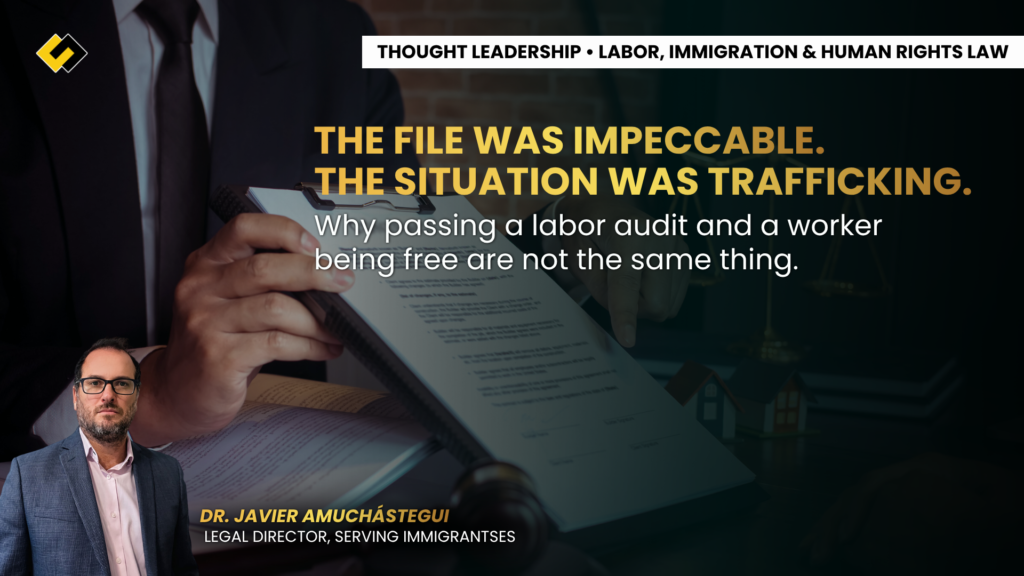
THOUGHT LEADERSHIP — LABOR, IMMIGRATION, AND HUMAN RIGHTS LAW By Dr. Javier Amuchástegui, Adjunct Professor of Labor Law, School of Law, Universidad Católica de Córdoba | Legal Director, Serving Immigrants (Florida, USA) In 2012, while serving on the Social Outreach Project team at the Universidad Católica de Córdoba on Prevention of Human Trafficking and Victim Assistance, I visited a horticultural establishment on the outskirts of the city alongside labor inspectors. The farm had everything in order: signed contracts, attendance records, pay stubs. The owner received us with coffee and a tidy folder. The workers, however, lived in makeshift structures on the premises, their identity documents were in the foreman’s possession, and none of them knew with any certainty how much money they were owed or whether they would ever collect it. The file was impeccable. The situation was trafficking. That experience, combined with more than twenty years of labor litigation in Argentina and three years as Legal Director at an immigration law firm in the U.S., convinced me of something that audit systems have yet to fully reckon with: the gap between formal compliance and a worker’s actual freedom is not a flaw in the system. It is a feature that the system, if not carefully designed, tends to produce. The Problem Is Not the Absence of Rules Argentina’s legal framework has advanced considerably. Law 26,364, enacted in 2008 and strengthened by Law 26,842 in 2012, defines forced labor, debt bondage, and labor trafficking with precision, and incorporated Articles 145 bis and ter into the Criminal Code to criminalize those conducts. A 2025 administrative directive from the Ministry of Human Capital formalized the Acta de Constatación de Indicios de Explotación Laboral, an inspection tool now used by labor inspectors across the country. The regulatory architecture exists and has matured. And yet the cases keep surfacing. In horticulture, in harvesting, in textiles. Not at the margins of the productive system, but inside it. The reason is simple to state and difficult to solve: an audit verifies that a system of paperwork exists. It does not verify that the people those documents describe are free. What the File Cannot See After years of litigation in Argentina, I learned that the first useful question is rarely a legal one. It is factual: what is actually happening inside that establishment? Contracts may be registered and wages deposited into a bank account the worker cannot access because the employer holds the card. Pay stubs may be signed by people who stopped working there months ago. The structural problem is that oversight systems are designed to verify the existence of documentation, not to test the substance of the employment relationship. And exploitation learned long ago how to produce documentation. This gets worse when subcontracting is involved. Article 12 of Law 26,727 makes the principal company jointly and severally liable for working conditions throughout the agricultural supply chain. But in practice, the ultimate beneficiary is separated from the worker by one or two layers of intermediation; precisely where the abuse occurs. The principal’s file is clean. The contractor who recruits, transports, houses, and controls the workers rarely appears on anyone’s compliance radar. A figure I heard from inspectors during the PEPS project has stayed with me: the cost of properly registering a worker for an entire harvest season can be minimal. The fine for not doing so, if it ever arrives, is manageable. The incentive not to register is economic, systematic, and perfectly rational from the intermediary’s perspective — who has the least reason to correct it, while the worker, who has every reason, has the least power to do so. What Changes When You Cross the Border Three years ago, my practice expanded in a way I had not anticipated: I began working as Legal Director at Serving Immigrants, an immigration law firm with offices in Florida. And there I encountered the same problem from the other side. Workers who arrive in the U.S. immigration system (many of them coming from agricultural, textile, or service supply chains in their home countries) bring stories that immigration law calls trafficking and Argentine law calls trata con fines de explotación laboral. It is the same phenomenon with a different name, seen from the other shore. The T visa, created by the Trafficking Victims Protection Act of 2000, offers immigration protection to victims of severe trafficking in the United States. In theory, it is a powerful tool. In practice, the hardest barrier is not legal: it is evidentiary and psychological. A worker who spent months under the control of an abusive employer, who lost their documents, who does not speak English, and who fears deportation if they speak up (because the exploiter convinced them of exactly that) does not arrive at the protection system in any condition to articulate their case. What my work at Serving Immigrants has taught me is that the compliance gap does not end at the factory or the field. It extends to the moment that worker tries to access justice, and the distance they must travel from fear to institutional trust is, in many cases, longer than any judicial proceeding. What Oversight Systems Keep Getting Wrong From that dual vantage point, I identify three patterns that repeat with troubling consistency. The first: the document is measured, not the relationship. A signed contract certifies that a formal tie existed at one point in time. It does not certify that the worker can walk off the job today, collect what they are owed, or recover their documents. Audits verify form; exploitation lives in substance. The second: joint liability exists on paper but not in the practice of oversight. Companies that benefit from subcontracted labor are legally responsible for the conditions under which that labor works; yet their compliance programs rarely reach beyond the first direct supplier. The contractor, where nearly all the abuse occurs, falls outside everyone’s audit radar. The third: criminal exposure for economic beneficiaries is real and expanding. Articles 145 bis and ter of
Corporate Governance in Family-Owned Companies: The Legal Risks of Informal Management Practices

I. Introduction Consider a company that has operated successfully for twenty years. Its founder signs contracts, opens bank accounts, and directs the hiring and firing of employees — yet no corporate resolution ever formally appointed him as director, the bylaws have not been amended since the company’s incorporation, and no shareholder meeting has been convened in over a decade. The company appears commercially stable. Beneath the surface, it is legally exposed. This scenario represents a common structural pattern among family-owned and closely held businesses. Corporate governance — the legal and institutional framework through which a company is managed, supervised, and controlled — is routinely reduced to a formality in such enterprises, or abandoned altogether. This article argues that governance deficiencies in family-owned companies are not merely technical irregularities. They are latent legal risks that become acute when the company faces litigation, regulatory scrutiny, succession conflicts, or financial distress. The question is not whether governance matters. The question is how long a company can afford to ignore it. II. The concept of Corporate Governance Corporate governance is not a term reserved for multinational corporations or publicly traded entities. At its core, it refers to the rules and mechanisms by which authority within a company is allocated, exercised, and held accountable. At a minimum, effective governance requires: Updated bylaws consistent with the company’s operational reality; Accurate and properly maintained corporate records; Valid shareholder and board resolutions authorizing corporate decisions; Clearly defined authority and formal appointment of directors and officers; Internal compliance procedures; and Transparent accounting and financial controls. In larger or publicly traded entities, governance structures may additionally encompass periodic financial disclosures, audit committees, compliance and risk management systems, and whistleblower mechanisms. For family-owned companies, the baseline requirements are less demanding — but no less important. The legal significance of this framework lies in its protection of the enforceability of corporate decisions, the limitation of personal liability, the integrity of ownership records, and the company’s capacity to survive changes in leadership or ownership structure. III. Governance deficiencies in family-owned companies Although corporate governance is commonly associated with large corporations, its importance is equally critical for closely held and family-owned businesses. Yet, in practice, many family-owned companies frequently operate through informal arrangements that diverge substantially from their legal documentation. The most common deficiencies include: Failure to distinguish personal assets from corporate assets; Use of company funds for personal or family expenses without proper authorization; Distribution of corporate assets without a legal basis; Family members exercising managerial authority without formal appointment; Individuals using executive titles —such as “CEO,” “General Director,” or “Managing Director”— that do not exist under the company’s bylaws; Informal or undocumented transfers of ownership interests; Outdated, incomplete, or nonexistent corporate records; Failure to hold meetings or approve formal shareholder and board resolutions; and Failure to issue or properly endorse share certificates. These deficiencies tend to persist because they may go unnoticed or disregarded during periods of commercial success. When a business is profitable and disputes are absent, the absence of a governance structure may appear to generate no immediate consequences, but this apparent tolerance reinforces the mistaken belief that governance is optional or a bureaucratic burden rather than a legal foundation. Commercial success alone does not eliminate the legal and operational risks associated with the business activity, but that success leads many company owners and directors to overlook them. As a result, many family-owned businesses are at risk of failure, and many fail, not because they are unprofitable, but because they never develop institutional structures capable of surviving beyond a single founder or generation. IV. When informality becomes liability The risks of weak governance in a company typically arise when the company faces disputes, such as: Shareholder and succession disputes: Informal transfers of ownership interests, undocumented capital contributions, and the absence of shareholder resolutions create the ground for disputes over ownership, voting rights, and entitlement to distributions. In succession contexts, the absence of documented governance can render ownership claims unenforceable or subject to challenge by competing heirs or co-founders. Creditor claims and insolvency proceedings: Commingled personal and corporate assets — a near-universal feature of poorly governed family businesses — expose shareholders and directors to personal liability for corporate obligations. Creditors or insolvency administrators who can demonstrate asset commingling may seek to pierce the corporate veil and eliminate the liability protection that the corporate form is designed to provide. Regulatory and tax scrutiny: Undocumented transactions, informal compensation arrangements, and the use of corporate funds for personal expenses can generate exposure to tax liability, administrative sanctions, and even criminal prosecution. Regulatory investigations that encounter deficient corporate records typically go deeper into and broaden their scope. Litigation and enforceability: Corporate decisions made without proper authorization — contracts signed by individuals lacking appointment as authorized signatories, resolutions never formally adopted — may be challenged as unenforceable. A company that cannot demonstrate the legal authority of those who acted on its behalf is legally vulnerable. A business may tolerate years of operational inefficiency, but it may not survive years of undocumented authority, commingled assets, deficient corporate records, and disregard for corporate formalities once legal disputes or regulatory scrutiny arise. V. Adopting genuine corporate governance The distinction between nominal and genuine governance is crucial. A company may claim to operate under sound governance principles while simultaneously maintaining deficient records, tolerating undocumented authority, and commingling assets. In some companies, the term “corporate governance” is used loosely to refer to centralized leadership and to suggest operational efficiency and stability. However, centralized control alone and claiming to follow corporate governance does not mean the company is being run accordingly. A business may appear operationally organized while lacking the legal structure necessary to support and protect its operations over time. True corporate governance exists when the following conditions are met: Individuals acting on behalf of the company possess actual legal authority to do so, as evidenced by formal appointment and documented authorization; Corporate decisions are properly authorized and recorded in accordance with the bylaws and applicable law; Governance bodies —
87% of General Counsels Now Use AI. Most of Them Do Not Have a Governance Framework to Match
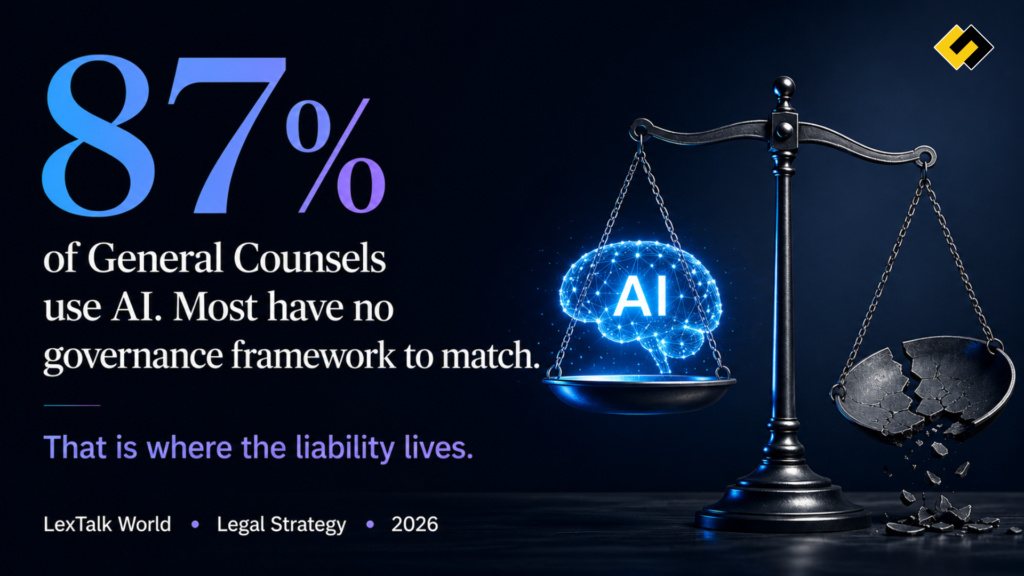
LEXTALK WORLD • LEGAL STRATEGY • 2026 AI adoption inside corporate legal departments has hit record levels in 2026. The liability that comes with it is growing just as fast. Here is what every senior lawyer needs to understand right now. What is AI governance for General Counsel? AI governance for General Counsel is the set of policies, oversight mechanisms, and accountability structures a legal department puts in place to manage the risks that come with using artificial intelligence in legal work. It covers how AI tools are selected, how their outputs are verified, how liability is assigned when AI produces errors, and how the department demonstrates compliance with AI-specific regulations to boards, regulators, and courts. Eighty-seven percent of General Counsels are now using AI tools in their workflows, according to a mid-2026 report by FTI Consulting and Relativity. That figure jumped from 44% a year ago and just 20% in 2024. The adoption curve is steep, and it shows no sign of flattening. What is flattening is the assumption that adoption is the hard part. The harder part is what comes after adoption. AI tools are now embedded in legal research, contract review, due diligence, compliance monitoring, and board preparation. They interact with sensitive data, generate outputs lawyers rely on, and in many cases influence decisions with material consequences. And in most legal departments, those tools operate without a governance framework designed to manage what happens when they are wrong. In 2026, that gap has a price. Over 700 court cases worldwide now involve AI hallucinations. Sanctions against lawyers who relied on AI-generated content without adequate verification range from formal warnings to five-figure monetary penalties. The ABA established in 2024 through Formal Opinion 512 that lawyers have a duty to maintain a reasonable understanding of AI’s capabilities and limitations. That obligation now sits squarely on the General Counsel’s desk. Why Is AI Governance the Defining Legal Risk of 2026? The speed of AI adoption inside organisations has outpaced the governance infrastructure that should accompany it. A June 2026 analysis found that nearly 90% of General Counsels still feel resource constraints limit their strategic impact, even with AI-driven productivity gains. The most commonly cited issue is not efficiency. It is governance. The risk is not hypothetical. Stanford researchers found error rates of 17% for Lexis+ AI and 34% for Westlaw AI-Assisted Research, which are legal-specific tools from established vendors. General-purpose models performed worse. When an AI tool hallucinates a case citation, a statute, or a contractual obligation, and a lawyer relies on that output without verification, the professional responsibility lies with the lawyer, not the vendor. Courts have confirmed this position across dozens of sanctions decisions. At the same time, the regulatory environment is tightening on multiple fronts simultaneously. The EU AI Act requires documented risk assessments, human oversight, audit trails, and intervention capabilities for high-risk AI systems, with full implementation for those systems from August 2026. The Colorado Artificial Intelligence Act, which took effect in June 2026, mandates annual AI impact assessments for certain high-risk uses. California’s AI requirements include meaningful human oversight, bias testing, and multi-year record retention. More than 1,000 state-level AI bills were introduced in 2025. Gartner projects that 80% of organisations will need to formalise AI policies addressing ethical, brand, and personal data risks by 2026. Most legal departments are not yet among that 80%. What Does a Governance Framework for AI in Legal Actually Look Like? Governance frameworks for AI in legal work are not the same as general AI policies, and they are not the same as existing data protection programmes. They are narrower and more specific, because the professional obligations of lawyers add a layer that does not apply to most other functions. A functional AI governance framework for a legal department has six components. 1. AI Tool Selection With Legal Oversight The selection of AI tools for legal work cannot be delegated entirely to IT or legal ops. When courts sanction lawyers for AI errors, they hold counsel responsible regardless of which department chose the tool. General Counsel need to be actively involved in evaluating whether a given tool’s design, training, and governance mechanisms support defensible legal workflows. The central question has shifted from whether a tool increases efficiency to whether it can withstand scrutiny if challenged. 2. Verified Output Protocols Every jurisdiction that has addressed AI use in legal practice has affirmed the same principle: AI output is a draft, not a deliverable. Dozens of federal and state judges have issued standing orders requiring AI disclosure and verification. A verified output protocol defines, in writing, what review is required before AI-generated content is relied on, cited, or submitted. It assigns responsibility for that review to a named individual and records that the review occurred. 3. Data Input Governance When lawyers or their teams input information into AI systems, they may inadvertently introduce confidentiality breaches, privilege waiver risks, or data protection violations. Employees often lack clarity about what information can safely be entered into which tools. A data input governance policy defines which categories of information can be entered into which tools, under what conditions, and with what client disclosure, if any is required. 4. Regulatory Tracking and Compliance Mapping The AI regulatory landscape across US states, the EU, and key international markets is changing faster than most organisations can track manually. A governance framework includes a system, maintained internally or supported by outside counsel, that monitors evolving requirements and maps them to existing AI deployments. This is not a one-time exercise. It is an ongoing function. 5. Board Accountability and Reporting According to the Director Confidence Index published by Diligent Institute in March 2026, directors increasingly look to their General Counsel for guidance on how to govern emerging technology without slowing the organisation down. Only 22% of boards have AI governance as a standing agenda item, despite 84% of directors believing boards should play a more active role in technology oversight. Placing AI governance on the board risk committee
Outside Counsel Costs Are Out of Control. Here Is What GCs Are Doing About It

How in-house legal teams are responding to law firm rates that rose nearly 10 percent in a single year, and why the old negotiation playbook no longer works. What is outside counsel cost management? Outside counsel cost management is the set of processes, controls, and strategies a legal department uses to plan, monitor, and control what it spends on external law firms before costs are incurred, not after. It includes matter budgeting, rate negotiation, billing guideline enforcement, vendor selection, and decisions about which work stays in-house versus goes to external counsel. Law firm billing rates went up an average of 9.6 percent in 2025. At Am Law 25 firms, the average partner rate crossed $1,349 per hour. Blended rates across all timekeeper levels hit $1,027 per hour. That is a 7.5 percent increase in the first quarter of 2025 alone, more than double inflation. For a legal department with a $50 million outside counsel budget, a 12 percent effective rate increase means $6 million more next year before a single new matter is opened. And yet most in-house legal teams are still responding to this pressure the same way they did a decade ago: by negotiating harder when firms send their annual rate proposals, then absorbing whatever increase results. That approach is no longer working. The data from 2026 makes clear that the legal teams managing outside counsel costs well are doing something different. They are not better negotiators. They are better prepared. Why Are Law Firm Rates Rising So Fast? Law firm billing rates have risen faster than inflation every year since 2019. Several structural forces explain why. First, firm operating costs have risen sharply. Technology spending at major firms increased 9.7 percent in 2025. Talent costs rose 8.2 percent. Firms that grew aggressively during the demand surge of 2025 now carry fixed costs that require sustained rate increases to support. Second, demand has been high enough that firms have had little incentive to restrain pricing. Regulatory complexity, trade uncertainty, and cross-border legal risk drove legal demand to some of the strongest levels in a decade during 2025. When clients are busy and work is flowing, firms raise rates and most clients pay. Third, the negotiation dynamic has historically favored firms. In-house teams typically respond to rate proposals with budget concerns and relationship history. Firms arrive with detailed internal cost data and market positioning. That is not a negotiation on equal terms. The combination of rising firm costs, strong demand, and weak in-house negotiating leverage has produced a market where average outside counsel rates now grow faster than any other major input cost in corporate legal. What Is the Real Cost of Outside Counsel Spending? The direct cost of outside counsel is visible: the invoices, the rates, the hours billed. The indirect cost is harder to see but often larger. Research published in 2026 found that only 20 percent of outside counsel matters finish within their original budget. On average, legal teams lose more than $160,000 per year to duplicated effort alone, reviewing and redrafting content that had already been worked on by another party. Most overruns trace to three gaps that are entirely within the in-house team’s control. The first gap is vague initial instructions. When a matter is opened without a clear scope, outside counsel defaults to continuing work until told to stop. That is not inefficiency on the firm’s side. It is a governance gap on the client’s side. The second gap is unmanaged scope changes. When new facts or risks emerge during a matter, scope expands. Without a documented change control process, those expansions become invisible additions to the bill. The third gap is untracked staffing shifts. Partners substitute associates. Senior timekeepers replace junior ones. Each change increases the billing rate for work that was scoped and budgeted at a lower rate. Without active monitoring, nobody catches it until the invoice arrives. These three gaps are responsible for more outside counsel cost variance than rate inflation itself. Fixing them does not require renegotiating rates. It requires better matter management. How Are GCs Bringing More Work In-House? The most significant structural shift in outside counsel management right now is not rate negotiation. It is reallocation. An Axiom study of 516 senior in-house legal leaders across eight countries, published in February 2026, found that 80 percent of in-house teams plan to move significant law firm work in-house or to alternative legal service providers within the next two years. Two-thirds of respondents said they now see alternative legal service providers as viable replacements for law firms for day-to-day strategic legal work. The reallocation is being driven by two forces. First, AI tools have made it possible for smaller in-house teams to handle work that previously required outside support. Contract review, legal research, due diligence support, and compliance monitoring are all tasks where AI-assisted in-house teams can now match or exceed the output of outside counsel at a fraction of the cost. A team of four in-house lawyers using AI tools can recover the equivalent of $700,000 or more in annual productivity compared to the same team working without them. Second, alternative legal service providers have matured significantly. In the UK and Europe, 76 percent of legal departments now use alternative providers for substantial legal work. In North America, the figure is still only 27 percent, which means most US and Canadian GCs are not yet taking advantage of a model that their European counterparts have already validated. The departments bringing work back in-house successfully are not simply adding headcount. They are building the internal systems, playbooks, and technology stack that let smaller teams handle more work without proportional cost increases. What Actually Works in Outside Counsel Rate Negotiations? Most rate negotiations fail not because law firms push back, but because in-house teams arrive unprepared. Firms come with internal cost data and market positioning. In-house teams come with budget constraints and relationship history. That is not a negotiation. It is a reaction. The tactics that are producing real
From Filing Cabinets to Superpowers: A Post-COVID Retrospective for Legal Teams
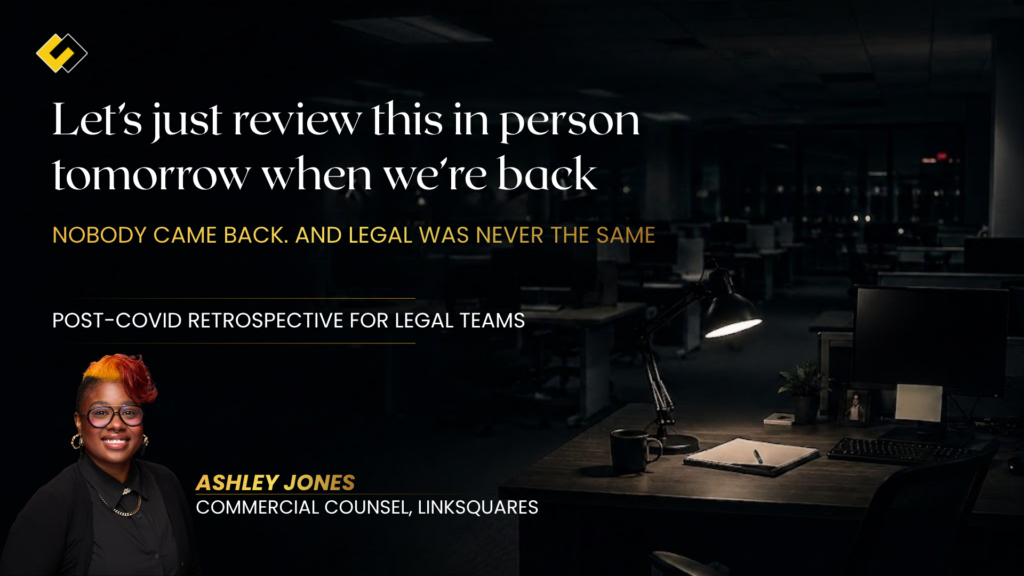
I remember the day vividly. It was early March 2020. Everyone was instructed to work remotely for the day, a relatively routine business continuity exercise to stress-test the work-from-home environment. My team didn’t think much of it, shifting meetings around to when we’d all be back in the office. I distinctly remember the hymn of the repetitive instant message saying, “Let’s just review this in person tomorrow when we’re back.” Later that evening, the state of emergency notification came through. We weren’t coming back tomorrow. And in hindsight, we never really did. What many of us thought was a business continuity exercise turned out to be something else entirely: a preview of the future. The Sudden End of the Physical Workflow Elements Before COVID, in-house legal workflows still had physical elements. E-signatures had existed for years, but wet signatures were still common and completely normal. A contract would get printed, reviewed, approved, and then walked over to the authorized signatory. It wasn’t unusual. It was just how things worked. Then almost overnight, those workflows didn’t just stall, they became obsolete. The physical handoffs. The paper routing. The casual “let me just walk this over” collaboration—all of it disappeared. Leaving us to not just question when we’d return to it but why it ever really worked at all. We had to digitize, and quickly. E-signature went from convenience to absolute necessity. Physical files became impractical artifacts of another era (one I’d soon revisit). Legal’s Role Expanded Overnight At the same time, the role of in-house legal began to shift. Before COVID, many legal teams operated in a reactive posture. Agreements came in, risks were assessed, issues were addressed. During the early pandemic months, legal departments found themselves helping design entirely new ways of working. Questions started appearing everywhere: How do we operationalize remote work across the business to retain visibility? What policies need updating? How do we retain cross-functional collaboration when no one is in the same building? What operational risks exist in a fully remote environment? Legal teams weren’t just reviewing the business anymore. We were helping reshape it. And for many of us, that shift from gatekeeper to architect was long overdue. The Data Awakening When everyone is working in the same office, the value of legal work is often seen simply through proximity. You’re physically present, collaborating, walking down the hall to solve problems. When everyone is remote, that visibility changes. Legal teams (and me nearly daily at the outset) were asking the age old question: How do we demonstrate the value of the work we’re doing (when people don’t see us doing it)? The answer increasingly became data. Contract output. Negotiation timelines. Sales support metrics. Project tracking. Volume trends. The pandemic didn’t create legal data, but it exposed an uncomfortable truth: many of us had been flying blind for years. Intuition was no longer enough; we needed proof in data and how to understand and leverage it. The Productivity and Location Paradox One of the most interesting dynamics of remote work for me to witness and be a part of was how it affected productivity. On one hand, many people (myself included) found they could work more efficiently. Without the daily commute and constant office interruptions, focus time increased. But there was an antithesis: the ‘always on’ problem. Laptops were always nearby. Slack and email migrated onto phones. The line between work and life became blurrier. Before the pandemic, leaving the office meant leaving work behind. Now my laptop can sit at my desk, or on the kitchen or coffee table moving fluidly as I do from room to room – a flexibility that sometimes toes the line of tether and freedom. As organizations grappled with this new reality, a different realization began to emerge: maybe the real question wasn’t where people were working from, or even when they were working. Maybe the real question was whether the work was getting done. Across many companies, office space gradually became optional rather than essential. For legal teams, that shift prompted new conversations about what efficient work and collaboration actually look like—and how to measure success based on outcomes rather than physical presence. The Death of the Filing Cabinet Speaking of office space, about a year and a half into the pandemic, my company at the time began shutting down its office space. Behind my desk sat filing cabinets filled with paper records—contracts, documents, and agreements stretching back years. I was tasked with revisiting and digitizing these impractical artifacts of another era so we could truly put an end to the filing cabinets. I’ll never forget how symbolic going through those cabinets truly was, because it was no longer about having a place for the filing cabinets. It was about having a place for the files, and that place wasn’t physical. Just success was no longer about physical office presence but measurable impact – a near perfect metaphor. From Digitization to Augmentation As legal teams continue evolving beyond the digitization inevitably caused by the pandemic, the next shift is well underway: artificial intelligence. If you’ve heard me speak or seen any of my LinkedIn posts, you know my favorite analogy: AI is not here to replace lawyers. It’s here to give us superpowers. Automation can streamline repetitive workflows. Integrated systems can create shared sources of truth across departments. AI-assisted tools can surface insights that once required hours of manual review. The result? Lawyers spend less time navigating administrative complexity and more time focusing on nuanced decisions that actually require legal expertise. A life preserver thrown to the ‘always on’ legal mind heading to burnout. Elevating the Normal Six years ago, many organizations were focused on finding a ‘new normal.’ But the reality today is different. We’re no longer simply adapting to a new environment. We’re refining it. We’re improving workflows. We’re elevating collaboration. We’re rethinking how legal teams operate inside modern organizations. We’re not creating new normals anymore. We’re improving and revolutionizing the ones we already have. The
The Cross-Border Compliance Crisis Every General Counsel Needs to Address in 2026
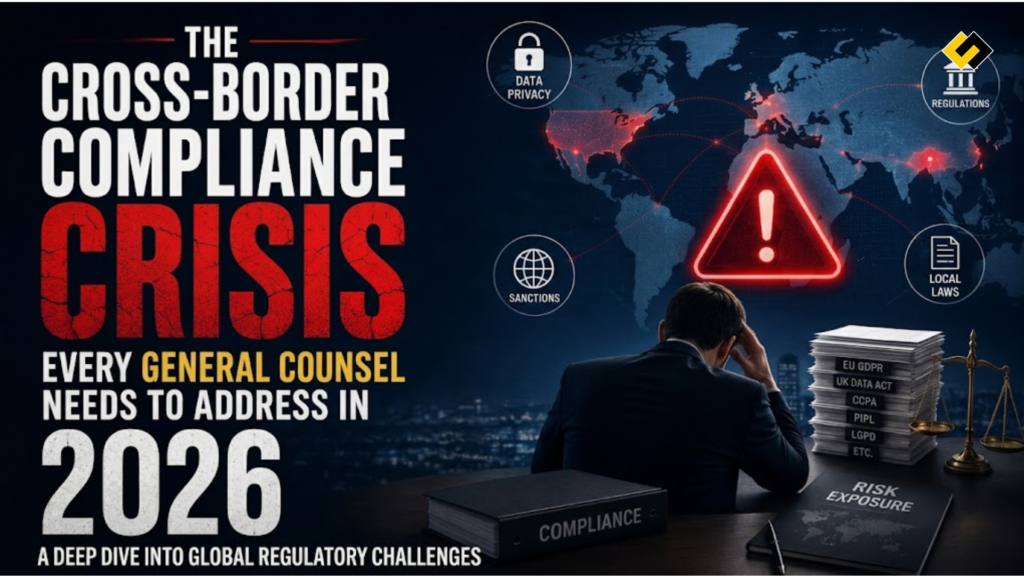
By the LexTalk World Editorial Team | May 2026 | Legal Leadership, Operations A multinational company would engage local counsel in each market, build a compliance matrix that mapped key obligations by jurisdiction, and run annual updates as laws changed. It was not simple work, but it was architecturable. The variables were finite. The frameworks were relatively stable. That architecture is collapsing in 2026, and general counsel around the world are feeling it in their bones. Three regulatory forces are converging simultaneously for the firstc time: AI-specific legislation emerging at the state and national level, ESG disclosure requirements fragmenting across more than 30 jurisdictions with different standards, and data privacy frameworks multiplying faster than any compliance team ccan map. Each of these alone would be a significant challenge. Together, they are creating a cross-border compliance environment that is genuinely unprecedented in scope and speed. The general counsel who will navigate it well are not the ones waiting for the frameworks to stabilise. They are the ones building organisations capable of operating in a world where the rules are always changing. Why This Year Is Different Every year brings regulatory change. The argument that 2026 is qualitatively different from previous cycles requires some examination, because legal leaders hear about unprecedented complexity so often that the word has nearly lost its meaning. But the data supports the argument this time. Bloomberg Law describes 2026 as the year to “operationalise” the realities of AI integration and evolving data privacy frameworks under heightened scrutiny, noting that as legislation struggles to keep pace with innovation, the stakes will continue to climb. The seventh annual General Counsel Report from FTI Consulting and Relativity, released in February 2026 and based on 224 general counsel and CLOs at organisations with revenues above $100 million, found that 87% of legal leaders report accelerating risk and demand, while 97% saw increased work volume over the prior year. Those numbers describe a profession under structural pressure, not a temporary spike. The work is increasing. The complexity is compounding. And the tools for managing it have not kept pace with the rate of change. Caption for stats callout graphic:87% of general counsel report accelerating risk and demand in 2026. Source: FTI Consulting and Relativity General Counsel Report, February 2026. The ESG Fragmentation Problem Start with ESG disclosure, because it is the most tangible illustration of what regulatory fragmentation looks like when it arrives at scale. More than 30 jurisdictions are deploying or planning to roll out IFRS sustainability disclosure standards in 2026, often with local modifications. This includes first ISSB-based disclosures expected in Hong Kong SAR and Singapore in 2026, sustainability reporting in mainland China expected early in the year, and European rules requiring businesses to navigate the CSRD. In North America, where ESG adoption sits at 79%, organisations are navigating a particularly fragmented environment. Federal SEC climate disclosure rules remain stayed, while California’s SB 253 requires Scope 1 and 2 reporting beginning in 2026 and Scope 3 from 2027. Canadian organisations are increasingly aligning with ISSB Standards through voluntary adoption while awaiting mandatory regulatory action. The challenge this creates for a general counsel at a company with operations in Europe, North America, and Asia is not simply one of tracking multiple frameworks. It is the challenge of building reporting infrastructure, governance processes, and disclosure language that satisfies conceptually different legal requirements simultaneously. Europe’s CSRD operates on double materiality, requiring businesses to measure both financial risk to the company and the company’s outward impact on society and climate. The US framework, where it exists at all, operates on single materiality. These are not minor technical differences in disclosure format. They represent fundamentally different legal theories of what a company owes its stakeholders. A general counsel advising their board on ESG disclosure strategy in 2026 is not answering a single question. They are managing a portfolio of partially contradictory obligations across jurisdictions that do not share a common regulatory philosophy. The AI Governance Patchwork The ESG fragmentation story is several years old. The AI governance fragmentation story is being written right now, in real time, and it is moving faster. Nithya Das, general manager of governance at Diligent, describes 2026 as a decisive moment for AI governance, stating: “In 2026, we anticipate that the pace of AI regulation will remain unpredictable and increasingly stringent.” Rather than expecting clarity or simplification, she points to mounting pressure driven by new and emerging laws, predicting a structural shift at the top of organisations and that boards and executive teams will be institutionalising AI governance as a core competency. The legal profession faces a new category of risk that is accelerating faster than previous technology-mediated legal obligations: the use of AI for legal work. When courts sanction lawyers for AI hallucinations, they hold counsel responsible regardless of which department selected the tool or how sophisticated the vendor’s claims were. The central procurement question will shift from “Can this tool increase efficiency?” to “Can this tool withstand scrutiny if challenged?” For a global general counsel, the AI governance challenge has a cross-border dimension that is not yet widely discussed. The EU AI Act creates a tiered risk framework that applies to AI systems used in high-stakes decisions. US state-level AI laws, including the Colorado Artificial Intelligence Act, create separate obligations for AI systems that materially impact consumers. Singapore and several Gulf Cooperation Council states are developing their own frameworks, each with different definitions of what counts as a covered AI system. A company deploying a single AI-assisted contract review or compliance monitoring tool across multiple jurisdictions may be operating under three or four separate regulatory regimes simultaneously. The general counsel who has delegated AI governance to IT or legal operations is, as several commentators have noted, in exactly the wrong position. These decisions require legal judgment at the most senior level, because the accountability for their consequences sits with the lawyer. AI systems are already embedded in business operations, touching sensitive data, making decisions, and interacting with
The Great Legal Reallocation: Why In-House Teams Are Taking Back Control in 2026

By the LexTalk World Editorial Team | May 2026 | Legal Leadership, Operations Something significant is happening inside corporate legal departments right now, and it is not showing up in any law firm’s marketing materials. For decades, the relationship between in-house legal teams and outside law firms operated on a relatively simple model. You have a legal problem. You send it to a firm. They bill by the hour. You pay and move on. The rates climbed every year. The invoices grew every quarter. And for most general counsel, the arrangement was treated as an immutable fact of professional life, expensive but irreplaceable. That model is cracking. And in 2026, it is cracking fast. The Numbers Behind the Shift A global study of 516 senior in-house legal leaders, conducted by InsightDynamics and commissioned by Axiom, published earlier this year, put hard numbers on what many general counsel have been sensing for some time. Over 80% of global in-house legal leaders are planning to reallocate law firm work to their internal teams or alternative legal service providers within the next two years. The study described the current moment as a “threshold moment” for the legal services market. Over half of in-house teams plan to move between 10 and 25% of law firm work in-house or to alternative legal service providers within the next 12 to 24 months. A further third plan to move between 26 and 40% of that work. To be clear about what this means: we are not talking about moving routine administrative tasks. We are talking about strategic legal work requiring high-quality output from elite lawyers, work that is increasingly being scaled with AI. The three forces driving this convergence are straightforward: rising law firm rates, near-universal AI adoption, and relentless pressure to improve operational efficiency despite budget increases. The Contradiction at the Heart of It Here is where it gets interesting. The same study that confirmed legal leaders’ intent to reallocation also uncovered a striking paradox. Two-thirds of in-house leaders now see alternative legal service providers as viable alternatives to law firms for strategic day-to-day legal work, yet 61% continue sending work to law firms out of habit rather than strategic choice. Read that again. Sixty-one percent of in-house leaders are spending money they know they do not need to spend, on providers they know are not their best option, because that is what they have always done. This is not irrational. It is a very human response to institutional inertia, relationship history, board expectations, and the genuine risk of disrupting workflows that are functional, if expensive. But calling it strategic would be a stretch. The legal leaders who are pulling ahead in 2026 are the ones who have decided to do something about the gap between what they know and what they do. What Is Actually Driving In-House Leaders to Move Understanding the insourcing trend requires understanding the specific pressures that are making the status quo unsustainable. The Budget Growth That Is Not Solving Anything You might assume that the legal departments planning the biggest reallocations are the ones facing budget cuts. The data suggests otherwise. Despite 66% of legal departments receiving budget increases averaging 12%, a striking 90% of in-house teams still face pressure to improve efficiency. Budget growth alone is not resolving the fundamental challenges facing legal departments. Transformation is. This is a critical insight for general counsel making the case for restructuring their external counsel relationships. The argument is not just about cost reduction. It is about building a legal function capable of absorbing increasing complexity without a proportional increase in spend. No amount of budget increase resolves that problem if the underlying delivery model remains unchanged. The Satisfaction Gap Is Real and Growing When in-house leaders are asked directly about their experience of working with traditional law firms versus alternative legal service providers, the results are striking. In-house leaders are three times more likely to report extreme satisfaction with alternative legal service providers than with traditional law firms, with 25% reporting extreme satisfaction with ALSPs compared to just 8% for law firms. The hypothesis behind this gap is straightforward: comparable or superior legal talent at significantly lower cost creates higher satisfaction almost by definition. When the output quality is equivalent and the rate is 30 to 50% lower, the satisfaction math changes. AI Adoption Is Making the Old Model Look Worse The acceleration of AI adoption inside legal departments is quietly but decisively changing the cost-benefit analysis of outside counsel relationships. General counsels are beginning to engage more deeply with their legal tech strategy, moving procurement conversations away from “Can this tool increase efficiency?” toward “Can this tool withstand scrutiny if challenged?” As AI absorbs more routine legal work inside the department, the baseline output of an internal legal team rises. Tasks that once justified a law firm engagement because of time or expertise constraints become manageable internally, with AI assistance, at a fraction of the cost. The most effective legal departments solve problems rather than chase tools. AI-enabled legal departments will demand more from law firms and legal service providers. Traditional models built on billable hours and narrow specialization face pressure as clients seek outcomes, integration with in-house systems, and measurable impact. The Talent Crisis Running Alongside the Cost Crisis The legal insourcing trend is not happening in isolation. It is playing out alongside an in-house talent crisis that most legal departments have not yet fully reckoned with. A global study of 544 in-house legal professionals found that 46% are actively job hunting despite 83% reporting high satisfaction with their roles. Stress and unsustainable workloads, not job dissatisfaction, are driving attrition. Think about what that means for a general counsel planning to bring more strategic work in-house. You are adding volume to a team where nearly half the people are already thinking about leaving, not because they hate the work, but because there is too much of it. In-house legal professionals experiencing high pressure are ten times more likely to
Why Every General Counsel Needs to Be in the Room: The Case for Legal Conferences in 2026

By the LexTalk World Editorial Team | May 2026 | Leadership, Legal Innovation There is a particular kind of clarity that only happens in a room full of people who understand exactly what you are dealing with. Not a Zoom call. Not a LinkedIn comment thread. A room. With people who have sat across from the same impossible tradeoffs, answered to the same skeptical boards, and navigated the same expanding portfolio of legal risk that no law school in the world actually prepared you for. For general counsel and senior in-house legal leaders in 2026, that room matters more than ever. Here is why. The Role of the General Counsel Has Changed Permanently For most of the last three decades, the general counsel’s mandate was relatively defined. Keep the company out of legal trouble. Manage outside counsel spend. Advise on contracts. Say no when necessary. That version of the job is gone. In its place is something far more complex, far more visible, and frankly far more interesting. Today’s general counsel is expected to sit at the strategy table, not just be called in when a deal needs reviewing. They are expected to have a point of view on AI adoption, ESG obligations, cross-border regulatory risk, data privacy frameworks, and enterprise-wide accountability structures. They are expected to translate legal risk into business language and then translate it back again when regulators come knocking. According to Bloomberg Law’s 2026 GC Guide, in-house legal teams are heading into what the publication described as a year to “operationalize” AI and compliance realities under significantly heightened scrutiny. The regulatory patchwork alone, with AI-specific laws emerging in Colorado, California, and across the EU, has created a compliance landscape that changes faster than most quarterly review cycles. The legal leaders who are navigating this well are not doing it alone. And they are not doing it by reading reports. They are doing it by talking to each other. What Actually Happens at a Legal Conference in 2026 There is an outdated mental model of what a legal conference looks like. Panels of silver-haired partners. Generic keynotes. Networking receptions where everyone holds a glass and makes small talk about billable hours. That is not what global legal conferences look like today, and it is particularly not what LexTalk World events look like. The conversations happening in legal conference rooms in 2026 are operational, specific, and often urgent. At the Law.com General Counsel Conference Midwest held in Chicago in April 2026, the central theme that emerged from attendees was clear: “resilience and agility are no longer optional.” In-house leaders are being called to balance innovation with risk management while positioning themselves not just as legal resources, but as business leaders. That is not an abstract aspiration. It is a description of a job that has already changed. At LexTalk World’s global events, this shift shows up in the agenda design. Hall A programming at the New York 2026 conference, for example, is built around topics that do not sit neatly inside any single department: AI Governance and Liability, Boardroom Risk and Accountability, Crisis and Regulatory Readiness, and Cross-Border Compliance. These are sessions designed for people who understand that the legal function now operates at the intersection of technology, geopolitics, and corporate strategy. The people in those sessions are not there to collect CPD credits. They are there because they have a problem they have not yet solved, and they suspect someone in that room has. The Peer Intelligence Problem Here is something that rarely gets discussed directly: the general counsel role is one of the loneliest senior roles in a corporation. The CEO has a peer network of other CEOs. The CFO benchmarks against CFOs constantly. Legal operations professionals have entire community networks built around sharing playbooks and metrics. The general counsel, particularly in a mid-sized or high-growth company, often operates in relative isolation. Sharing internal legal strategy with outside counsel creates conflicts. Discussing compliance approaches with competitors raises antitrust concerns. Even peer networks within industry groups can feel guarded, formal, and slow. The right legal conference strips away most of those barriers. When a Corporate Counsel from Google sits on a panel about AI governance, when a Senior VP from Citi discusses cross-border data risk, when a compliance leader from Medtronic shares how their legal department approaches AI accountability, that is peer intelligence that you cannot get from a white paper. It is filtered through real organizational context. It comes with the credibility of someone who has actually lived the decision. This is not an incidental benefit of attending a conference. For many general counsel, it is the primary one. Why AI Governance Has Made Legal Events More Valuable, Not Less There is an argument that the rise of AI should be making legal conferences redundant. You can attend webinars on AI law from your desk. You can read analyses of the EU AI Act or the Colorado Artificial Intelligence Act without getting on a plane. You can follow legal tech developments through newsletters and podcasts and LinkedIn posts from every AI vendor in the market. All of that is true. And none of it replaces what happens when two general counsels compare notes on how their boards are actually responding to AI governance proposals. Or when a group of CLOs work through how they are structuring vendor procurement conversations now that the question has shifted, as Corporate Compliance Insights noted in early 2026, from “Can this tool increase efficiency?” to “Can this tool withstand scrutiny if challenged?” The data tells its own story. AI adoption among in-house legal teams more than doubled between 2024 and 2025, rising from 23% to 54% according to ACC and Everlaw research. And yet, as of late 2025, 44% of law firms had not implemented formal AI governance policies, and only 41% of legal organizations had any formal generative AI policy at all. That gap between adoption and governance is exactly the kind of problem that gets solved in person.