
The Importance of a Stable Legal Framework for Foreign Investment in the Dominican Republic: A Strategic Advantage for Sustainable Development

How legal certainty, investor protections, and targeted tax incentives have positioned the Dominican Republic as one of Latin America’s most attractive investment destinations. In today’s global economy, foreign direct investment (FDI) is far more than a source of capital. It serves as a catalyst for innovation, job creation, technology transfer, infrastructure development, and economic diversification. While factors such as geographic location, market size, and labor availability continue to influence investment decisions, one consideration consistently ranks among the most important for international investors: the existence of a stable and predictable legal framework. Investors commit capital where they can reasonably anticipate that the rules governing their investments will remain transparent, enforceable, and consistent over time. In an increasingly competitive global marketplace, countries that provide legal certainty gain a significant advantage in attracting long-term investment and fostering sustainable economic growth. The Dominican Republic offers a compelling example of how legal stability can become a strategic economic asset. Over the past several decades, the country has developed a legal and institutional framework that promotes investment, protects property rights, facilitates capital mobility, and provides targeted sector-specific incentives. These efforts have contributed to the country’s transformation into one of the leading recipients of foreign direct investment in the Caribbean and one of the most dynamic economies in Latin America. At the center of this success lies a fundamental principle: investor confidence is built not only on economic opportunity, but also on the strength of the rule of law. Legal Certainty as the Foundation of Investment Decisions From a legal perspective, certainty creates predictability. Investors require confidence that contracts will be enforced, regulatory approvals will be administered fairly, property rights will be protected, and disputes will be resolved through reliable legal mechanisms. Large-scale investment projects typically involve substantial capital expenditures and long-term planning horizons. Whether financing a luxury resort, establishing a manufacturing operation, developing renewable energy infrastructure, or acquiring commercial real estate, investors must evaluate legal risk alongside financial risk. A stable legal environment reduces uncertainty by allowing businesses to structure investments based on clear expectations. Conversely, abrupt regulatory changes, inconsistent administrative practices, or weak institutional enforcement can significantly undermine a country’s ability to compete for international capital. The Dominican Republic has recognized that legal certainty is not merely a legal principle; it is an essential component of economic competitiveness. Foreign Investment Law No.16-95: A Modern Framework for Investment Protection The cornerstone of the Dominican foreign investment regime is Law No.16-95 on Foreign Investment. Enacted to modernize the country’s investment framework and align it with international standards, the law established a liberalized regime designed to encourage foreign participation in the national economy. One of the law’s most significant contributions is the principle of national treatment. Under this framework, foreign investors generally enjoy the same rights and obligations as Dominican nationals, subject only to limited exceptions involving specific activities reserved by law. This principle carries substantial legal significance. Equal treatment reduces regulatory uncertainty, creates a level playing field, and signals commitment to free enterprise and open markets. It demonstrates that foreign investment is viewed not as an exception to the economic system, but as an integral component of national development. The law also recognizes multiple forms of foreign investment, including cash contributions, tangible assets, intellectual property, technology transfers, and reinvested earnings. This flexible approach enables the legal framework to accommodate contemporary business structures and increasingly sophisticated investment models. Equally important, the law provides a mechanism for the registration of foreign investments, ensuring transparency while facilitating the protection of investor rights. Constitutional Guarantees and Protection of Property Rights Statutory protections alone are rarely sufficient to attract long-term investment. Investors also evaluate the constitutional principles underlying a legal system. The Constitution of the Dominican Republic provides robust protections for private property, economic freedom, and free enterprise. These constitutional guarantees establish fundamental limits on government action and create an additional layer of legal security for domestic and foreign investors alike. Property rights remain one of the most important factors considered in investment decisions. Investors are naturally more inclined to commit capital in jurisdictions where ownership rights are clearly recognized and legally protected. The constitutional framework also reinforces confidence in the broader legal system by ensuring that government actions affecting economic activity remain subject to legal scrutiny and judicial oversight. For investors considering projects with long-term horizons, such as tourism developments, infrastructure concessions, manufacturing facilities, and mixed-use real estate projects, constitutional protections provide reassurance that their investments are supported by enduring legal principles rather than temporary policy choices. Free Repatriation of Capital and Profits Another critical element of investment protection is the ability to freely transfer capital and profits. The Dominican foreign investment regime recognizes the right of foreign investors to remit dividends, profits, and capital abroad following compliance with applicable legal requirements. This guarantee is particularly important in an era characterized by global investment flows and integrated capital markets. The ability to repatriate profits reduces investor concerns regarding capital restrictions and allows businesses to efficiently manage international investment portfolios. It also facilitates project financing by increasing confidence among lenders and institutional investors evaluating opportunities within the Dominican market. From a legal perspective, the free movement of capital is closely linked to broader principles of economic freedom and protection of property rights. Its inclusion within the investment framework has contributed significantly to the country’s attractiveness as an investment destination. International Commitments and Investor Protection The Dominican Republic’s legal framework benefits from its integration within the international legal architecture governing investment. The country participates in international agreements designed to promote trade, investment, and economic cooperation. Most notably, the Dominican Republic is a party to the Dominican Republic-Central America-United States Free Trade Agreement (DR-CAFTA), which includes important investment protection provisions and dispute resolution mechanisms. These international commitments provide additional reassurance to investors by establishing legal standards that complement domestic legislation. They enhance predictability, reinforce the country’s commitment to international best practices, and strengthen investor confidence in the overall legal framework. As global investment becomes increasingly interconnected, alignment with international standards has become an
Comparative Analysis of AI Regulation in Judicial Proceedings: Human Rights Risks in the European-Spanish and Mexican Legal Frameworks
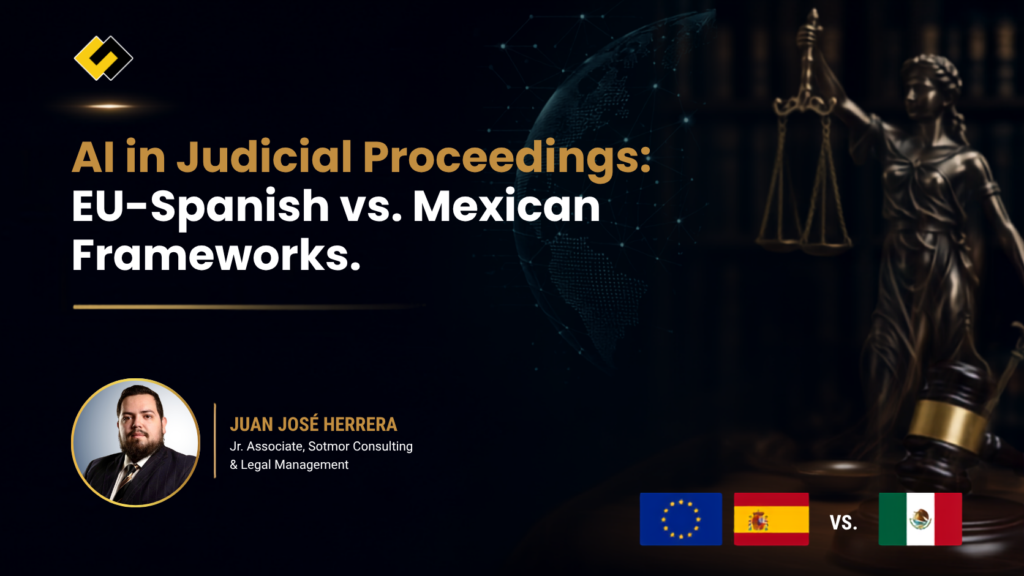
“Those who cannot remember the past are condemned to repeat it” (Santayana, 1905). This warning is particularly relevant when studying artificial intelligence in the judicial process. Cases such as COMPAS show that automation is not neutral: an algorithmic system can reproduce human biases, conceal them under a technical guise, and undermine fundamental rights in high-stakes decisions (Guanche, 2023). Therefore, the central legal question is not whether AI can make the justice system more efficient, but rather what regulatory limits must be imposed to prevent efficiency from eroding due process, effective judicial protection, equality, privacy, judicial independence, and the right to a natural judge. The comparative analysis must be limited to regulatory systems. According to Zweigert and Kötz’s functional method, one does not compare identical institutions, but rather systems that fulfill an equivalent function (Zweigert & Kötz, 1998). In this case, the common function of the European-Spanish model and the Mexican model is to regulate the use of AI in the administration of justice to protect human rights and prevent opaque, discriminatory, or unduly automated decisions. The European system offers more comprehensive regulation. Regulation (EU) 2024/1689 adopts a risk-based model and classifies certain AI systems used by judicial authorities—or on their behalf—to interpret facts, interpret the law, or apply rules to specific cases as high-risk. This classification imposes enhanced obligations: risk management, data governance, technical documentation, record-keeping, transparency, human oversight, accuracy, robustness, and cybersecurity. In the judicial sphere, this means that AI cannot operate as a substitute for the judge or as an opaque source of decision-making. Spain supplements this framework through Royal Decree-Law 6/2023, which distinguishes between automated, proactive, and assisted actions within the administration of justice. The distinction is essential: automated actions are reserved for simple procedures that do not require legal interpretation; assisted actions may generate drafts or complex documents, but these do not constitute judicial rulings without human validation and must be modifiable by the competent authority. The Spanish model, therefore, embraces technology while preserving the human core of the judicial system. Mexico, on the other hand, still lacks a comprehensive law in force regarding judicial AI. However, its constitutional and treaty-based framework provides sufficient grounds for imposing limits. The Mexican Constitution recognizes access to justice, due process, the requirement to state reasons and provide justification, equality, property rights, the amparo proceeding, and the right to be tried by previously established courts. The Amparo Law requires special caution regarding any mechanism that could unduly restrict access to constitutional justice, as dismissal is only permissible in cases of manifest and indisputable grounds. Furthermore, the General Law on the Protection of Personal Data Held by Obligated Entities requires security, proportionality, and impact assessments when authorities process personal data on a large scale. The proposed Mexican regulation, currently under discussion in the Senate, functionally aligns with the European model by incorporating transparency, auditing, traceability, protection of rights, human oversight, and control over technologies with significant impact. However, Mexico should not automatically adopt European regulations. It must adapt them to its constitutional tradition, the amparo proceeding, structural inequality, and the need to prevent systems trained on flawed historical data from amplifying discrimination. The impact on human rights is central. AI can affect access to justice if it becomes a formalistic barrier to the admission of lawsuits or appeals. It can violate due process if the parties are unaware of which data, rules, or criteria influenced a ruling. It can compromise equality and non-discrimination if it reproduces biases found in case files, statistics, or precedents. It can affect privacy and the protection of personal data when processing financial, family, medical, criminal, or sensitive information. It can also erode judicial independence if a judge uncritically adopts automated recommendations. Added to these risks is the impact on the right to a natural judge and the right to a human judge. The guarantee of the right to a natural judge not only requires a pre-established, competent, independent, and impartial court; it also requires that the decision come from a human authority capable of listening, contextualizing, weighing the evidence, and justifying the ruling. Tovar warns that the red line is drawn where technological assistance begins to replace human judgment, undermining independence, impartiality, reasoning, and effective judicial protection (Tovar, 2025). Therefore, an automated justice system may be formally jurisdictional, but in substance contrary to the right to be judged by a human judge. The deeper risk is that poorly regulated AI may reinforce an outdated conception of the judge as a mere mechanical enforcer of the law, ignoring the fact that adjudication involves interpreting, arguing, evaluating, and deciding responsibly (Pantoja Morán, 2010). Furthermore, a judicial ruling does not merely apply general norms; it also tailors the law to individual cases and, to a certain extent, participates in its judicial creation (Bulygin, 2003). In conclusion, the European-Spanish model offers a preventive and rights-protecting approach; Mexico has a fragmented framework, but one that is constitutionally sufficient to demand limits. Mexican regulations should adopt a high-risk approach to judicial AI, incorporating transparency, explainability, traceability, auditing, data protection, meaningful human oversight, and a ban on fully automated decisions. In conclusion, the European-Spanish model offers a preventive and rights-based approach to the use of AI in the judicial system, while Mexico still has a fragmented framework—albeit one that is constitutionally sufficient to impose limits. Any future Mexican regulation should not be based on uncritical trust in the technology or on an absolute ban on its use. The purpose of this analysis is not to argue that artificial intelligence should be excluded from the administration of justice, but rather to foster a critical, prudent, and constitutionally informed approach. AI can contribute to a more efficient, orderly, and accessible justice system; however, it can also pose risks and dangers that must be assessed, weighed, and regulated prior to its implementation. These risks are not solely technical, as they are not limited to programming errors, data failures, or cybersecurity issues. They are also legal, procedural, and democratic. Poorly regulated judicial AI can affect access
Two AI Rulings, Ten Days Apart, Look Like a Split. They Might Not Be
If a client types something about their case into ChatGPT, is that conversation privileged? In February 2026, two federal courts answered that question within ten days of each other, and reached opposite results. A Massachusetts state court added a third data point in July. Taken together, they’re often described as a split in the law. Read closely, they’re something more useful than that: a consistent test, applied to three different sets of facts. The two February rulings Warner v. Gilbarco, Inc. (E.D. Mich., decided February 10, 2026): A pro se plaintiff in an employment discrimination case had used a generative AI tool to help prepare litigation materials. The defendants moved to compel production of everything related to that AI use, and asked the court to overrule any privilege or work product objection. Magistrate Judge Anthony Patti denied the motion, protecting the plaintiff’s AI-assisted materials as work product. The court’s reasoning centered on a simple idea: generative AI tools are, in the court’s words, tools, not persons, and using one doesn’t waive protection over a party’s own litigation-related thinking. Compelling production of that material, the court noted, would risk nullifying work product protection in nearly every modern drafting environment. United States v. Heppner (S.D.N.Y., oral ruling February 10, written opinion February 17, 2026): A criminal defendant facing securities and wire fraud charges had used the AI platform Claude to prepare materials related to his defense, then asserted privilege over them. Judge Jed Rakoff disagreed, ruling from the bench that he saw no basis for any claim of attorney-client privilege. His written opinion, addressing what he called a question of first impression nationwide, held that the AI documents failed on multiple grounds: Claude is not an attorney, so the communications were never between a client and counsel in the first place, and the materials weren’t prepared at counsel’s direction or shown to reflect defense strategy. Both privilege and work product protection were denied. The distinction that actually matters On the surface, these look contradictory: one court protected AI-assisted materials, the other stripped protection entirely. But the facts differ in exactly the way that matters under existing doctrine. In Warner, the litigant’s own use of AI to organize her own thinking was treated the way any self-prepared litigation material would be treated. In Heppner, the defendant’s AI use was not directed by counsel, did not involve counsel at all in its creation, and the court found no indication it reflected legal strategy. Several law firms tracking these decisions have made the same point: neither ruling changes privilege law. Each applies the same, decades-old test, involvement of counsel, purpose of the communication, expectation of confidentiality, to a new kind of tool. A Massachusetts state court reinforced the same pattern in Shealy v. Seaside Investments, LLC, a commercial dispute decided in the Business Litigation Session of the Superior Court. There, a party’s romantic partner, not an attorney, had used ChatGPT to help prepare materials related to the case. The court held that neither the partner nor the AI tool qualified as a “representative” for work product purposes, so the resulting materials were not protected. Again, the deciding factor wasn’t the presence of AI. It was the absence of counsel. What this means in practice For litigators, the practical takeaway is specific: if you want AI-assisted work product to be protected, the involvement of counsel needs to be real and demonstrable, not assumed. That means directing the AI use, or at minimum being able to show the materials were prepared in anticipation of litigation and reflect legal strategy, not just a client or employee thinking out loud into a chatbot. For General Counsel and in-house teams, this is a policy problem as much as a legal one. A blanket instruction to avoid AI entirely doesn’t reflect how these rulings actually work, and it’s also increasingly unrealistic given how embedded these tools already are in day-to-day work. The more useful policy question is narrower: for any matter where privilege might eventually matter, is AI use happening under attorney direction, documented as such, and kept within tools whose confidentiality terms have actually been reviewed. Consumer-grade AI platforms, several firms tracking this area have noted, often retain user inputs for model training under their own terms of service, which raises a separate confidentiality problem even before privilege is considered. For legal operations and legal technology teams, the practical distinction between a public AI tool and an enterprise instance with contractual confidentiality protections is becoming a real compliance line, not just a preference. Several of the law firm client alerts tracking this area draw exactly that distinction: enterprise AI tools used at the direction of counsel tend to fare better under these emerging rulings than consumer tools used independently. Where this goes next These are early decisions, not settled law, and legal commentators tracking the issue are explicit that many other courts have yet to weigh in. Some have noted the doctrinal questions could extend beyond attorney-client and work product privilege into other protected relationships as AI tools become more embedded in personal and professional life generally. Worth watching, and worth updating internal AI-use guidance for now rather than waiting for a definitive answer that may be a while coming. This article reflects the status of these rulings as of the publication date below. As with any actively developing area of law, readers should confirm current status and consult counsel before relying on this piece for compliance purposes.
THE LEGAL DEPARTMENT AS AN ESG AGENT IN THE BRAZILIAN (RE)INSURANCE MARKET

The rise of the ESG (Environmental, Social and Governance) agenda has been redefining the way the entire insurance and reinsurance market operates in Brazil, demanding a posture that transcends the mere pursuit of selling insurance products in favor of sustainable longevity. In this scenario of transformation, the legal department has been moving away both from the image of an “intensive care unit”, called upon only when a problem has already materialized, and from the position of a mere validator of processes and contracts, to become a central agent in the strategic architecture of (re)insurers. The connection between Law and sustainability is not merely formal; it is intrinsic, since the Governance pillar constitutes the backbone upon which environmental and social practices are built and overseen. In my role as executive legal manager at a Brazilian insurance company, the clear perception of this transformation is what distinguishes reactive management from a performance that effectively adds value to the company’s business. Worldwide, the insurance sector operates under the logic of long-term risk management, tied to mutualism — its fundamental pillar — making it naturally aligned with sustainability principles. Working in the legal department of an insurer requires a solid understanding of the company’s business and how its various areas operate, as well as deep technical knowledge of how the different types of insurance work. In this context, the in-house legal department acts as a kind of guardian of corporate trust, striving to ensure that risk analysis and underwriting occur within applicable legal and regulatory parameters, always aiming at the sustainability of the insurer’s operations and, ultimately, of the (re)insurance market. For this performance to be truly transformative and valuable, the composition of the legal team is a determining factor. In my view, there is a rather outdated notion that legal departments should be composed of generalist lawyers or litigation specialists (under the argument that those who handle litigation can handle anything else, being, for example, able to work in advisory roles). However, this view has been losing ground in the face of the growing demand for multidisciplinary teams. In building a high-performance team, I have been prioritizing diversity of backgrounds and specialties, bringing together professionals who understand not only the Brazilian legal system but also risk management, sustainability metrics, and who demonstrate the continuous development of soft skills, such as: clear communication, active listening to understand internal demands, the ability to mediate between areas, and collaboration skills.[1] This plurality of perspectives allows the legal department to provide technical guidance more assertively, aiming at conducting business safely and in a balanced manner. It is worth noting that intellectual diversity within a legal department is an ESG practice, enabling richer discussions both within the department and with other areas of the company. The relevance of this structure is heightened by the Brazilian regulatory environment. In Brazil, the insurance market is supervised by the Superintendence of Private Insurance (SUSEP), a regulatory body that has been proactive in implementing sustainability guidelines. In particular, Circular SUSEP No. 666/2022 establishes clear frameworks for the integration of ESG risks into the management of (re)insurers. In this context, the legal department, together with the risk and compliance team, assumes the role of guiding interpreter and implementer of the regulation in question, ensuring that the company’s board makes well-informed decisions focused on regulatory compliance or, where appropriate, on the conscious assumption of certain risks. The [1] I have already discussed this in an interview published on the Revista Roncarati website: https://legismap.com.br/conteudos/colunistas/rodrigo-filgueiras/entrevista-com-taisa-loureiro-gerente-executiva-juridica-na-fator-seguradora legal team’s technical and regulatory knowledge adds significant value by enabling the insurer to navigate well-informed and safely through a sea of regulatory requirements. As can be seen, the legal department has already positioned itself as a decision-support hub for the company’s senior executives. It has thus been moving away from being a backoffice area and has begun to act as a true strategic advisor, providing the necessary substrate for strategic decision-making. The active participation of the legal department in the daily life of the board of directors ensures that the vision of risks and opportunities is present at every step of the insurer. When the legal department is heard as a voice of strategic leadership, corporate governance is strengthened against legal and reputational challenges. Historically, many legal departments were called upon only as an “intensive care unit,” summoned to remedy problems or litigation that had already arisen. The current dynamic, however, demands that the legal team actively act as a partner to the business areas from the very first discussions and negotiations. For instance, Brazil has a new legal framework for the insurance market, Law No. 15,040/2024, which required, among other things, the adaptation of insurance policy wordings to the new rules in force. By working on the update of insurance products, in partnership with the Product, Underwriting, and Claims teams, our legal department contributed by presenting to the board a structured action plan for product adaptation, as well as identifying what needed to be changed in each product and wording that could raise questions in cases of litigated claim denials, among other issues. In the field of litigation, the legal department’s performance has also been strategically impacted. The discussion and development of defense theories, whether in the judicial or administrative sphere, in conjunction with outsourced law firms, has been incorporating elements of sustainability and the social function of contracts. Currently, it is not merely about winning a lawsuit, but about building jurisprudence favorable to the Brazilian (re)insurance market, based on theories that reflect both the technical reality of the (re)insurance market and the importance of preserving mutualism for the very longevity of the market. The in-house legal department that deeply understands the company’s business is better equipped to present outside counsel with arguments that connect legislation, market-specific regulation, and the insurer’s operational reality. This, in turn, contributes to the development of more assertive, technical, and well-founded defense theories and strategies. This sophistication in legal disputes is essential to maintain the economic and financial balance of contracts. As outlined
Democracy Reconstruction?
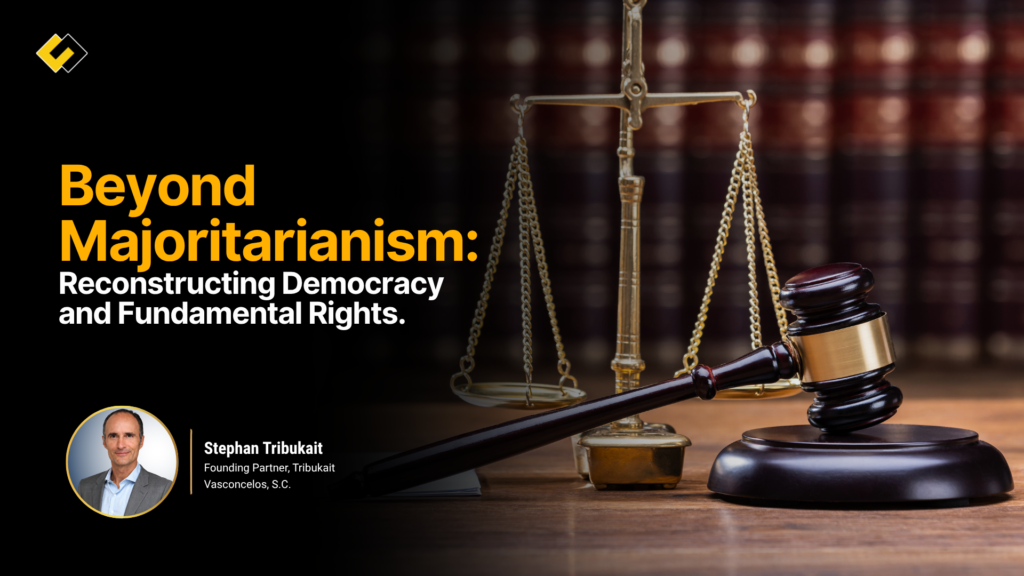
The question entitling these notes hints at a misunderstanding of the roots of current autocratic regimes. The “systems” of capitalism and communism have been considered by the political theory of the past century as abstractions that fail to address the fundamental problem. This difficulty is said to lie in building institutions or orderly and peaceful means for political, economic and social exchange. But, such construction was deemed to be moral in nature by the same political theory. Two keys may provide the grounds for a straightforward solution in a context where the challenge of new institutions starts with grasping the task. First, there is a reasoning on morality based on conscious individuals instead of a herd or its political equivalent of an omnipotent Volk. The ramifications of a moral focus on individuals, as opposed to an appreciation of good and evil for the community, may be spared for purposes of these notes. In the second place, lessons on the effectiveness and function of fundamental rights should be learned from by their transformation of the absolute State. The “classic” limiting function of these rights can be coupled with a moral approach to minorities to craft a twofold criterion. This criterion may replace mass-related protections for minorities not to be subdued by a supermajority or other voting exercises. At the same time the contents and scope of fundamental rights in the modern State organization may be set out generally for groups of individuals beyond the case-by-case rule of such rights’ proportionality. In conclusion, a different concept of morality enhanced with a content-providing function of fundamental rights may result in small sets of rules, especially at a non-constitutional level. The effective enforcement of these rules through prohibitions of certain governmental action may transform merely electoral democracies into an authentic legitimacy. About the Author Stephan H. Tribukait Vasconcelos, Founding Partner, Tribukait Vasconcelos, S.C. Stephan Tribukait is the founder of Tribukait Vasconcelos, S.C., established in Mexico City in 2010. With nearly 30 years of experience, he specializes in complex transactions, mergers and acquisitions, finance, and competition law. A graduate with honors from Escuela Libre de Derecho, he earned an LL.M. in International Trade Law in England in 2000. Fluent in English, German, and Spanish, Stephan advises multinational companies on cross-border transactions. He is a non-governmental advisor to the International Competition Network (ICN), a long-time member of the American Bar Association, and has taught competition law for nearly three decades while publishing extensively on competition and international trade law.
California Is Closing In on the First Binding AI Rules for Lawyers
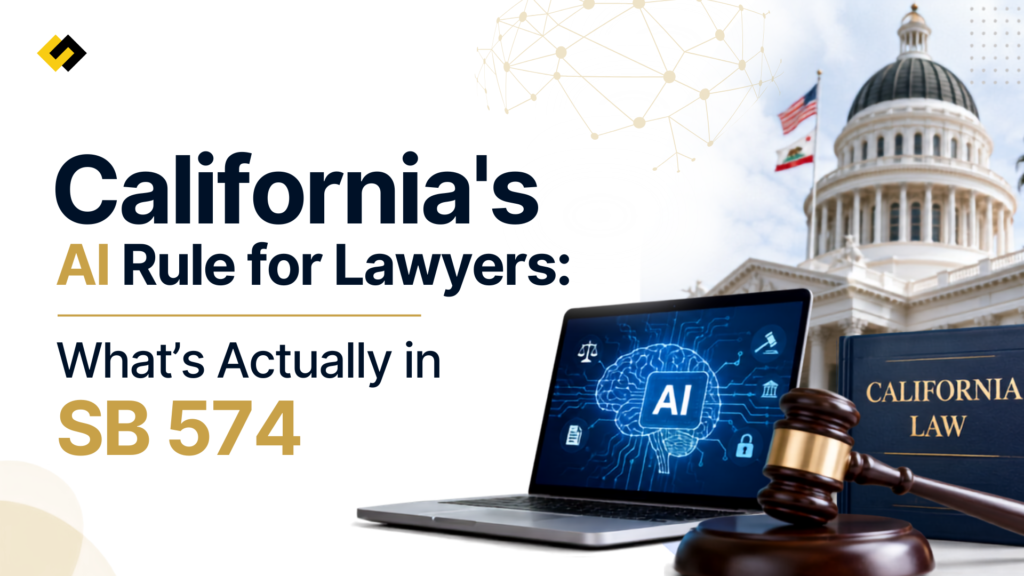
Most states have told lawyers how they should use AI. California is close to being the first state that can actually enforce it. Senate Bill 574 passed the California Senate 39 to 0 in late January 2026 and is now working its way through the Assembly, which must pass it by August 31, the final day of the legislative session, or it dies for this session. If it clears the Assembly, it goes to Governor Gavin Newsom, who can sign it, let it become law without a signature, or veto it. If enacted, it would typically take effect the following January. What makes SB 574 different from what has come before isn’t really its content. Most of what it asks of lawyers already exists in some form as guidance from the State Bar of California. What’s different is the form. Guidance is advisory. A statute is not. What the bill actually requires Introduced by State Senator Tom Umberg, chair of the Senate Judiciary Committee, SB 574 sets duties for attorneys and arbitrators using generative AI. Stripped of the legislative language, four things stand out. First, confidentiality at the point of input. Attorneys would be prohibited from entering confidential, personal identifying, or otherwise nonpublic information into a public generative AI system. The bill does not attempt to define every edge case of what counts as confidential, but it does specify personal identifying information clearly: birthdates, Social Security numbers, driver’s license numbers, financial account numbers, addresses, and phone numbers, along with anything already sealed or protected by court order or statute. Second, personal verification. This is the provision most directly aimed at the hallucination problem. An attorney responsible for a filing would have to personally read and verify every citation in it, regardless of whether AI, a paralegal, or the attorney themselves originally produced it. Delegating the drafting is fine. Delegating the verification is not. Third, protection against bias. The bill includes language intended to prevent generative AI use from producing discriminatory or unlawfully biased outcomes, an obligation that sits alongside existing anti-discrimination duties rather than replacing them. Fourth, disclosure consideration. Attorneys would need to consider whether disclosing AI use is appropriate when generative AI is used to create public-facing content, though this provision is framed as a duty to consider rather than a blanket disclosure mandate. The bill also reaches beyond lawyers to arbitrators, who would be barred from delegating actual decision-making to a generative AI tool. An arbitrator can use AI as an aid. The independent analysis of facts and law has to remain the arbitrator’s own. Why this is happening now SB 574 didn’t emerge from nowhere. It’s a direct legislative response to a problem that has been building in courtrooms across the country for three years: AI systems producing fabricated case citations, invented quotations, and misstated holdings, some of which have made it past the attorney who signed the filing and into the official court record. The scale of the problem is no longer a handful of embarrassing anecdotes. Researchers tracking the issue have documented well over a thousand US court proceedings in which a party relied on AI-hallucinated material and a court responded, with sanctions escalating sharply since the first widely reported case in 2023. Several federal appellate courts have noted publicly that warnings and reprimands alone have not slowed the trend. California’s own State Bar has been working a parallel, related track. Its ethics committee, COPRAC, separately proposed folding AI-specific obligations directly into the state’s formal Rules of Professional Conduct, rather than keeping them in a non-binding practical guidance document. That rule-amendment process and SB 574 are distinct efforts moving on separate timelines, one through the bar’s rulemaking process and one through the legislature, but they point in the same direction: California moving AI obligations from advisory to enforceable. What it would mean in practice For law firm partners and litigators, the personal verification requirement is the one to plan around. It doesn’t ban AI-assisted drafting or research. It does mean the attorney who signs a filing cannot treat AI-checked as good enough; they need their own read of every citation, which has real implications for how review workflows and billing are structured, particularly on large filings. For General Counsel, the relevant question is less about internal use and more about what standard to expect from outside counsel. If California codifies personal verification as a matter of law, it becomes a reasonable baseline to ask about when engaging or auditing outside firms, in California and, over time, likely well beyond it. For legal operations and legal technology teams, the confidentiality provision is the most immediately actionable. It draws a clear line around public generative AI tools specifically, which puts pressure on firms and departments to be explicit about which tools are “public” versus private or closed instances, and to have that distinction documented rather than assumed. What happens next As of this writing, SB 574 is pending in the Assembly, working through committee review ahead of the August 31 deadline. A unanimous Senate vote signals strong support but does not guarantee passage in the Assembly, and the bill has already been amended once since its introduction in response to feedback from practitioners and legal educators. We’ll be tracking where it lands. California has a track record of setting standards that other states eventually adopt in some form, from privacy law to AI regulation more broadly. Whether or not SB 574 becomes law this session, it’s a reasonable preview of where the rest of the profession is headed on AI accountability. Worth knowing now, not after it’s already the rule in your state. This article reflects the status of SB 574 as of the publication date noted below. Legislative status can change quickly; readers should confirm current status before relying on this piece for compliance purposes.
The Future of work for General Counsels: Designing an Agentic Legal Ops and the Rise of a new GRC Framework
The Legacy Industry Bottleneck The legal technology revolution has been engineered by and designed for the tech industries, like software companies, financial services platforms, and data-native enterprises. But what happens when cutting-edge artificial intelligence collides with asset-heavy sectors governed by layers of complex regulations, entrenched bureaucracy, and high-stakes physical and judicial liabilities? The answer, for most legal departments in these sectors, has been a painful paradox: extraordinary pressure to adopt AI, coupled with structural conditions that resist it. Legacy industries carry an enormous volume of legal obligations, municipal permits, environmental licenses, zoning disputes, supply chain contracts, social housing compliance frameworks and a production site that is mostly physical. In that scenario, basic automation tools are facing difficulties, but the pressure to pivot is coming. The thesis here is both urgent and actionable: to survive the next decade, General Counsels in traditional, asset-heavy industries must move decisively beyond basic automation and embrace what I am calling “Agentic Legal Ops”. This shift will require not just the creation of agents and orchestration, but the adaptation of the logic in our model of GRC (Governance, Risk, and Compliance). Yet the technology alone is insufficient. Sustainable success demands a parallel commitment to a human-centric leadership model that embraces cultural transformation. The Rise of Agentic Legal Ops There is a critical, misunderstood distinction at the heart of this conversation: the difference between automation and autonomy. Automation, in the legal context, refers to rules-based tools that execute predefined tasks when triggered by specific conditions. A system that auto-populates a contract template when a deal stage advances in a CRM; a workflow that routes an NDA to the correct approver based on deal value; a dashboard that flags regulatory deadlines on a calendar. These tools have genuine value. But they are reactive, brittle, and fundamentally dependent on humans to define every fork in the road. Agentic AI, by contrast, refers to systems capable of executing complex, multi-step workflows with a degree of autonomy. Advanced AI extensions are transforming modern Legal Operations by moving far beyond a simple “question-and-answer” function to execute complex, contextual tasks directly within a professional’s browser workflow. Instead of just drafting standalone text, AI for litigation lawyers can now actively interface with legal platforms to streamline end-to-end tasks: it can automatically navigate and log into judicial systems like the PJe, map out open deadlines from incoming subpoenas, and draft highly localized initial petitions or responses using the firm’s pre-existing templates. Furthermore, it significantly accelerates case analysis and knowledge management by digesting entire lawsuits in minutes, instantly mapping timelines, evidence, and parties while simultaneously scanning databases or the STJ for favourable jurisprudence, summarizing lengthy depositions, and standardizing file management by auto-organizing downloads into specific client folders. For contract lawyers, an agentic legal system does not simply populate a template; it reads the incoming contract, cross-references its terms against a jurisdiction-specific regulatory database, identifies deviating clauses, scores aggregate risk exposure, proposes redlines with supporting rationale, and flags unresolved issues for attorney review. For traditional industries, this distinction is transformational as Real estate and infrastructure transactions are document-intensive by nature. A single development project may generate hundreds of contracts across suppliers, public agencies, financiers, and regulatory bodies, each subject to different governing law and compliance obligations. Agentic workflows can move the legal department from passive document storage to active risk management: continuously monitoring contract portfolios, scoring exposure against shifting municipal regulations, and triggering alerts when judicial trends in a specific jurisdiction create material risk in existing agreements. But the General Counsel who wants to implement this shift must know that the decisive shift from AI assistants to AI agents was not a matter of intelligence; it was a matter of hands. For years, large language models could reason, draft, and analyse, but remained confined to the boundaries of a conversation window, unable to act on the world beyond it. Tools changed that. They gave agents the capacity to do, not merely to advise. This is the architectural inflexion point that separates the assistant era from the agentic one. That autonomy, however, only becomes governable when agents are connected securely to corporate systems, data repositories, and specialized legal tools through APIs, enterprise connectors, or emerging interoperability standards such as the Model Context Protocol (MCP). It is this secure, structured connectivity that transforms an AI model from a sophisticated drafting aid into a genuine operational actor within the legal department. The Guardrails of Trust: Governance, Risk and Compliance The introduction of autonomous AI agents into a corporate legal framework does not eliminate risk, it changes it. General Counsels who move aggressively into agentic architectures without parallel investment in AI governance are trading known legal risks for novel, and potentially more complex, ones. The rapid integration of AI into the corporate ecosystem is fundamentally transforming the practice of GRC from a framework of static, periodic reviews into a model of dynamic, real-time oversight. A profound competence gap currently exists within boards of directors and executive committees, leaving leadership teams to navigate and govern without the tools to properly decode the risks. But this gap is not only technical, it is also linguistic. Board members and executive committees are fluent in the vocabularies of reputational, financial, and operational risk; AI risk, as it is typically presented, speaks a different dialect entirely. The strategic imperative for the General Counsel, therefore, is not simply to raise AI risk on the board agenda, but to translate it: to reframe model hallucination as reputational exposure, data governance failure as regulatory and financial liability, and over-reliance on autonomous agents as operational concentration risk. When AI risk is mapped onto the risk categories that boards already own and govern, it stops being only a technology conversation. To mitigate this extreme institutional vulnerability, GRC practices and Audit Committees must urgently step up. Modernizing corporate governance demands an immediate structural rethink of both board agendas and executive literacy. The Board of Directors must expand its standard oversight to include a new, multi-dimensional matrix that scrutinises five critical pillars:
“Clean Stadium” and Ambush Marketing: The Invisible Dispute Over Brands at the World Cup

The World Cup is not merely a football tournament. It is also one of the largest commercial assets in global sport. Behind the scenes of the matches lies a sophisticated structure of economic exploitation involving broadcasting rights, licensing, advertising, sponsorship, ticket sales, official merchandise, and intellectual property protection. Within this landscape, the “clean stadium” policy adopted by FIFA reveals a less visible, yet legally significant, dimension of the event: the attempt to control the competition’s commercial environment in order to preserve the exclusivity granted to its official sponsors. The expression “clean stadium” may sound like a reference to the physical organization of the event venue. In the context of major sporting events, however, its meaning is essentially trademark- and advertising-related. It refers to the requirement that official competition venues be delivered free of brands, advertisements, trade names, promotional activations, or visual identities belonging to companies that are not among the organizing entity’s authorized sponsors or partners. In practice, this may mean the removal, concealment, or neutralization of advertising boards, local sponsors’ names, brands in circulation areas, promotional activations, and even stadium naming rights. Thus, a venue that is known throughout the year by a company’s name may, during the World Cup, be identified by a neutral designation, generally linked to the host city. The measure seeks to prevent unauthorized brands from benefiting from the event’s global exposure without having acquired the corresponding rights. This dynamic connects directly to the concept of ambush marketing. Broadly speaking, ambush marketing occurs when a brand seeks to take advantage of the visibility, prestige, or exposure of an event without authorization to do so. The brand “rides on” the economic and symbolic value of that event, creating, whether explicitly or implicitly, an improper commercial association. In the context of major sporting events, this practice is usually divided into two main categories: (i) ambush by association and (ii) ambush by intrusion. The first occurs when a company suggests, without authorization, some connection with the event, its organizers, or its official symbols — as observed in a campaign run by 99 in Brazil, which led the CBF (Brazilian Football Confederation) to send the company a cease-and-desist notice.1 This may occur through the use of names, slogans, mascots, trophies, logos, visual identity, hashtags, or expressions capable of leading the public to believe there is sponsorship, support, or official authorization. The second occurs when a brand physically inserts itself into the event environment, displaying its products, services, or promotional elements in high-visibility locations without the organizing entity’s authorization. It is precisely in this second dimension that the “clean stadium” policy gains greater relevance. During the World Cup, the stadium is not merely a sporting venue but a global showcase. Every advertising board, stand shot, aerial view, mixed-zone interview, and every detail visible in the broadcast can generate significant advertising value. If non-sponsoring brands were to remain exposed in these environments, they could gain a commercial advantage incompatible with the exclusivity contracted for by official sponsors. 1 For more information, see https://www.infomoney.com.br/negocios/cbf-acusa-99-de-marketing-de-emboscada-apos-campanha-inspirada-em-endrick/ FIFA’s rationale, therefore, is clear: if a company paid to become an official World Cup sponsor, it expects its investment to be protected against the competing presence of brands that did not acquire the same right. The “clean stadium” policy thus functions as a preventive barrier against ambush marketing by intrusion. Even before any discussion of consumer confusion or improper association arises, the event environment is controlled to reduce the risk of parasitic exposure. FIFA’s Intellectual Property Guidelines2 help to illustrate this rationale. In its guidelines, FIFA emphasizes that it holds broad rights related to the World Cup, including intellectual property, media, marketing, licensing, ticketing, and other commercial rights. It also states that its protected assets are not limited to official names and logos, but extend to signs, symbols, slogans, visual elements, mascots, trophies, event designations, and other identifiers capable of referring to the tournament. Moreover, the entity’s guidelines make clear that the examples provided are non-exhaustive. This point is particularly important, as it shows that the analysis of a potential infringement is not limited to a formal check of whether a given logo was used. The assessment is contextual. A campaign may be problematic even without fully reproducing a registered trademark, if its overall visual language, wording, or commercial strategy suggests an unauthorized association with the World Cup. This reasoning also applies to the “clean stadium” policy. The concern is not limited to removing identical brands or direct competitors of official sponsors. The goal is to prevent the public, the press, or the global audience from being exposed to brands that could benefit from the context of the competition without authorization. For this reason, the neutralization of naming rights, however excessive it may seem from an everyday standpoint, is justified within the event’s economic rationale, and the official space should reflect only the brands authorized by FIFA. Naturally, this policy generates tensions. Many modern stadiums are built or maintained under long-term naming rights agreements. For the companies holding these rights, the temporary removal of their brand during an event with a worldwide audience can represent a significant loss of exposure. For fans and the local public, the name change may seem artificial. For creative brands, the censorship or visual adaptation of their signs can even become an opportunity for humorous communication, as seen in recent episodes involving brands that made light of their own neutralization, such as Levi’s and Gillette. These reactions show that the topic is not merely legal, but also cultural and commercial. In a digital communication environment, attempting to erase a brand can, paradoxically, generate even more attention for it. Creatively dodging the stadiums’ visual clean-up rules can create social media engagement, provided it does not cross the line between legitimate commentary and improper association. That boundary, however, is a delicate one. From the standpoint of Brazilian law, the issue also gained more relevant contours with the General Sports Law (Law No. 14,597/2023). Unlike the scenario following the 2014 World Cup, when the
Two Federations, One Question
By Matheus de Albuquerque Schulhan Vidal, Head of Legal, Paag Before a federation can regulate betting, it has to settle a prior question: who does the regulating? The center, or the units? The United States answered “the units”. Brazil answered “the center”. Most comparisons of the two markets stop there, usually with a table of tax rates attached. The more interesting fact is that neither answer held. In April 2025 a federal appeals court told New Jersey it could not enforce its gambling laws against a federally licensed exchange. Three months later a judge in Manhattan held the opposite. Brazil has spent two years watching its Supreme Court strike down state and municipal betting regimes that keep growing back. Both federations are relitigating the question they thought they had settled, from opposite ends. Fragmentation, and the federal law nobody talks about The American market is usually called mature, mostly because of physical casinos dating from the 19th century. On the other hand, legal sports betting in the United States, as it is today, only dates to 2018, when the Supreme Court struck down PASPA in Murfihy v. NCAA,1 a decision that legalized nothing, but only removed a federal prohibition on states legalizing, and handed the question to fifty legislatures. What followed was not deregulation but multiplication. Roughly thirty-nine states plus the District of Columbia now permit sports betting in some form, about thirty-two of them online. Tax rates on gross gaming revenue run from 5.75 percent in Nevada to 51 percent in New York.2 New Hampshire and Rhode Island built single-operator monopolies; New Jersey and Colorado opened competitive marketplaces. Minimum age, college-betting rules, licensing standards and enforcement powers all change at the border. 1 Murfihy v. Nat’l Collegiate Athletic Ass’n, 584 U.S. 453 (2018). 2 As of mid-2025, roughly 38 to 40 states plus the District of Columbia permit sports betting in some form, with about 32 offering statewide online wagering. Tax rates on gross gaming revenue range from 5.75 percent (Nevada and Iowa) to 51 percent (New York, New Hampshire, and Rhode Island). See Tax Found., Online Sfiorts Betting Taxes (2025), https://taxfoundation.org; state counts and rates vary by source and change frequently — confirm against state gaming-commission filings before publication. It would be wrong, though, to say there is no federal law in the US. There is. It is just the wrong kind. The Wire Act of 1951 still criminalizes the interstate transmission of wagering information, which means that in a country with thirty-nine legal markets, an operator cannot pool liquidity across state lines and must keep servers physically inside the state whose bets they process. The compliance stack duplicates at every border, and it does so not because Congress designed a federalist regulatory scheme, but because Congress passed a prohibition in 1951 and never replaced it with anything. That is the shape of the American federal presence in gambling: prohibitionary rather than regulatory. It tells states what they may not send across a wire. It says nothing about how to license an operator, what a bettor is owed, or who audits the book. Those questions went to whoever wanted them, and the answer works reasonably well against licensed operators and badly against everyone else. State regulators can audit, fine and revoke. Against an offshore book they have no reach, and no federal partner to call. Centralization, won in court Brazil went the other way, and did it in one statute. Law 14.790/2023 created a single national regime: one licensing authority (the Secretariat of Prizes and Betting, SPA, inside the Ministry of Finance), one monitoring layer (SIGAP), a mandatory .bet.br domain, and a federal concession costing R$30 million, covering up to three brands for five years.4 The architecture was not simply legislated into place. It has been enforced, decision by decision, against states and municipalities building cheaper alternatives. Rio de Janeiro’s state lottery, Loterj, licensed operators for a fraction of the federal price and let them take bets nationwide. In January 2025 Justice André Mendonça ordered it to stop and to restore geolocation controls; the full Court confirmed the injunction in February.5 In December 2025 Justice Nunes Marques suspended municipal betting laws throughout the country, an injunction that still awaits plenary referendum. More than eighty municipalities had passed such laws in three years, fifty-five of them in 2025 alone.5 3 18 U.S.C. § 1084 (2018) (the Wire Act). 4 Lei No. 14.790, de 29 de dezembro de 2023, Diário Oficial da União [D.O.U.] de 30.12.2023 (Braz.). 5 S.T.F., ACO 3595, Rel. Min. André Mendonça, liminar de 02.01.2025, referendada pelo Plenário Virtual em 28.02.2025 (Braz.). [Loterj barred from crediting ofierators for bets filaced outside Rio de fianeiro; geolocation controls reinstated.] 5 S.T.F., ADPF 1212, Rel. Min. Nunes Marques, medida cautelar de 03.12.2025 (ad referendum do Plenário) (Braz.). The decision records that roughly 55 municipalities across 17 states enacted lottery laws in 2025 alone, and more than 80 The statutory hook is Article 35-A of Law 13.755/2018, as amended: states and the Federal District may exploit only the lottery modalities set out in federal law, and only within their own territory. The Court reads that against a line of precedent (ADPFs 492 and 493, ADI 4.985) affirming the Union’s exclusive competence over lotteries.7 So Brazil’s model is a contested hierarchy that the Union keeps winning. It holds for a reason that has little to do with doctrine. Because betting settles through Pix and the .bet.br domain, the payment rail is the enforcement layer. KYC happens at cash-in and cash-out. Credit cards are prohibited outright. When the Ministry of Finance decided that welfare recipients should not be betting, it did not need a rule for operators to follow: it blocked 2.8 million beneficiaries who already held accounts, and barred the other 24 million from opening one.8 Whatever one thinks of that decision, no American state could execute it, because no American state controls the money. The inversion Here is what a static comparison misses. The federal vacuum the United States left
The Ghost in the Pipeline: Managing “Agentic AI” Liability in Corporate Workflows

By the LexTalk World Editorial Team | August 2026 | Legal Leadership & AI Governance For the past two years, the corporate conversation around Artificial Intelligence focused on experimentation. Legal departments ran pilot programs, experimented with Large Language Models (LLMs) for document summarization, and debated the ethics of generative drafting. That initial phase is officially over. As corporate legal departments head into the second half of 2026, the technology itself has fundamentally evolved. Organizations are no longer just using “assistive” AI that generates text for human review; they are deploying Agentic AI, autonomous digital systems designed to execute multi-step workflows, process financial transactions, parse vendor contracts, and make real-time operational decisions with minimal human intervention. This shift from assistance to agency introduces an unprecedented corporate challenge: The Liability Gap. When an autonomous system makes a flawed decision that leads to a regulatory breach, a financial loss, or a trade secret leak, who holds the primary fiduciary responsibility? The Failure of Passive AI Policy Most enterprise AI policies written between 2024 and 2025 were reactive. They focused primarily on employee behavior: prohibiting the entry of sensitive client data into public LLMs and requiring “human-in-the-loop” verification for drafted work. However, passive policy frameworks crumble when applied to agentic workflows. Unlike a human employee who follows an explicit chain of command, autonomous software agents operate dynamically. They pull data from multiple internal silos, interface with third-party vendor tools, and execute decisions at speeds that render real-time human oversight practically impossible. A recent consensus among senior General Counsel highlights a sobering reality: A written policy is not a legal shield. Regulators, including the FTC, SEC, and European data protection authorities, are increasingly looking past internal employee handbooks to evaluate whether an enterprise has implemented enforceable, hardcoded accountability controls. If your organization cannot demonstrate “Compliance by Design”, where legal guardrails and audit trails are built directly into the software architecture. Your board remains dangerously exposed. The Three Invisible Risks Facing In-House Teams To navigate this new era of autonomous workflows, General Counsel and Chief Legal Officers must audit three “invisible” risk vectors within their enterprise: 1. Shadow AI and Embedded Vendor Tools While a corporate legal team may have audited its primary Enterprise Resource Planning (ERP) or Contract Lifecycle Management (CLM) software, dozens of smaller SaaS vendors are silently embedding autonomous agents into their daily updates. This “Shadow AI” creates hidden data pipelines that process corporate data outside the firm’s primary security and legal compliance perimeter. 2. Explainability Under Legal Scrutiny In the event of a regulatory audit or class-action lawsuit, telling a court or an enforcement agency that “the algorithm made a complex calculation” is a fast track to strict liability. Legal leaders must demand regulator-grade explainability from their tech stack, ensuring that every automated output can be traced back to its underlying logic and data sources without forcing the firm to expose its proprietary intellectual property. 3. The “Kill-Switch” Protocol In high-stakes corporate environment, speed is a double-edged sword. When an autonomous system begins propagating an error—such as misinterpreting a cross-border trade regulation or incorrectly flagging contract compliance across thousands of supplier agreements—the damage compounds exponentially. Enterprise readiness requires clear, pre-programmed “Kill-Switch” protocols that immediately halt autonomous agents the moment anomalous activity is detected. Redefining the Boardroom Conversation The role of the General Counsel in 2026 is not to stall innovation or play the “Department of No.” Instead, elite legal leaders are acting as Growth Architects by translating complex algorithmic risks into clear, actionable boardroom choices. When presenting AI strategy to the Board of Directors, forward-thinking GCs are moving away from technical jargon and focusing on three core governance questions: Traceability: Do we have an immutable audit log for every automated decision that impacts our financial statements or regulatory obligations? Vendor Accountability: Do our software contracts clearly define liability limits when an embedded third-party AI agent fails? Fiduciary Oversight: Has the board established a clear standard of care for monitoring autonomous decision-making systems? Building the Architecture of Defensible Governance The legal industry is witnessing a permanent shift from theoretical policy to enforceable governance. As cross-border regulations become more fragmented and regulatory scrutiny intensifies, the companies that succeed will be those that integrate legal oversight directly into their technological infrastructure. Navigating this transition requires more than reading whitepapers or attending vendor demonstrations. It requires continuous, candid peer intelligence, comparing notes with fellow legal leaders who are testing these frameworks in real time. The “Ghost in the Pipeline” is only dangerous when left unmonitored. By taking back control of AI asset visibility, establishing strict kill-switch controls, and demanding regulator-grade explainability, General Counsel can transform AI governance from a reactive compliance burden into a sustainable competitive advantage. (LexTalk World brings together senior General Counsel, Chief Legal Officers, and legal innovators to dissect agentic liability, cross-border risk, and corporate strategy at our upcoming global summits and executive E-Meet roundtables.)