
 Yash Diwan
Marketing Manager at LexTalk World
Yash Diwan
Marketing Manager at LexTalk World 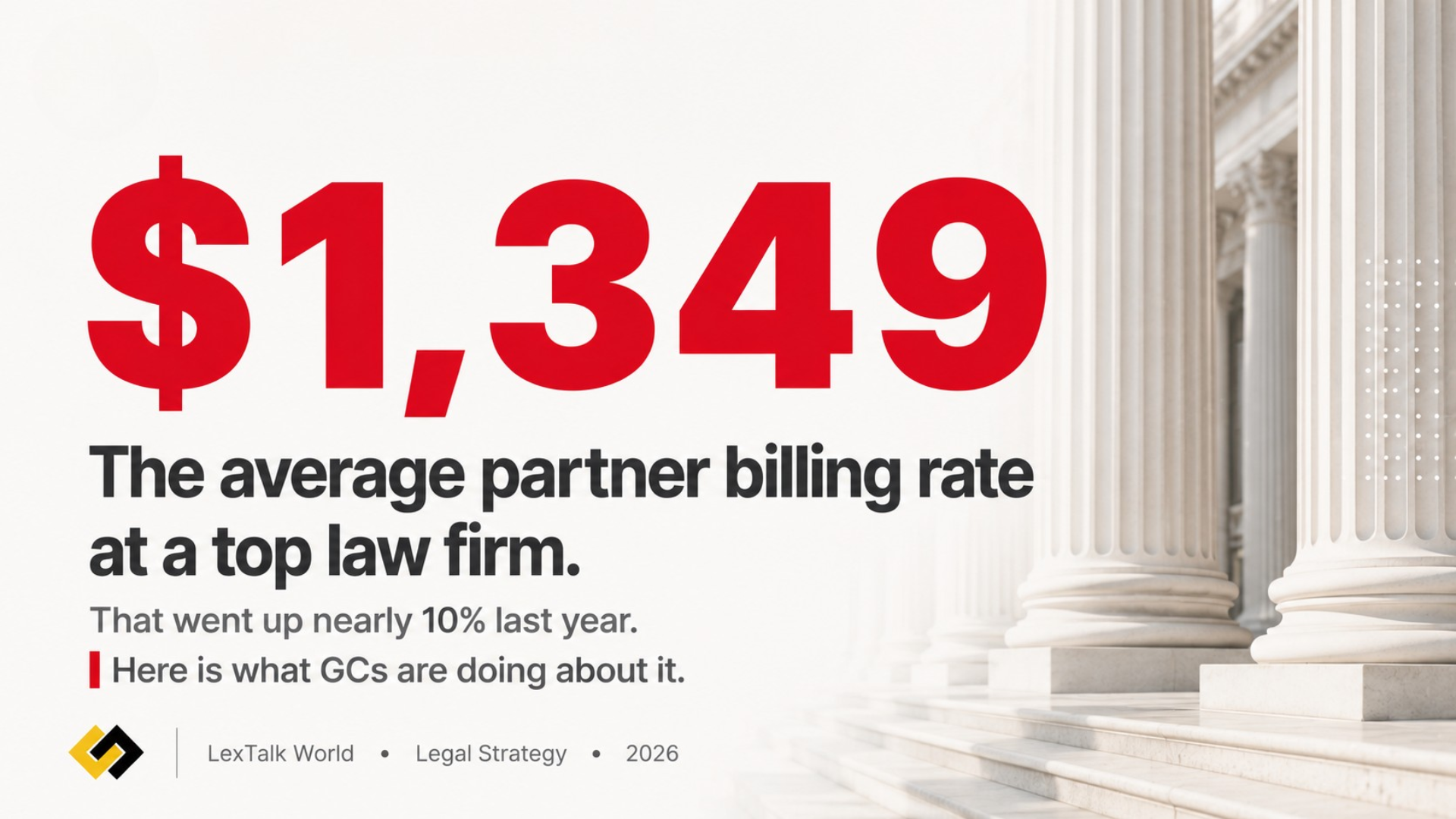
How in-house legal teams are responding to law firm rates that rose nearly 10 percent in a single year, and why the old negotiation playbook no longer works.
What is outside counsel cost management?
Outside counsel cost management is the set of processes, controls, and strategies a legal department uses to plan, monitor, and control what it spends on external law firms before costs are incurred, not after. It includes matter budgeting, rate negotiation, billing guideline enforcement, vendor selection, and decisions about which work stays in-house versus goes to external counsel.
Law firm billing rates went up an average of 9.6 percent in 2025. At Am Law 25 firms, the average partner rate crossed $1,349 per hour. Blended rates across all timekeeper levels hit $1,027 per hour. That is a 7.5 percent increase in the first quarter of 2025 alone, more than double inflation.
For a legal department with a $50 million outside counsel budget, a 12 percent effective rate increase means $6 million more next year before a single new matter is opened.
And yet most in-house legal teams are still responding to this pressure the same way they did a decade ago: by negotiating harder when firms send their annual rate proposals, then absorbing whatever increase results.
That approach is no longer working. The data from 2026 makes clear that the legal teams managing outside counsel costs well are doing something different. They are not better negotiators. They are better prepared.
Why Are Law Firm Rates Rising So Fast?
Law firm billing rates have risen faster than inflation every year since 2019. Several structural forces explain why.
First, firm operating costs have risen sharply. Technology spending at major firms increased 9.7 percent in 2025. Talent costs rose 8.2 percent. Firms that grew aggressively during the demand surge of 2025 now carry fixed costs that require sustained rate increases to support.
Second, demand has been high enough that firms have had little incentive to restrain pricing. Regulatory complexity, trade uncertainty, and cross-border legal risk drove legal demand to some of the strongest levels in a decade during 2025. When clients are busy and work is flowing, firms raise rates and most clients pay.
Third, the negotiation dynamic has historically favored firms. In-house teams typically respond to rate proposals with budget concerns and relationship history. Firms arrive with detailed internal cost data and market positioning. That is not a negotiation on equal terms.
The combination of rising firm costs, strong demand, and weak in-house negotiating leverage has produced a market where average outside counsel rates now grow faster than any other major input cost in corporate legal.
What Is the Real Cost of Outside Counsel Spending?
The direct cost of outside counsel is visible: the invoices, the rates, the hours billed. The indirect cost is harder to see but often larger.
Research published in 2026 found that only 20 percent of outside counsel matters finish within their original budget. On average, legal teams lose more than $160,000 per year to duplicated effort alone, reviewing and redrafting content that had already been worked on by another party. Most overruns trace to three gaps that are entirely within the in-house team’s control.
The first gap is vague initial instructions. When a matter is opened without a clear scope, outside counsel defaults to continuing work until told to stop. That is not inefficiency on the firm’s side. It is a governance gap on the client’s side.
The second gap is unmanaged scope changes. When new facts or risks emerge during a matter, scope expands. Without a documented change control process, those expansions become invisible additions to the bill.
The third gap is untracked staffing shifts. Partners substitute associates. Senior timekeepers replace junior ones. Each change increases the billing rate for work that was scoped and budgeted at a lower rate. Without active monitoring, nobody catches it until the invoice arrives.
These three gaps are responsible for more outside counsel cost variance than rate inflation itself. Fixing them does not require renegotiating rates. It requires better matter management.
How Are GCs Bringing More Work In-House?
The most significant structural shift in outside counsel management right now is not rate negotiation. It is reallocation.
An Axiom study of 516 senior in-house legal leaders across eight countries, published in February 2026, found that 80 percent of in-house teams plan to move significant law firm work in-house or to alternative legal service providers within the next two years. Two-thirds of respondents said they now see alternative legal service providers as viable replacements for law firms for day-to-day strategic legal work.
The reallocation is being driven by two forces. First, AI tools have made it possible for smaller in-house teams to handle work that previously required outside support. Contract review, legal research, due diligence support, and compliance monitoring are all tasks where AI-assisted in-house teams can now match or exceed the output of outside counsel at a fraction of the cost. A team of four in-house lawyers using AI tools can recover the equivalent of $700,000 or more in annual productivity compared to the same team working without them.
Second, alternative legal service providers have matured significantly. In the UK and Europe, 76 percent of legal departments now use alternative providers for substantial legal work. In North America, the figure is still only 27 percent, which means most US and Canadian GCs are not yet taking advantage of a model that their European counterparts have already validated.
The departments bringing work back in-house successfully are not simply adding headcount. They are building the internal systems, playbooks, and technology stack that let smaller teams handle more work without proportional cost increases.
What Actually Works in Outside Counsel Rate Negotiations?
Most rate negotiations fail not because law firms push back, but because in-house teams arrive unprepared. Firms come with internal cost data and market positioning. In-house teams come with budget constraints and relationship history. That is not a negotiation. It is a reaction.
The tactics that are producing real results in 2026 share one thing in common: they change who sets the agenda.
The first tactic is controlling the timing of rate submissions. Instead of waiting for firms to send annual rate proposals and then responding, proactive departments establish submission windows and deadlines that fit their budget cycle, not the firm’s.
The second tactic is matter-type benchmarking. General rate comparisons are weak because rates vary significantly by practice area, geography, and timekeeper level. Departments that benchmark at the practice area and timekeeper level can identify exactly where proposed increases are concentrated and negotiate with precision.
The third tactic is multi-year agreements. Firms facing cost pressure value revenue predictability. In exchange for a volume commitment over two or three years, in-house teams can lock in rate trajectories that are significantly lower than what annual negotiations would produce.
The fourth tactic is the ‘most favored nation’ clause. This requires firms to disclose when they offer lower rates to other clients in similar circumstances and to match those rates. It does not eliminate rate increases, but it ensures the in-house team is not paying more than comparable clients for the same work.
How Do You Measure Outside Counsel Performance Beyond Cost?
Cost is one dimension of outside counsel performance. For most legal departments, it is the one they measure best and manage worst.
The departments getting the most from their outside counsel relationships in 2026 have added a second dimension: predictability. Not just what did this cost, but did we know what it would cost, and why did it change.
Practical performance metrics that distinguish strong outside counsel relationships from weak ones include budget variance by matter type, invoice turnaround and compliance with billing guidelines, communication quality at defined escalation points, and staffing stability across the life of a matter.
A firm may deliver strong legal work while still creating avoidable cost variance through weak scoping, late communication, or inconsistent staffing. Those outcomes are manageable if expectations are clear at matter opening. They are invisible if the relationship is governed only by a rate card.
What Do Legal Teams Bringing Outside Counsel Under Control Have in Common?
Research across multiple studies published in 2025 and 2026 points to consistent patterns in legal departments that manage outside counsel costs well.
They establish matter budgets before work begins, not after invoices arrive. They define scope in writing at matter inception, including what the engagement covers and what it does not. They use technology to monitor cumulative spend against budget in real time. They review outside counsel performance on communication and predictability, not just legal outcome. And they are actively building the internal capability to handle work that was previously sent out by default rather than by design.
The Chambers and Partners 2026 study of 204 senior in-house counsel found that technology and innovation had become the top strategic priority for legal departments on both sides of the Atlantic, ahead of talent, compliance, and cost management individually. The connection is direct: the departments that have adopted legal technology have the capacity to bring work in-house, the data to negotiate from strength, and the visibility to manage outside counsel spend proactively rather than reactively.
Is the Outside Counsel Relationship Changing Permanently?
The Axiom 2026 GC Report puts the question plainly: are we crossing a point where law firms are reserved for the highest-stakes work, while alternative providers and internal teams handle everything else?
The data suggests yes, gradually. Two-thirds of in-house legal leaders now see alternative providers as viable for strategic day-to-day work. Sixty-one percent say they continue sending work to law firms out of habit rather than a deliberate assessment that law firms are the right choice. That is not a sustainable basis for a major budget allocation.
What is not changing is the need for specialist outside counsel in genuinely complex, high-risk matters. Cross-border transactions, major litigation, regulatory investigations, and bet-the-company decisions will continue to require the deep expertise of specialist firms. The shift is not away from outside counsel entirely. It is toward a more deliberate model where the work is allocated based on where it can be done best at the right cost, rather than where it has always gone.
For GCs, that shift is an opportunity. The departments that build the internal systems to handle the volume work, negotiate rates from a position of data and preparation, and use alternative providers strategically are the ones that will control their budgets, demonstrate measurable value, and have the resources to invest in the legal function rather than simply managing its costs.
About LexTalk World
LexTalk World is a global legal community connecting General Counsels, law firm leaders, in-house practitioners, and LegalTech innovators. Through conferences in Houston, New York, Singapore, Dubai, and across India, LexTalk World creates the rooms where the legal industry moves forward.