
 León Felipe Banegas Ruiz
Senior Legal Manager at Laernian Operations
León Felipe Banegas Ruiz
Senior Legal Manager at Laernian Operations 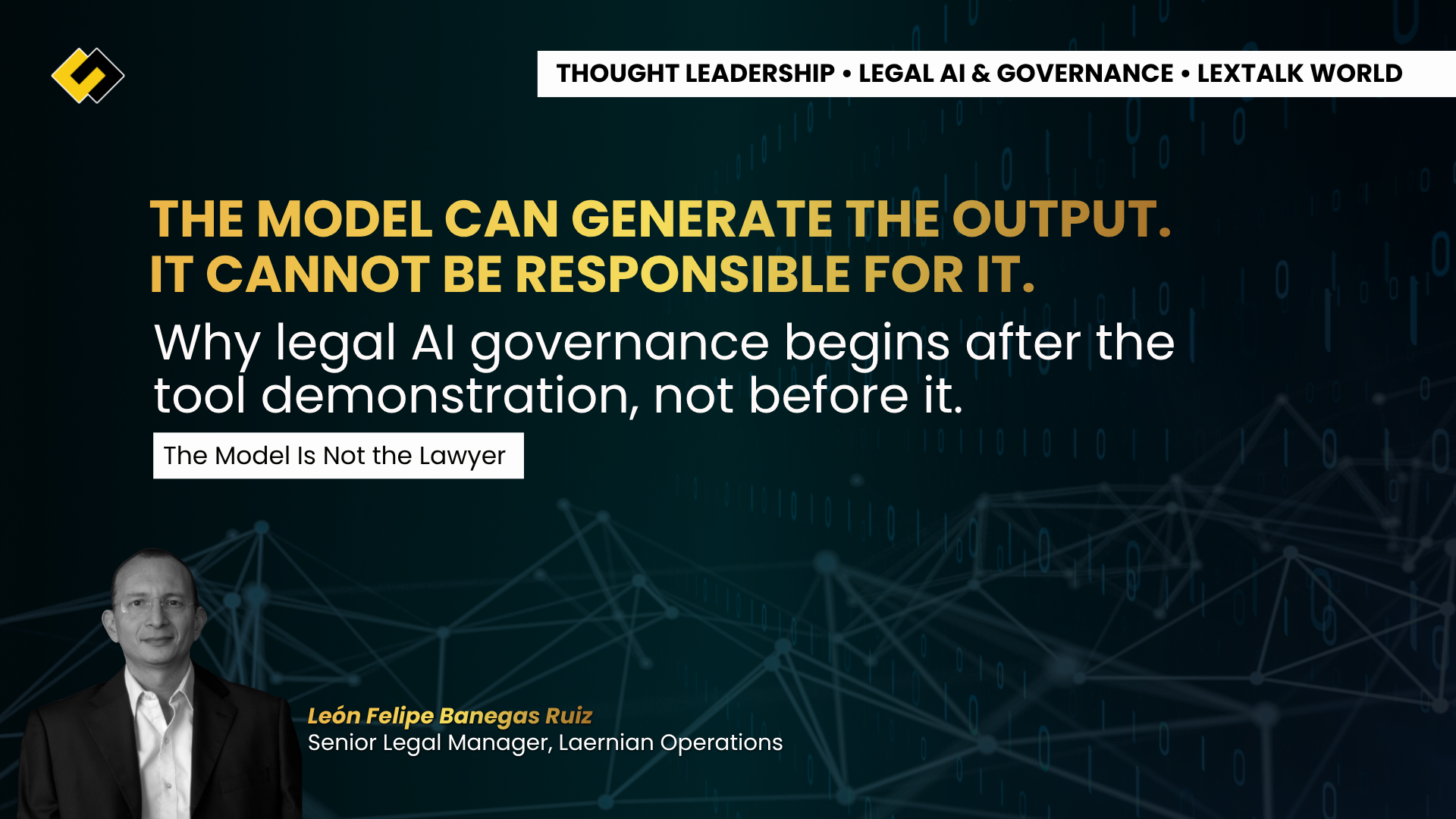
Much of the current conversation about legal AI begins with seductive questions:
Can it summarize a contract? Can it draft a clause? Can it compare two versions of an agreement? Can it answer a policy question? Can it support intake, triage, research organization, first-pass drafting, obligation extraction, or document review?
These are useful questions. They are also insufficient.
In our work, the more serious question is not only what the model can generate. It is under what conditions the model’s output is allowed to matter.
That distinction is the line between experimentation and reliance.
A model may produce fluent language. It may produce a useful summary. It may even produce something that resembles legal reasoning. But the moment that output influences a decision, a negotiation, a filing, a risk assessment, a contract position, an internal policy, or a business action, the organization is no longer dealing only with technology. It is dealing with reliance and reliance, creates exposure.
The model will never be the lawyer. It does not hold professional responsibility. It does not understand the client relationship as a lawyer must. It does not protect privilege by duty (or liability). It does not know when a business risk requires escalation unless the workflow around it has been designed to make that visible. It does not carry institutional accountability.
It generates output inside the conditions that humans and organizations create around it. legal AI governance cannot stop at procurement approval, tool selection, or a general instruction to “review AI outputs.” Those measures matter, but they are only the outer wall. The real work begins inside the interaction itself.
Legal teams must now govern not only the tool, but the conditions under which the tool is questioned, constrained, reviewed, relied upon, documented, and allowed to leave the room.
Tool capability is not the operating model, capability is easy to demonstrate; a platform can produce a contract summary in seconds. It can classify documents. It can identify clauses. It can draft an email. It can propose alternative wording. It can create a neat answer to a complicated question.That is impressive. Alas, It is not by itself, governance.
A legal function does not create value merely because a tool can produce output. value appears when that output enters a workflow safely, improves a decision, reduces unnecessary friction, preserves accountability, and can survive scrutiny after the urgency has passed.
The real questions begin after the demonstration:
- Who may use the tool?
- For which matters?
- With what kind of data?
- Under what confidentiality conditions?
- For what categories of work?
- With what review standard?
- At what point may the output influence a decision?
- Who approves that reliance?
- What must be documented?
- What happens when the output is incomplete, uncertain, inconsistent, or too confident?
These are not obstacles to innovation. They are the operating conditions that allow innovation to become defensible. Without them, AI becomes another fragmented layer of legal technology: useful in isolated moments, inconsistent across teams, difficult to measure, and dangerous when people begin to rely on it without a shared operating model.
The tool may be powerful, but power without operating discipline is not maturity. It is velocity without a brake record; Interaction without quality becomes risk.
Many organizations still treat interaction with AI as a user skill. They call it prompting. They offer tips. Advise specifics. Provide metrics and rules for context. Teach how to ask follow-up questions and check the output. That is useful at a basic level, but in law, interaction quality is not merely a productivity technique: It is a risk factor.
Who frames the question matters.
A poorly framed question can hide the real issue. It can turn a legal risk into a drafting exercise. It can ask the model to optimize language without identifying the commercial context, regulatory constraint, jurisdictional sensitivity, evidentiary burden, internal policy, approval threshold, or risk appetite. The answer may be fluent and still miss the point.
What context is provided matters.
A model cannot evaluate what it has not been given. If the user omits negotiation history, counterparty behavior, internal approval rules, prior concessions, local law concerns, business urgency, or the reason the question matters, the output may be superficially correct and operationally dangerous.
Which assumptions are tested matters.
Legal work often turns on assumptions: who has authority, which facts are established, what jurisdiction applies, whether an exception has precedent, whether an obligation is enforceable, whether a risk has already been accepted, and whether the current version of the document is actually the operative one.
If the interaction does not force assumptions into the open, the output may create confidence where the organization needed verification.
Who reviews the output matters.
Review is not a ceremonial glance before copying text into a document. Review is where professional judgment re-enters the workflow. It is where the lawyer asks whether the output is accurate, complete, proportionate, confidential, useful, aligned with the client’s interest, and appropriate for the intended use.
When reliance is permitted matters.
There is a difference between using AI to explore a question, using it to organize information, using it to draft a preliminary version, and allowing its output to shape a final legal position.
Mature legal teams should not treat all AI-assisted work as the same. The risk changes when the output moves from internal support to external consequence.
These are not “prompting tips.” They are governance questions.
The quality of the interaction shapes the quality of the risk. A strong model used through a weak interaction can produce weak legal work. A disciplined professional using a modest tool, within clear constraints and review standards, may produce a more defensible result.
The tool matters.
But the interaction around the tool may matter more than we are comfortable admitting. The lawyer remains the accountable interface. One of the most dangerous ideas in legal AI is the casual suggestion that the system is becoming a legal peer. It is not.
A peer can be responsible, a peer can be disciplined, a peer can understand duties of loyalty, confidentiality, competence, independence, and professional judgment. A peer can decide when silence is more prudent than speed. A peer can say: this cannot proceed without escalation. A peer can own the consequence of advice. A model can assist, It cannot assume that role.
This does not make AI useless. Quite the opposite. AI can support many parts of legal work: drafting, summarization, issue spotting, research organization, obligation extraction, intake triage, policy navigation, translation, comparison, and review preparation.
Used properly, it can reduce friction and give legal professionals more room for judgment, strategy, negotiation, and risk analysis.
But usefulness is not responsibility.
- The lawyer remains the accountable interface between machine output and legal consequence.
- The lawyer decides what the question really is.
- The lawyer determines whether the context is sufficient.
- The lawyer reviews the answer against law, fact, policy, risk, purpose, and institutional consequence.
- The lawyer decides whether the output should be used, modified, escalated, rejected, documented, or buried with honors.
Hence, legal AI outputs often sound more complete than they are. Fluency can create the appearance of authority. Clean structure can conceal missing analysis. Confidence can obscure uncertainty.
The professional task is not to admire the fluency.
The professional task is to govern the moment when fluency seeks to become reliance. Privilege, confidentiality, escalation, client interest, evidentiary defensibility, and institutional responsibility cannot be delegated into language generation. They must remain anchored in human judgment and organizational controls. The machine may help produce the sentence. The lawyer remains responsible for whether that sentence should exist.
Legal Operations must turn interaction into workflow
If interaction quality is a governance issue, then Legal Operations has a central role to play.
Legal Ops lives in the space between legal judgment and organizational execution. It is concerned not only with what lawyers know, but with how legal work moves: through intake, assignment, review, approval, documentation, escalation, reporting, obligation tracking, and closure. That is exactly where AI-assisted legal work needs structure.
A mature legal AI operating model should define review standards. A low-risk internal summary, a draft negotiation position, a regulatory analysis, and a document intended for external use should not move through the same control path.
It should define documentation rules. If an AI output materially influences a decision, what evidence should exist? Should the prompt be retained? Should the output be stored? Should the reviewer document modification, rejection, or reliance? The answer may vary by matter type, confidentiality, jurisdiction, and policy. But the organization should decide intentionally, not accidentally. It should define version control and final-form validation.
One of the emerging risks of AI-assisted work is residue.
The working layer crossing into the final layer, draft logic survives where it should have been removed. Internal scaffolding remains attached to the argument. Machine-generated phrasing enters a legal product without sufficient review. The final document should not carry the workshop still attached to its walls.
Some outputs should never move directly from user to action. If AI surfaces uncertainty, conflicting obligations, sensitive data, privilege concerns, regulatory exposure, or high-value contractual impact, the workflow should know where the matter goes next.
“A person reviewed it” is not a governance model.
Who reviewed it? With what competence? Against what standard? Before what use? With what authority to approve, reject, modify, or escalate?
It should define auditability. If the decision is questioned later, the organization should be able to explain not only what was decided, but how AI-assisted work entered the process, how it was reviewed, and why reliance was permitted.
This is where legal AI moves from experimentation to infrastructure. The prompt is not the governance layer.
The workflow is.
The next mature legal function
The next mature legal function will not be the one that adopted the most AI tools. It will be the one that knows how AI-assisted work enters, moves through, and exits the legal workflow.
It will know where AI is useful, where it is limited, where it requires review, where it must be prohibited, and where escalation is mandatory.
- It will not confuse speed with maturity.
- It will not confuse output with judgment.
- It will not confuse adoption with governance.
Legal AI value depends on more than model capability. It depends on interaction quality, workflow design, professional responsibility, and institutional discipline. AI can assist legal work. It can make parts of the work faster, clearer, and more efficient. It can help legal teams handle complexity at greater speed.
But governance decides when AI-assisted work is ready to matter.
The model is not the lawyer.
The lawyer remains the accountable interface, and Legal Operations must build the infrastructure that allows AI-assisted work to become useful without becoming uncontrolled reliance.
That is the work ahead. Not to fear the tool.
Not to worship the tool.
But to build the conditions under which legal judgment can use the tool without being replaced by its fluency.
About the Author:
León Felipe Banegas Ruiz, Senior Legal Manager at Laernian Operations
León Felipe Banegas Ruiz is a Mexican lawyer and legal operations professional with over 20 years of experience in commercial contracts, corporate governance, compliance, regulatory support, and risk-based legal strategy. He has advised complex public and private sector organizations on high-value contractual matters, regulatory compliance, audit support, and scalable legal operations. His notable achievements include contributing to a recovery litigation matter involving MXN 65 million plus interest and leading the legal-operational coordination of a Human Capital Management implementation across 110 companies. León is recognized for translating legal complexity into practical solutions that strengthen governance, reduce risk, and deliver measurable business value.