
 Federico Pereyra Zorraquin
Legal Manager at Life Academy
Federico Pereyra Zorraquin
Legal Manager at Life Academy 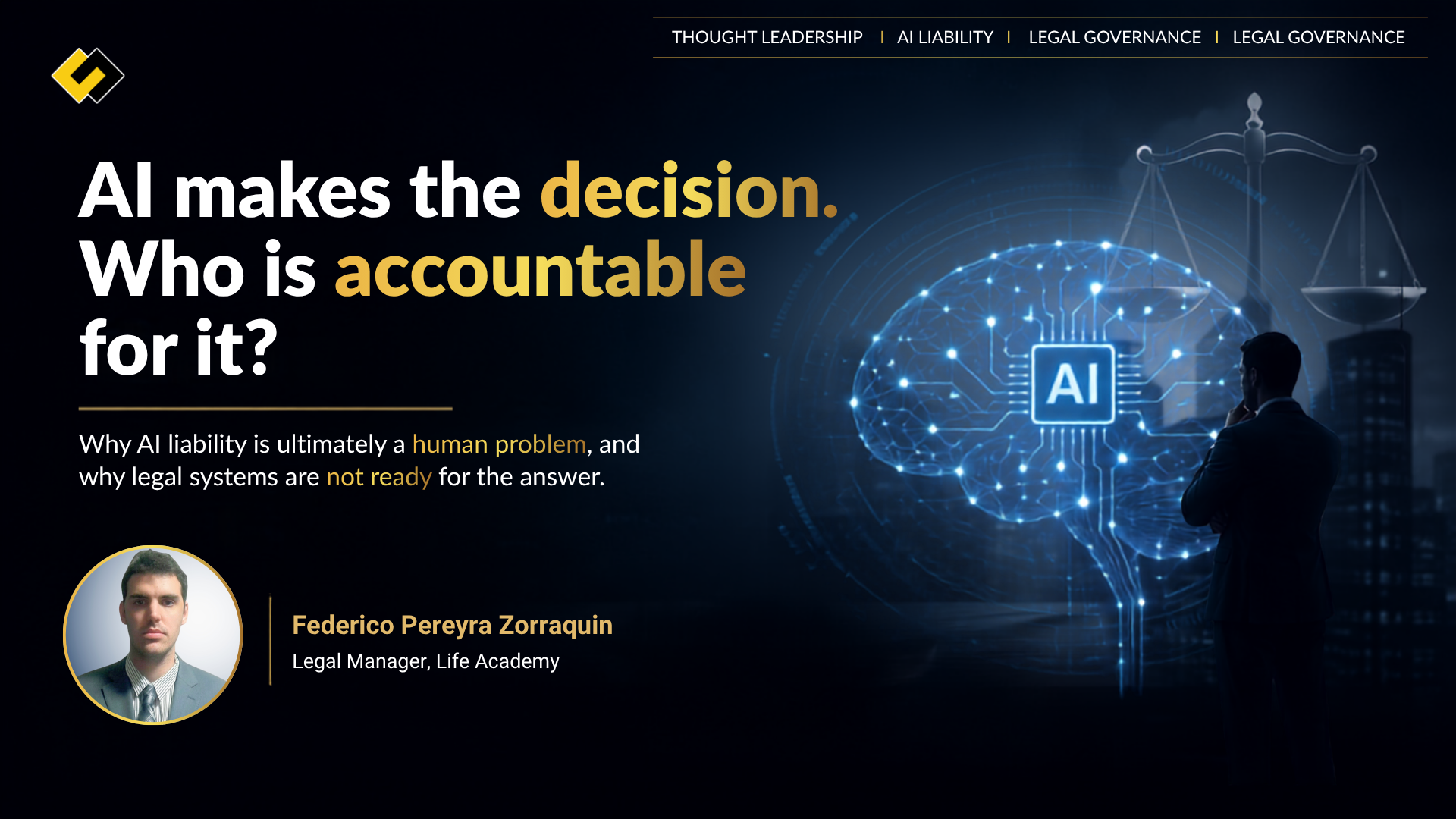
Artificial Intelligence is rapidly reshaping the architecture of modern decision-making. Algorithms now influence who receives credit, who gets hired, which transactions are flagged as suspicious, what information reaches consumers, and increasingly, how legal, financial, and operational risks are assessed within organizations. In many sectors, AI has quietly evolved from a productivity tool into critical decision-making infrastructure, becoming embedded in processes that directly affect rights, opportunities, reputations, and economic outcomes.
As this transformation accelerates, a deceptively simple question is emerging in boardrooms, regulatory agencies, and courtrooms around the world: who is liable when AI fails? While the question appears straightforward, it risks obscuring the deeper legal challenge. Artificial intelligence does not sign contracts, owe fiduciary duties, appear before courts, compensate injured parties, or assume legal obligations. Despite increasingly sophisticated and human-like outputs, AI remains a technological instrument rather than a legal actor. Consequently, the central issue is not whether artificial intelligence should be held accountable, but rather how legal systems should allocate responsibility among the individuals and organizations that design, train, deploy, supervise, commercialize, and benefit from these systems.
The significance of this debate extends far beyond technology regulation. Artificial intelligence is forcing legal systems to confront fundamental questions regarding governance, accountability, and the allocation of risk in increasingly automated environments. More importantly, the real question is not whether AI becomes more powerful. Technological progress strongly suggests that it will. The real question is whether our legal institutions, governance structures, and regulatory frameworks will mature at the same pace.
The Return of an Old Legal Question
Every transformative technology eventually confronts the legal system with the same fundamental challenge: how should responsibility be allocated when innovation causes harm? Throughout history, the printing press, railroads, electricity, aviation, the internet, social media platforms, cryptocurrencies, and countless other disruptive technologies have generated legal uncertainty precisely because they altered existing patterns of economic activity and social interaction. Although the technologies themselves differed dramatically, the underlying legal problem remained remarkably consistent.
Legal systems do not evolve in isolation. They adapt when technological developments alter the practical constraints under which societies operate or create economic incentives too significant for existing frameworks to ignore. The history of law is, in many respects, the history of institutional adaptation to changing realities. Yet law remains inherently conservative. Courts look to precedent, legislators build upon existing frameworks, and regulators often seek continuity rather than disruption. When confronted with genuinely novel technological challenges, legal institutions rarely invent entirely new doctrines from scratch. Instead, they attempt to understand emerging issues through analogies to established legal concepts.
Artificial intelligence is likely to follow a similar trajectory. The challenge facing courts and regulators will not be the absence of legal tools, but rather determining which tools are most appropriate. Questions surrounding AI-related harm may be analyzed through the lenses of negligence, product liability, consumer protection, agency law, professional responsibility, contractual obligations, or data protection frameworks. As has occurred during previous technological transitions, existing doctrines will likely be adapted and refined rather than replaced altogether. While the actors participating in these disputes may differ from those involved in earlier technological revolutions, the principles used to allocate responsibility are likely to remain surprisingly familiar.
AI Is Challenging the Assumptions of Private Law
What makes artificial intelligence particularly significant is not merely its commercial impact or technical sophistication. Rather, it is the extent to which AI challenges assumptions that have quietly underpinned private law for centuries. Most legal systems were built upon a relatively simple premise: legally relevant
decisions are made by human beings or by legal entities acting through human beings. Responsibility could therefore be traced to identifiable actors capable of exercising judgment, assuming obligations, and bearing legal consequences.
Artificial intelligence increasingly complicates that assumption. In a growing number of narrow domains, advanced AI systems are already outperforming human experts. Sophisticated models can process enormous quantities of information, identify patterns invisible to human observers, and generate recommendations with levels of speed and accuracy that frequently exceed those of experienced professionals. This increased level of machine intelligence raises significant challenges for legal frameworks that have traditionally treated human judgment as the central element of legally relevant decision-making.
The issue is not whether machines are becoming intelligent in a technical sense. The issue is whether legal systems remain capable of identifying responsibility when intelligence, decision-making, and operational control become distributed across increasingly complex technological ecosystems. In sectors such as healthcare, finance, insurance, employment, and legal services, algorithmic outputs increasingly influence decisions carrying substantial legal and economic consequences. As these systems become more capable and more deeply integrated into organizational processes, the boundary between human judgment and machine influence becomes increasingly difficult to define.
The Emerging Accountability Gap
One of the most significant risks associated with artificial intelligence is not technological failure itself, but the emergence of what may be described as an accountability gap. Traditional liability systems function most effectively when decision-making authority can be clearly identified and linked to a specific actor. Artificial intelligence complicates this process because responsibility becomes fragmented across multiple participants within a broader technological ecosystem.
Model developers design and train the underlying systems, data providers contribute the information upon which those systems depend, technology vendors commercialize the resulting products, and organizations integrate them into business processes that ultimately affect employees, consumers, and other stakeholders. When harm occurs, each participant may plausibly argue that another actor exercised greater control over the final outcome. The result is a diffusion of responsibility that challenges the foundations upon which conventional liability frameworks have historically operated.
This challenge becomes particularly visible when AI systems are used to approve loans, screen job applicants, detect fraud, assess insurance claims, or generate legal and financial recommendations. If the resulting outputs are discriminatory, inaccurate, misleading, or otherwise harmful, identifying responsibility becomes substantially more complicated than in traditional cases involving defective products or negligent professionals. The relevant question may involve flawed training data, architectural limitations, inadequate supervision, improper implementation, unreasonable reliance on automated outputs, or some combination of these factors.
Artificial intelligence is not merely creating new forms of risk; it is amplifying a longstanding legal concern: the growing separation between those who make decisions and those who bear their consequences. Historically, consumer protection frameworks emerged to address situations characterized by informational asymmetries, unequal bargaining power, and significant disparities in knowledge. AI intensifies each of these concerns simultaneously. Most individuals cannot meaningfully evaluate how advanced algorithms generate outputs, what data informs those outputs, whether bias is present, or what mechanisms exist to challenge adverse decisions. As a result, transparency is evolving from a desirable governance objective into a prerequisite for legitimacy. A decision that cannot be explained may still be technically accurate, but from a legal perspective it becomes considerably more difficult to justify, audit, or contest.
Organizations should therefore approach automation with a simple but powerful rule: if a decision cannot be adequately explained, meaningfully challenged, or effectively overridden by human actors, serious consideration should be given to whether that decision should be automated at all. Efficiency may justify automation, but it cannot justify the disappearance of accountability.
Why AI Is Not a Legal Person — At Least Not Yet
As artificial intelligence becomes increasingly sophisticated, proposals periodically emerge suggesting that AI systems should be granted some form of legal personality. The argument is understandable. If AI systems can generate content, influence decisions, interact with individuals, and in some cases outperform human experts, should they not also bear legal responsibility for the consequences of their actions?
Current legal doctrine overwhelmingly answers that question in the negative. To possess legal personhood, an entity must be recognized as a legal actor with legal capacity. Legal persons possess rights, assume obligations, participate in legal relationships, own assets, and bear responsibility under the law. Artificial intelligence currently satisfies none of these requirements.
The dominant view remains reflected in traditional agency law. As the Restatement (Third) of Agency makes clear, computer programs are not capable of acting as principals or agents under common law. Rather, they remain instrumentalities of the individuals and organizations that use them. Under this approach, software is legally comparable to any other instrumentality. Whether the instrument is a paper document, an automated trading platform, or an advanced generative AI model, the legal consequences of its operation remain attributable to the human actors responsible for deploying and relying upon it. The intelligence of the tool does not automatically transform the tool into a legal actor.
This conclusion becomes even more significant when artificial intelligence intersects with personal data. Modern AI systems depend upon enormous quantities of information, much of which consists of personal data capable of revealing individual preferences, behaviors, financial circumstances, and, in some cases, highly sensitive characteristics. Consequently, questions concerning AI liability increasingly overlap with broader debates involving privacy, profiling, cybersecurity, automated decision-making, transparency obligations, and cross-border data transfers. Across multiple jurisdictions, regulators have gradually embraced a common principle: individuals should not be subjected exclusively to automated decisions capable of producing significant legal or economic effects without meaningful safeguards. This principle reflects a broader recognition that technological efficiency cannot entirely replace human judgment where fundamental rights are at stake. In the AI era, data governance and liability governance are becoming inseparable.
From Blockchain to AI: A Familiar Accountability Challenge
In many respects, artificial intelligence presents a challenge similar to that previously raised by blockchain technologies and digital assets. Both innovations seek to reduce reliance on traditional intermediaries and replace elements of human judgment with technological processes. Yet the removal of intermediaries often creates a parallel problem: the disappearance of clearly identifiable accountability structures.
Legal systems have historically relied upon intermediaries not only to facilitate transactions, but also to absorb responsibility when disputes arise. The rise of decentralized technologies challenged that model by distributing decision-making across networks rather than institutions. Artificial intelligence introduces a similar dynamic. The more organizations rely upon technological systems to generate outcomes, the more difficult it becomes to identify who should ultimately bear responsibility when those outcomes produce harm. The challenge is therefore not merely technological. It is institutional.
This debate may become even more complex as artificial intelligence converges with decentralized governance structures. The emergence of Decentralized Autonomous Organizations (DAOs) illustrates how technology is beginning to challenge not only traditional notions of decision-making but also the concept of legal personality itself. These structures operate through blockchain-based governance mechanisms and smart contracts, often without conventional management bodies or clearly identifiable decision-makers. As AI systems become increasingly integrated into such environments, courts and regulators may face unprecedented questions regarding attribution of responsibility, jurisdiction, and enforcement. The challenge may no longer be determining who programmed the system, but identifying who remains accountable when governance itself becomes partially automated.
Conclusion
For centuries, legal systems have evolved by adapting established principles to new technological realities. The steam engine, electricity, aviation, the internet, and digital platforms each forced lawmakers and courts to confront unfamiliar risks while preserving familiar concepts of responsibility. Artificial intelligence represents the latest chapter in that evolution, but perhaps also the most consequential one.
The temptation is to view AI as a fundamentally different phenomenon requiring entirely new legal theories and unprecedented regulatory structures. Yet history suggests a more nuanced conclusion. The central challenge is not that machines are becoming capable of making increasingly sophisticated decisions. The central challenge is determining how responsibility should be allocated when those decisions influence human lives, economic opportunities, fundamental rights, and societal trust.
At present, artificial intelligence remains a tool rather than a legal actor. It cannot bear obligations, exercise legal rights, or answer for its conduct before a court of law. Responsibility therefore continues to reside with the individuals and organizations that design, deploy, supervise, and ultimately benefit from these systems. As AI becomes more deeply embedded in business operations, public services, financial markets, healthcare systems, and governance structures, accountability cannot be allowed to disappear into the complexity of the technology itself.
Ultimately, we are not merely regulating artificial intelligence. We are building the legal architecture of a new digital society. The values that we choose to embed—or fail to embed—into that architecture will shape the relationship between technology, markets, institutions, and individual rights for decades to come.
The history of innovation is often described as a search for efficiency. The history of law is, in many respects, a search for accountability. The defining challenge of the AI era is ensuring that we do not achieve the former at the expense of the latter.
Artificial intelligence will almost certainly become more capable, more autonomous, and more deeply integrated into everyday life. The real question is whether our legal systems, institutions, and governance structures will mature at the same pace.
Technology can distribute decision-making, automate execution, and even simulate judgment. What it cannot eliminate is the legal necessity of accountability.
Because the future of AI liability may ultimately be the future of human responsibility itself.
About the Author:
Federico Pereyra Zorraquin, Legal Manager, Life Academy
Federico Pereyra Zorraquin is a Senior Legal Counsel with over 10 years of experience advising multinational organizations across Latin America in the financial services, energy, technology, and digital platform sectors. As Regional Legal Counsel for a multinational financial services group, he leads legal, compliance, governance, and dispute resolution matters across multiple jurisdictions. Previously, he advised organizations including Libertex Group, Aggreko, Chevron, and Accenture on technology law, data protection, cross-border transactions, and regulatory compliance. Federico holds a Master’s Degree in Business Law from UADE and serves as Assistant Lecturer at the Pontifical Catholic University of Argentina, focusing on technology, AI, digital assets, and consumer protection.