
 Joaquin Cabrera Hurtado
Senior Associate at TRCM | Tapia Robles Cabrera Moreno
Joaquin Cabrera Hurtado
Senior Associate at TRCM | Tapia Robles Cabrera Moreno 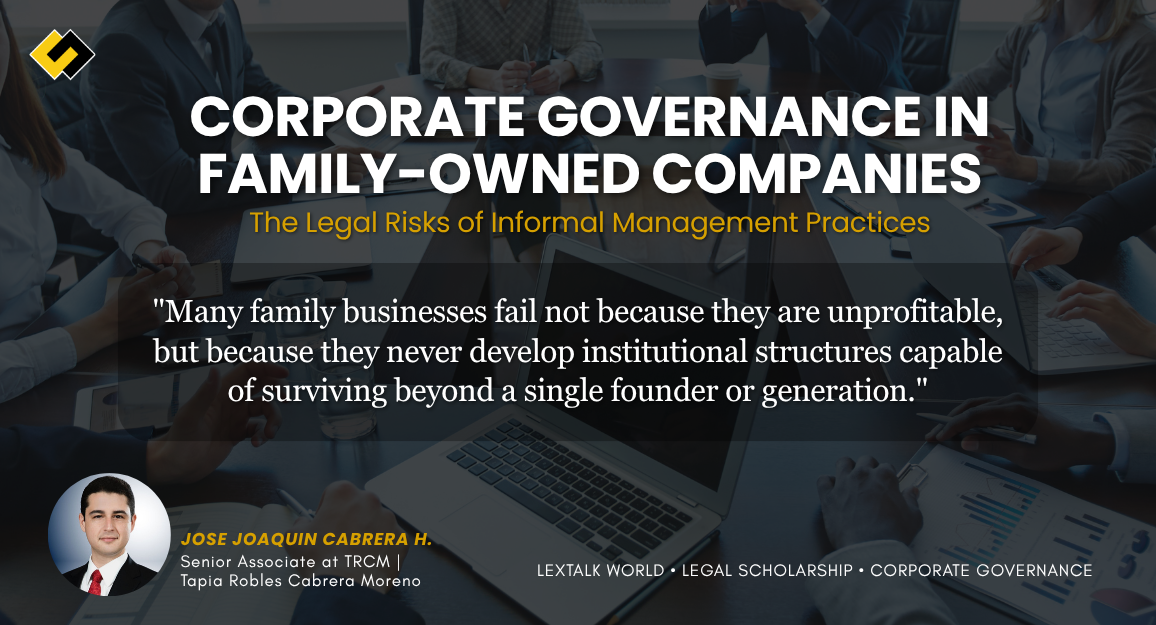
I. Introduction
Consider a company that has operated successfully for twenty years. Its founder signs contracts, opens bank accounts, and directs the hiring and firing of employees — yet no corporate resolution ever formally appointed him as director, the bylaws have not been amended since the company’s incorporation, and no shareholder meeting has been convened in over a decade. The company appears commercially stable. Beneath the surface, it is legally exposed.
This scenario represents a common structural pattern among family-owned and closely held businesses. Corporate governance — the legal and institutional framework through which a company is managed, supervised, and controlled — is routinely reduced to a formality in such enterprises, or abandoned altogether.
This article argues that governance deficiencies in family-owned companies are not merely technical irregularities. They are latent legal risks that become acute when the company faces litigation, regulatory scrutiny, succession conflicts, or financial distress. The question is not whether governance matters. The question is how long a company can afford to ignore it.
II. The concept of Corporate Governance
Corporate governance is not a term reserved for multinational corporations or publicly traded entities. At its core, it refers to the rules and mechanisms by which authority within a company is allocated, exercised, and held accountable. At a minimum, effective governance requires:
- Updated bylaws consistent with the company’s operational reality;
- Accurate and properly maintained corporate records;
- Valid shareholder and board resolutions authorizing corporate decisions;
- Clearly defined authority and formal appointment of directors and officers;
- Internal compliance procedures; and
- Transparent accounting and financial controls.
In larger or publicly traded entities, governance structures may additionally encompass periodic financial disclosures, audit committees, compliance and risk management systems, and whistleblower mechanisms. For family-owned companies, the baseline requirements are less demanding — but no less important.
The legal significance of this framework lies in its protection of the enforceability of corporate decisions, the limitation of personal liability, the integrity of ownership records, and the company’s capacity to survive changes in leadership or ownership structure.
III. Governance deficiencies in family-owned companies
Although corporate governance is commonly associated with large corporations, its importance is equally critical for closely held and family-owned businesses. Yet, in practice, many family-owned companies frequently operate through informal arrangements that diverge substantially from their legal documentation.
The most common deficiencies include:
- Failure to distinguish personal assets from corporate assets;
- Use of company funds for personal or family expenses without proper authorization;
- Distribution of corporate assets without a legal basis;
- Family members exercising managerial authority without formal appointment;
- Individuals using executive titles —such as “CEO,” “General Director,” or “Managing Director”— that do not exist under the company’s bylaws;
- Informal or undocumented transfers of ownership interests;
- Outdated, incomplete, or nonexistent corporate records;
- Failure to hold meetings or approve formal shareholder and board resolutions; and
- Failure to issue or properly endorse share certificates.
These deficiencies tend to persist because they may go unnoticed or disregarded during periods of commercial success. When a business is profitable and disputes are absent, the absence of a governance structure may appear to generate no immediate consequences, but this apparent tolerance reinforces the mistaken belief that governance is optional or a bureaucratic burden rather than a legal foundation.
Commercial success alone does not eliminate the legal and operational risks associated with the business activity, but that success leads many company owners and directors to overlook them. As a result, many family-owned businesses are at risk of failure, and many fail, not because they are unprofitable, but because they never develop institutional structures capable of surviving beyond a single founder or generation.
IV. When informality becomes liability
The risks of weak governance in a company typically arise when the company faces disputes, such as:
- Shareholder and succession disputes: Informal transfers of ownership interests, undocumented capital contributions, and the absence of shareholder resolutions create the ground for disputes over ownership, voting rights, and entitlement to distributions. In succession contexts, the absence of documented governance can render ownership claims unenforceable or subject to challenge by competing heirs or co-founders.
- Creditor claims and insolvency proceedings: Commingled personal and corporate assets — a near-universal feature of poorly governed family businesses — expose shareholders and directors to personal liability for corporate obligations. Creditors or insolvency administrators who can demonstrate asset commingling may seek to pierce the corporate veil and eliminate the liability protection that the corporate form is designed to provide.
- Regulatory and tax scrutiny: Undocumented transactions, informal compensation arrangements, and the use of corporate funds for personal expenses can generate exposure to tax liability, administrative sanctions, and even criminal prosecution. Regulatory investigations that encounter deficient corporate records typically go deeper into and broaden their scope.
- Litigation and enforceability: Corporate decisions made without proper authorization — contracts signed by individuals lacking appointment as authorized signatories, resolutions never formally adopted — may be challenged as unenforceable. A company that cannot demonstrate the legal authority of those who acted on its behalf is legally vulnerable.
A business may tolerate years of operational inefficiency, but it may not survive years of undocumented authority, commingled assets, deficient corporate records, and disregard for corporate formalities once legal disputes or regulatory scrutiny arise.
V. Adopting genuine corporate governance
The distinction between nominal and genuine governance is crucial. A company may claim to operate under sound governance principles while simultaneously maintaining deficient records, tolerating undocumented authority, and commingling assets. In some companies, the term “corporate governance” is used loosely to refer to centralized leadership and to suggest operational efficiency and stability. However, centralized control alone and claiming to follow corporate governance does not mean the company is being run accordingly. A business may appear operationally organized while lacking the legal structure necessary to support and protect its operations over time.
True corporate governance exists when the following conditions are met:
- Individuals acting on behalf of the company possess actual legal authority to do so, as evidenced by formal appointment and documented authorization;
- Corporate decisions are properly authorized and recorded in accordance with the bylaws and applicable law;
- Governance bodies — boards of directors, shareholder assemblies — are legally constituted and functioning;
- Shareholder rights, including rights to information, voting, and distributions, are respected;
- Corporate and personal assets remain strictly separate;
- Financial practices are transparent and subject to appropriate controls; and
- Compliance procedures are consistently implemented and followed.
VI. Conclusion
Many family-owned companies are at risk of failure, and many do fail, because they never develop institutional structures capable of outlasting a single founder or generation. Corporate governance in a family-owned company can only exist when its owners, shareholders, directors, and managers are genuinely willing to comply with the law, respect the company’s internal rules, safeguard corporate assets, and protect the rights and interests of shareholders and stakeholders alike.