
 Magdalena Cuprys
Founder and CEO at Serving Immigrants (Florida, USA)
Magdalena Cuprys
Founder and CEO at Serving Immigrants (Florida, USA) 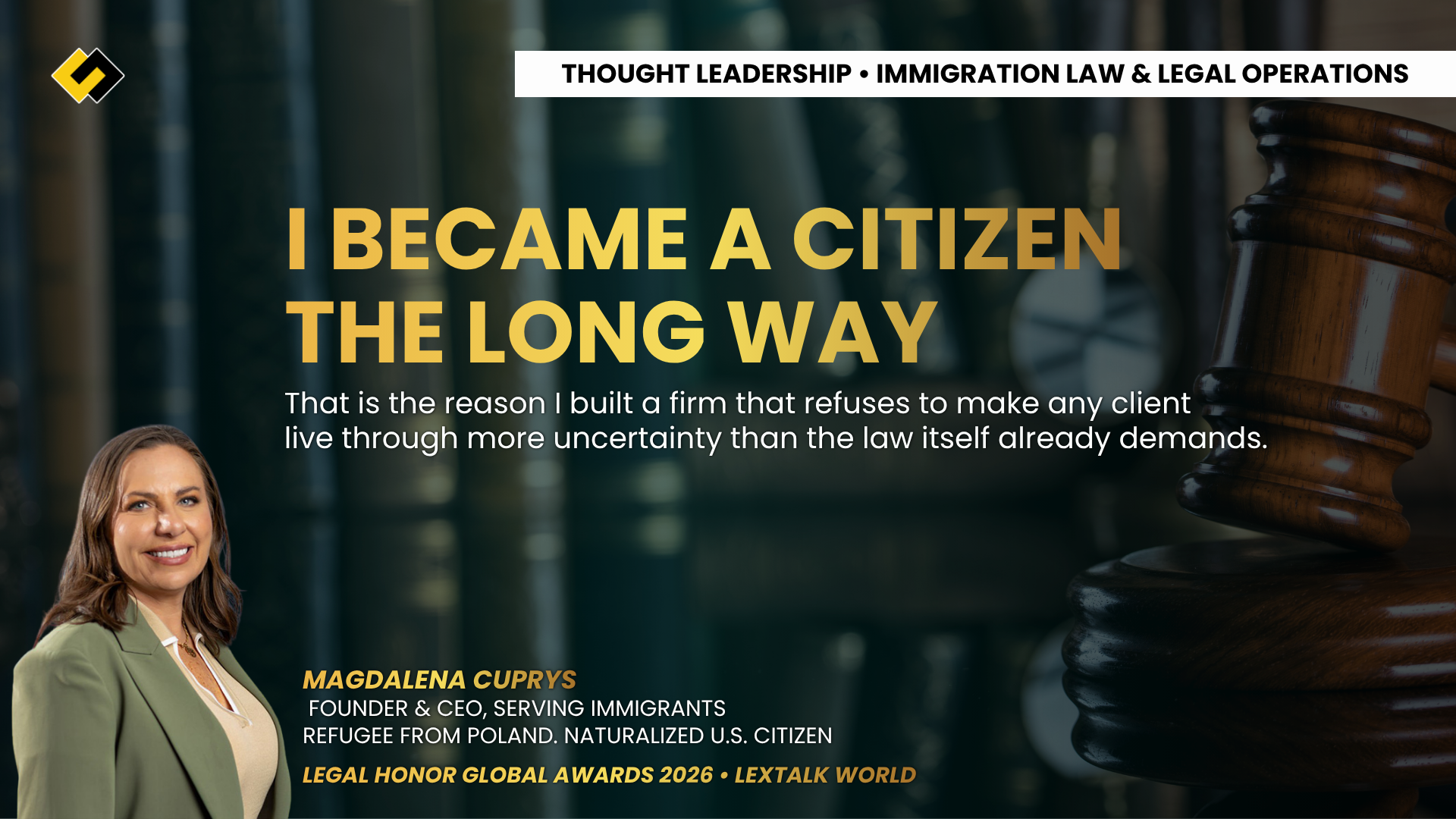
THOUGHT LEADERSHIP — IMMIGRATION LAW AND LEGAL OPERATIONS
By Magdalena Cuprys, CEO, Serving Immigrants (Florida, USA)
I arrived in the United States as a refugee from Poland. I did not choose the timing, the language, or the uncertainty that came with it — those were simply the terms of survival. What I did choose, years later, was to spend my career on the other side of that experience: representing people living through the version of uncertainty I once lived through myself.
That choice became concrete the first time I touched an immigration file as a law student. It was not a case number. It was a family that had already been waiting two years for an answer, and every additional week of delay was a week of a parent unable to work legally, a child unable to enroll in school with full certainty, a life held in suspension. I had lived that suspension. I knew what it felt like to have the course of your life depend on a bureaucratic decision you could not influence or accelerate. And it taught me something no casebook ever could: in immigration law, the cost of inefficiency is not measured in billable hours. It is measured in years of someone’s life.
That lesson has stayed with me through every stage of my career, from intern at the Northwest Immigrants Rights Project to founder and CEO of Serving Immigrants. It is the foundation of everything I have built since, and I believe it is the single most overlooked advantage in our profession: lawyers and leaders who have lived the system they now operate inside make different decisions than those who have only studied it. I did not learn that from a textbook. I learned it from being on the other side of the desk before I ever sat behind one.
Why This Matters Now
Immigration systems across the world are under simultaneous strain. In the United States, processing backlogs, shifting enforcement priorities, and rapid policy changes have made the past year one of the most volatile in recent memory for practitioners. Similar pressures are visible in the UK’s points-based system reforms, the EU’s ongoing migration pact implementation, and asylum backlogs across multiple OECD countries.
What strikes me, talking with peers in London, Toronto, and São Paulo, is how familiar this dynamic feels even outside immigration law specifically. Regulatory fragmentation is the defining condition of legal practice right now. The jurisdictions differ, but the underlying problem is identical: legal teams built for a stable rule set are being asked to operate inside a rule set that changes faster than most firms can update their own internal processes.
I saw this play out concretely earlier this year, when a sudden shift in enforcement posture meant that several of our clients — long-term permanent residents who had spent years building stable lives — needed updated guidance within days, not weeks. The legal analysis itself was not the hard part; experienced immigration attorneys can read a policy change quickly. The hard part was making sure that every paralegal, intake coordinator, and attorney across our offices understood the new guidance the same way, on the same day, before a single client got a wrong answer from the wrong person. That is not a legal problem. It is an operational one, and it is the kind of problem that decides, in real time, whether a firm protects its clients or quietly fails them.
The Discipline of Responsibility and Efficiency
Responsibility and efficiency are not in tension; they are the same discipline viewed from two angles. Early in my career, I watched how powerful it was when a legal team was simply organized: cases moved faster, clients felt supported, and outcomes improved. The opposite is also true. When a firm treats delay as an acceptable byproduct of complexity, it is making a choice about whose time matters less. Leaders do not always recognize that as a choice. It is one. I recognize it instantly, because I remember exactly what it felt like to be on the receiving end of someone else’s delay — not as a professional inconvenience, but as months of uncertainty about where my life was going.
What Outcome-First Design Changes
Most legal services are built backward: a firm defines its internal process, then fits the client into it. We design the other way. Before anything else, we ask what the client ultimately needs, what legal path provides the strongest route to that outcome, and what timeline and documentation strategy supports it. Only then do we build the workflow. This is a small reordering with large consequences, because it forces every team member to understand how their specific task connects to the client’s final result. People who can see that connection work with more focus and take more ownership than people executing a step they cannot place in context.
This approach did not come from a business school framework. It came from knowing, firsthand, what it means to be the person waiting on the other end of a process you do not control and cannot fully understand. That experience shapes how I train attorneys, how I design intake systems, and how I measure whether we are actually doing our job.
Trust and Accountability, Engineered Together
When I moved from hands-on case work into the CEO role, the hardest adjustment was not strategic, it was psychological. Lawyers are trained to solve problems themselves. Leadership requires building an environment where other talented professionals can solve problems without you. That only works if structure and trust arrive at the same time. Structure without trust produces compliance without judgment. Trust without structure produces inconsistency dressed up as autonomy. The organizations that scale well in legal services refuse to pick one over the other.
Working across English, Spanish, and Polish — and with teams that serve clients in all three languages and more — taught me early that consistency of process is not the enemy of cultural sensitivity. It is the precondition for it. You cannot serve a detained immigrant client with the care their situation demands if the internal system handling their case is held together by one person’s memory and goodwill. The care has to be built into the structure, not dependent on it.
The Real Deciding Factor
Operational discipline, not legal talent alone, will decide which immigration and mission-driven legal organizations survive the next decade of regulatory volatility. Legal expertise is the entry price. It is necessary, but every serious competitor has it. What is rarer is the ability to adapt quickly when the rules change, which depends on internal systems: continuous training, clear communication channels, and processes built to flex rather than break when conditions shift.
I say this as someone who came up through the legal side first, not the operations side, so it is not a comfortable conclusion for me either. A brilliant attorney inside a disorganized system still produces inconsistent outcomes, because the system, not the individual, determines whether the right information reaches the right person at the right time.
This is also where empathy earns its place in the conversation, not as a soft addition to legal strategy but as a structural requirement of it. Clients arrive at our door during some of the most stressful moments of their lives, often facing decisions that will reshape where they live, work, and raise their families. I do not need to imagine what that feels like. They do not need more complexity explained to them. They need a structured path forward and the honesty to understand the risks on that path. Clarity is how empathy gets operationalized at scale.
A Concrete Step
If there is one change a reader could make this quarter, it is this: pick the single case type or matter type your firm handles most often, and map every handoff point where institutional knowledge currently lives in one person’s head rather than in a documented process. In most firms I have seen, that map reveals three to five single points of failure that nobody had named out loud. Naming them is the easy part. Building the redundancy around them is the actual work — but it is work that pays for itself the first time a key team member is unreachable during a deadline.
The Question I Close With
Here is the question I ask leaders in this field, and the one I would ask any reader running a legal organization, immigration-focused or not: if your most experienced person left tomorrow, would your clients notice a drop in quality, or only a change in voice?
If the honest answer is quality, you do not have a firm. You have a collection of talented individuals who happen to share an address. Building the systems and accountability that make the answer “only a change in voice” is not the glamorous part of legal leadership. It rarely gets discussed at conferences. But it is the part that determines whether an organization can keep its promises to the people trusting it with their futures, long after any one person’s tenure ends — whether that firm is in Miami, London, or São Paulo.
I became a citizen of this country the long way, through every form, every delay, every year of uncertainty that the system put in front of me. That is not a detail I mention for sympathy. It is the reason I built a firm that refuses to make any client live through more uncertainty than the law itself already demands.
About the author:
Magdalena Cuprys is the founder and CEO of Serving Immigrants, an immigration law firm with offices across Florida and Puerto Rico. A refugee from Poland who became a naturalized U.S. citizen, her career spans frontline immigrant advocacy, complex humanitarian visa practice, and executive leadership. She holds degrees from the University of Chicago and the University of Washington School of Law, is licensed in Florida and California, and is an active member of the American Immigration Lawyers Association (AILA). A fluent speaker of English, Spanish, Polish, Russian, and Italian, she is a recipient of the Legal Honor Global Awards 2026.