
 Dr. Javier Amuchástegui
Adjunct Professor of Labor Law, School of Law, Universidad Católica de Córdoba | Legal Director at Serving Immigrants (Florida, USA)
Dr. Javier Amuchástegui
Adjunct Professor of Labor Law, School of Law, Universidad Católica de Córdoba | Legal Director at Serving Immigrants (Florida, USA) 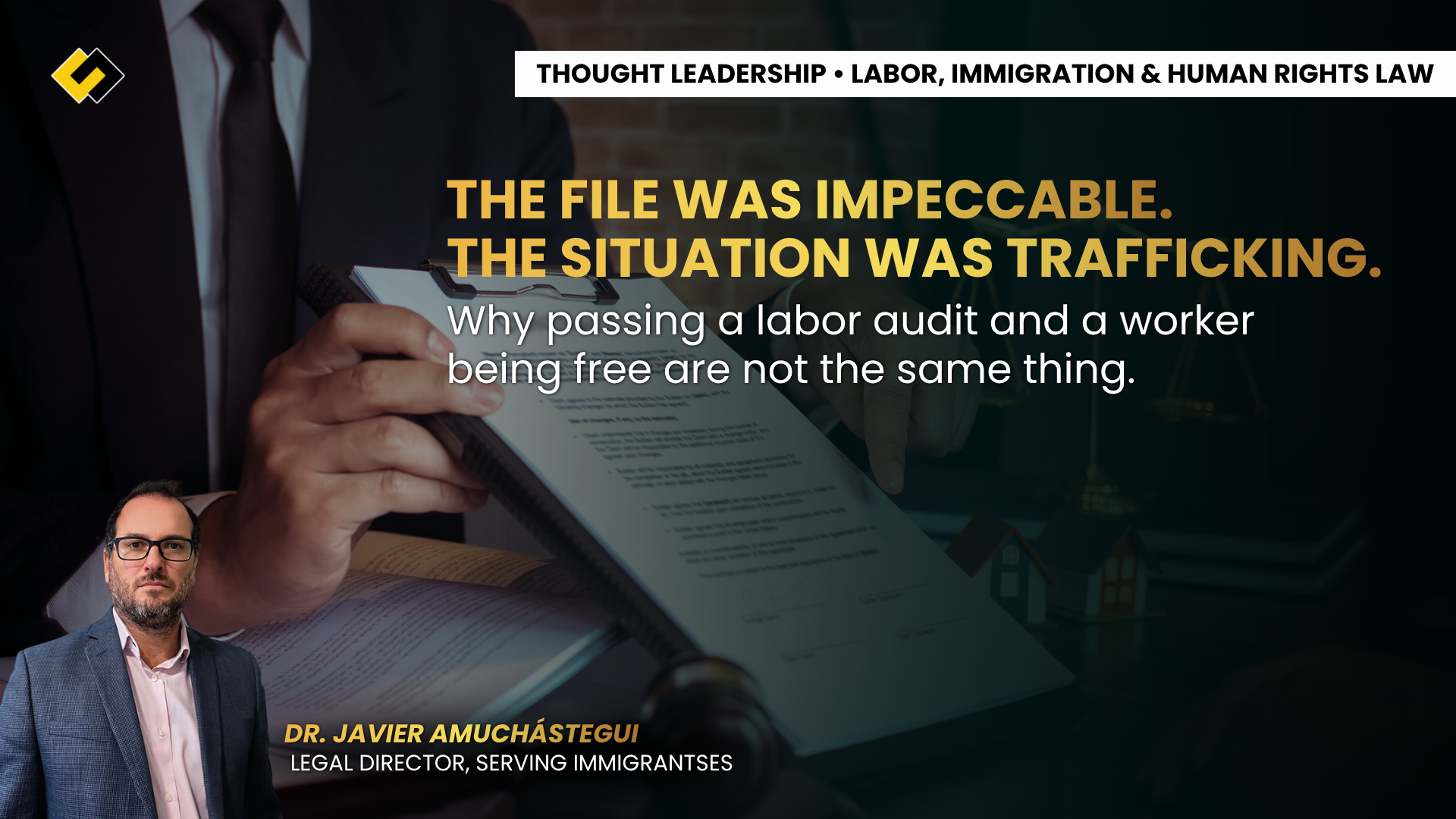
THOUGHT LEADERSHIP — LABOR, IMMIGRATION, AND HUMAN RIGHTS LAW
By Dr. Javier Amuchástegui, Adjunct Professor of Labor Law, School of Law, Universidad Católica de Córdoba | Legal Director, Serving Immigrants (Florida, USA)
In 2012, while serving on the Social Outreach Project team at the Universidad Católica de Córdoba on Prevention of Human Trafficking and Victim Assistance, I visited a horticultural establishment on the outskirts of the city alongside labor inspectors. The farm had everything in order: signed contracts, attendance records, pay stubs. The owner received us with coffee and a tidy folder. The workers, however, lived in makeshift structures on the premises, their identity documents were in the foreman’s possession, and none of them knew with any certainty how much money they were owed or whether they would ever collect it.
The file was impeccable. The situation was trafficking.
That experience, combined with more than twenty years of labor litigation in Argentina and three years as Legal Director at an immigration law firm in the U.S., convinced me of something that audit systems have yet to fully reckon with: the gap between formal compliance and a worker’s actual freedom is not a flaw in the system. It is a feature that the system, if not carefully designed, tends to produce.
The Problem Is Not the Absence of Rules
Argentina’s legal framework has advanced considerably. Law 26,364, enacted in 2008 and strengthened by Law 26,842 in 2012, defines forced labor, debt bondage, and labor trafficking with precision, and incorporated Articles 145 bis and ter into the Criminal Code to criminalize those conducts. A 2025 administrative directive from the Ministry of Human Capital formalized the Acta de Constatación de Indicios de Explotación Laboral, an inspection tool now used by labor inspectors across the country. The regulatory architecture exists and has matured.
And yet the cases keep surfacing. In horticulture, in harvesting, in textiles. Not at the margins of the productive system, but inside it.
The reason is simple to state and difficult to solve: an audit verifies that a system of paperwork exists. It does not verify that the people those documents describe are free.
What the File Cannot See
After years of litigation in Argentina, I learned that the first useful question is rarely a legal one. It is factual: what is actually happening inside that establishment? Contracts may be registered and wages deposited into a bank account the worker cannot access because the employer holds the card. Pay stubs may be signed by people who stopped working there months ago.
The structural problem is that oversight systems are designed to verify the existence of documentation, not to test the substance of the employment relationship. And exploitation learned long ago how to produce documentation.
This gets worse when subcontracting is involved. Article 12 of Law 26,727 makes the principal company jointly and severally liable for working conditions throughout the agricultural supply chain. But in practice, the ultimate beneficiary is separated from the worker by one or two layers of intermediation; precisely where the abuse occurs. The principal’s file is clean. The contractor who recruits, transports, houses, and controls the workers rarely appears on anyone’s compliance radar.
A figure I heard from inspectors during the PEPS project has stayed with me: the cost of properly registering a worker for an entire harvest season can be minimal. The fine for not doing so, if it ever arrives, is manageable. The incentive not to register is economic, systematic, and perfectly rational from the intermediary’s perspective — who has the least reason to correct it, while the worker, who has every reason, has the least power to do so.
What Changes When You Cross the Border
Three years ago, my practice expanded in a way I had not anticipated: I began working as Legal Director at Serving Immigrants, an immigration law firm with offices in Florida. And there I encountered the same problem from the other side.
Workers who arrive in the U.S. immigration system (many of them coming from agricultural, textile, or service supply chains in their home countries) bring stories that immigration law calls trafficking and Argentine law calls trata con fines de explotación laboral. It is the same phenomenon with a different name, seen from the other shore.
The T visa, created by the Trafficking Victims Protection Act of 2000, offers immigration protection to victims of severe trafficking in the United States. In theory, it is a powerful tool. In practice, the hardest barrier is not legal: it is evidentiary and psychological. A worker who spent months under the control of an abusive employer, who lost their documents, who does not speak English, and who fears deportation if they speak up (because the exploiter convinced them of exactly that) does not arrive at the protection system in any condition to articulate their case.
What my work at Serving Immigrants has taught me is that the compliance gap does not end at the factory or the field. It extends to the moment that worker tries to access justice, and the distance they must travel from fear to institutional trust is, in many cases, longer than any judicial proceeding.
What Oversight Systems Keep Getting Wrong
From that dual vantage point, I identify three patterns that repeat with troubling consistency.
The first: the document is measured, not the relationship. A signed contract certifies that a formal tie existed at one point in time. It does not certify that the worker can walk off the job today, collect what they are owed, or recover their documents. Audits verify form; exploitation lives in substance.
The second: joint liability exists on paper but not in the practice of oversight. Companies that benefit from subcontracted labor are legally responsible for the conditions under which that labor works; yet their compliance programs rarely reach beyond the first direct supplier. The contractor, where nearly all the abuse occurs, falls outside everyone’s audit radar.
The third: criminal exposure for economic beneficiaries is real and expanding. Articles 145 bis and ter of the Criminal Code, along with Article 148 bis incorporated by Law 26,847, are increasingly used by prosecutors not only against the on-site contractor but against those who benefited economically further up the chain. The subcontracting shield is more porous than most boards realize.
The Question No Audit Asks
The practical solution does not require a larger oversight system. It requires a different question.
Instead of “does this worker have a registered contract?”, the question that actually surfaces risk is this: can this worker leave this establishment today, without losing their documents, their housing, or their right to be paid for days already worked?
That question, asked directly to workers and without the contractor as intermediary, reveals more than any compliance folder. It tests control, not form. And it is precisely the question a prosecutor, a labor inspector, or a federal agent will eventually ask if the case reaches that stage.
One concrete step any legal counsel can implement: require that contracts with labor intermediaries include a direct, confidential interview channel for subcontracted workers (without the contractor present). If the compliance program cannot guarantee that channel, it cannot guarantee that those workers are free to complain. And if it cannot guarantee that, it cannot guarantee that they are free at all.
What Comes Next
Regulatory systems across Latin America, Europe, and the United States are converging on the same conclusion: the duty of due diligence in labor matters is migrating from the contractor’s payroll to the ultimate beneficiary’s balance sheet. Companies that wait for a new rule to force action will build their compliance infrastructure under the pressure of an investigation, not the comfort of strategic planning.
We have seen this with anti-corruption: for years it was an ethical argument, until it was no longer one. Labor exploitation due diligence is on the same trajectory.
The question I close with is the same one I learned to ask myself in that field outside Córdoba, Argentina, in 2012, and that I keep asking today in Florida, U.S.: if someone with authority asked the workers in your supply chain tomorrow whether they are free to leave… Are you sure you know what they would say?
About the author:
Dr. Javier Amuchástegui is an attorney with more than twenty years of practice in Argentina, focusing on labor law and civil litigation in Argentina. He is an Adjunct Professor of Labor Law at the School of Law of the Universidad Católica de Córdoba, where he also served on the Social Outreach Project team on Prevention of Human Trafficking and Victim Assistance (PEPS, 2011–2013). Since 2022, he serves as Legal Director at Serving Immigrants, an immigration law firm with offices in Florida.