
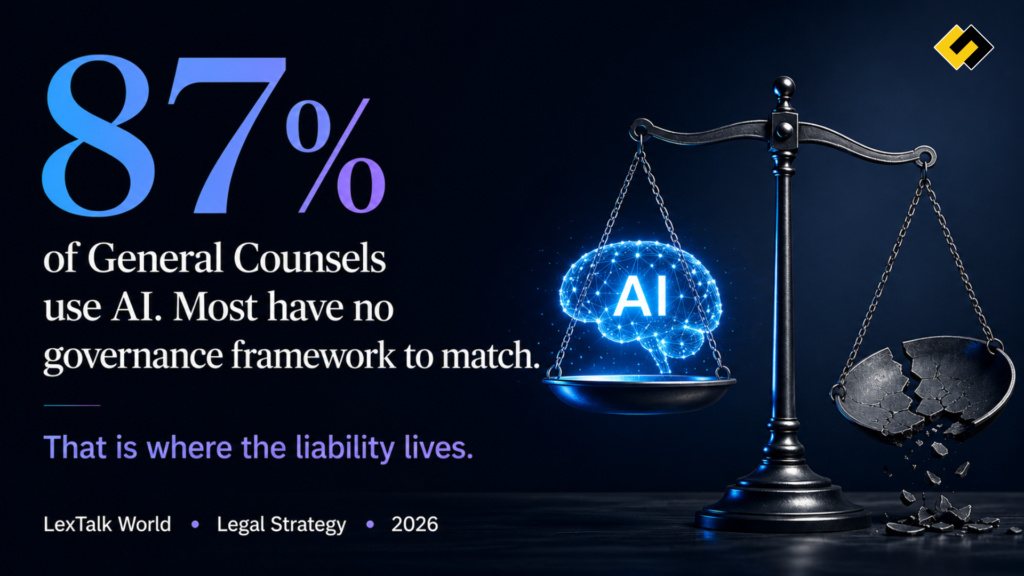
LEXTALK WORLD • LEGAL STRATEGY • 2026
AI adoption inside corporate legal departments has hit record levels in 2026. The liability that comes with it is growing just as fast. Here is what every senior lawyer needs to understand right now.
What is AI governance for General Counsel?
AI governance for General Counsel is the set of policies, oversight mechanisms, and accountability structures a legal department puts in place to manage the risks that come with using artificial intelligence in legal work. It covers how AI tools are selected, how their outputs are verified, how liability is assigned when AI produces errors, and how the department demonstrates compliance with AI-specific regulations to boards, regulators, and courts.
Eighty-seven percent of General Counsels are now using AI tools in their workflows, according to a mid-2026 report by FTI Consulting and Relativity. That figure jumped from 44% a year ago and just 20% in 2024. The adoption curve is steep, and it shows no sign of flattening.
What is flattening is the assumption that adoption is the hard part.
The harder part is what comes after adoption. AI tools are now embedded in legal research, contract review, due diligence, compliance monitoring, and board preparation. They interact with sensitive data, generate outputs lawyers rely on, and in many cases influence decisions with material consequences. And in most legal departments, those tools operate without a governance framework designed to manage what happens when they are wrong.
In 2026, that gap has a price. Over 700 court cases worldwide now involve AI hallucinations. Sanctions against lawyers who relied on AI-generated content without adequate verification range from formal warnings to five-figure monetary penalties. The ABA established in 2024 through Formal Opinion 512 that lawyers have a duty to maintain a reasonable understanding of AI’s capabilities and limitations. That obligation now sits squarely on the General Counsel’s desk.
Why Is AI Governance the Defining Legal Risk of 2026?
The speed of AI adoption inside organisations has outpaced the governance infrastructure that should accompany it. A June 2026 analysis found that nearly 90% of General Counsels still feel resource constraints limit their strategic impact, even with AI-driven productivity gains. The most commonly cited issue is not efficiency. It is governance.
The risk is not hypothetical. Stanford researchers found error rates of 17% for Lexis+ AI and 34% for Westlaw AI-Assisted Research, which are legal-specific tools from established vendors. General-purpose models performed worse. When an AI tool hallucinates a case citation, a statute, or a contractual obligation, and a lawyer relies on that output without verification, the professional responsibility lies with the lawyer, not the vendor. Courts have confirmed this position across dozens of sanctions decisions.
At the same time, the regulatory environment is tightening on multiple fronts simultaneously. The EU AI Act requires documented risk assessments, human oversight, audit trails, and intervention capabilities for high-risk AI systems, with full implementation for those systems from August 2026. The Colorado Artificial Intelligence Act, which took effect in June 2026, mandates annual AI impact assessments for certain high-risk uses. California’s AI requirements include meaningful human oversight, bias testing, and multi-year record retention. More than 1,000 state-level AI bills were introduced in 2025.
Gartner projects that 80% of organisations will need to formalise AI policies addressing ethical, brand, and personal data risks by 2026. Most legal departments are not yet among that 80%.
What Does a Governance Framework for AI in Legal Actually Look Like?
Governance frameworks for AI in legal work are not the same as general AI policies, and they are not the same as existing data protection programmes. They are narrower and more specific, because the professional obligations of lawyers add a layer that does not apply to most other functions.
A functional AI governance framework for a legal department has six components.
1. AI Tool Selection With Legal Oversight
The selection of AI tools for legal work cannot be delegated entirely to IT or legal ops. When courts sanction lawyers for AI errors, they hold counsel responsible regardless of which department chose the tool. General Counsel need to be actively involved in evaluating whether a given tool’s design, training, and governance mechanisms support defensible legal workflows. The central question has shifted from whether a tool increases efficiency to whether it can withstand scrutiny if challenged.
2. Verified Output Protocols
Every jurisdiction that has addressed AI use in legal practice has affirmed the same principle: AI output is a draft, not a deliverable. Dozens of federal and state judges have issued standing orders requiring AI disclosure and verification. A verified output protocol defines, in writing, what review is required before AI-generated content is relied on, cited, or submitted. It assigns responsibility for that review to a named individual and records that the review occurred.
3. Data Input Governance
When lawyers or their teams input information into AI systems, they may inadvertently introduce confidentiality breaches, privilege waiver risks, or data protection violations. Employees often lack clarity about what information can safely be entered into which tools. A data input governance policy defines which categories of information can be entered into which tools, under what conditions, and with what client disclosure, if any is required.
4. Regulatory Tracking and Compliance Mapping
The AI regulatory landscape across US states, the EU, and key international markets is changing faster than most organisations can track manually. A governance framework includes a system, maintained internally or supported by outside counsel, that monitors evolving requirements and maps them to existing AI deployments. This is not a one-time exercise. It is an ongoing function.
5. Board Accountability and Reporting
According to the Director Confidence Index published by Diligent Institute in March 2026, directors increasingly look to their General Counsel for guidance on how to govern emerging technology without slowing the organisation down. Only 22% of boards have AI governance as a standing agenda item, despite 84% of directors believing boards should play a more active role in technology oversight. Placing AI governance on the board risk committee agenda, framed as regulatory exposure, litigation risk, and operational risk, is a practical first step that turns a technical concern into a board-level accountability.
6. Incident Response for AI Errors
No AI governance framework is complete without a defined response procedure for when AI tools produce significant errors. Who is notified? What review is triggered? What disclosure obligations arise? These questions are much easier to answer before an error occurs than in the hours after one is discovered.
What Are the Specific Liability Risks GCs Need to Prepare For?
The liability landscape for AI use in legal work has three distinct categories, and each requires a different response.
The first is professional liability from AI-generated errors. When a lawyer submits a brief citing a hallucinated case, fails to include a clause because an AI missed it, or misadvises a client based on AI research, the professional responsibility framework treats it as a legal error. The fact that AI generated the error is not a defence. Malpractice and sanctions risk are both live.
The second is organisational liability from AI-driven decisions. When AI systems are used for decisions that materially affect consumers, employees, or counterparties, those decisions may trigger liability under AI-specific statutes, consumer protection law, employment law, or data protection frameworks. The Colorado and California AI laws are the first domestic examples of statutes that explicitly attach liability to AI-assisted decision-making processes.
The third is regulatory enforcement. The EU AI Act creates enforcement exposure for organisations deploying high-risk AI systems without the required documentation and oversight structures, regardless of whether any harm has occurred. SEC examination priorities for 2026 list AI alongside cybersecurity as a top concern, signalling that regulatory inquiry into AI governance is coming.
How Should General Counsel Lead the AI Governance Conversation at Board Level?
Legal sits at the intersection of contracts, regulation, litigation, and board oversight. That position is not a burden in the AI governance conversation. It is an advantage. General Counsel are already the people boards turn to for framing regulatory, compliance, and litigation exposure. AI governance belongs in those conversations, not as a technical update, but as a fiduciary risk issue.
The organisations with active board engagement on AI governance show measurably stronger performance in AI impact assessments, human oversight controls, and incident containment. Board attention drives resource allocation. Resource allocation drives implementation. Implementation determines whether governance exists on paper or in practice.
The practical first step is placing AI governance on the board risk committee agenda in familiar language: regulatory exposure from the EU AI Act and state laws, litigation risk from AI hallucinations and AI-assisted decisions, and operational risk from the gap between AI deployment and governance infrastructure. That framing is one a board can act on.
What Comes Next for AI Governance in Legal
The transition happening in 2026 is from experimentation to infrastructure. AI tools are moving from interesting pilots to operational systems that legal departments depend on for daily work. The governance infrastructure that should accompany that transition has not kept pace.
For General Counsels, the window to get ahead of this is closing. The EU AI Act’s full implementation schedule, the wave of state-level AI regulation, and the growing body of court decisions on AI liability are all converging in the second half of 2026. Organisations that have built AI governance frameworks before enforcement begins are in a fundamentally different position from those that are still building them when the first regulatory inquiry arrives.
The legal industry is gathering in New York this July to work through exactly these questions, from practical governance frameworks to cross-border regulatory strategy to the question of how AI changes the structure and economics of legal work itself.
The central question for in-house legal leaders has shifted from ‘Can this tool increase efficiency?’ to ‘Can this tool withstand scrutiny if challenged?’ General Counsels who answer that question before a regulator or court asks it are the ones who will be ahead.
LexTalk World New York 2026
AI, Enterprise Risk & The Future of Legal Business
July 23 & 24, 2026 • NYC Bar Association, 42 W 44th Street, New York
300+ Delegates • 80+ Speakers • 15+ Countries • CLE Credits Available
Register: lextalk.world/new-york-delegate-registration •
LinkedIn Event: linkedin.com/events/7449427268168335360
About LexTalk World
LexTalk World is a global legal community connecting General Counsels, law firm leaders, in-house practitioners, and LegalTech innovators. Events have been hosted in Houston, San Francisco, Singapore, Dubai, and across India. LexTalk World New York 2026 takes place on July 23 and 24 at the NYC Bar Association.