
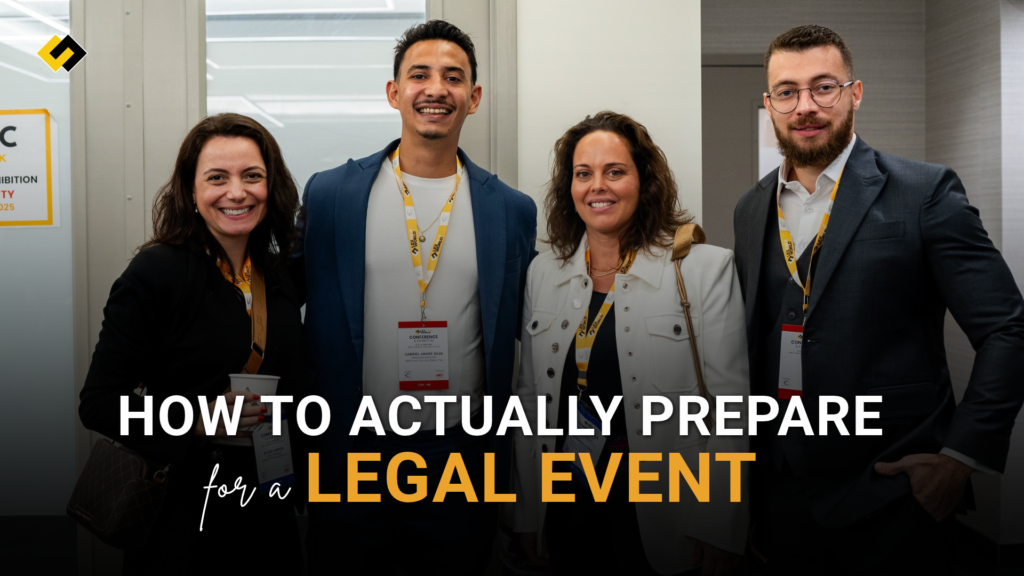
Legal Event Preparation is essential for legal professionals who want to turn conference attendance into meaningful conversations, useful knowledge, and lasting professional relationships.
That gap between attending and actually gaining something isn’t about the event itself. It’s about preparation. General Counsel, law firm partners, compliance leaders, and legal operations professionals who consistently get real value out of legal conferences tend to do a handful of specific things differently, before the event starts, while they’re in the room, and after they’ve left.
This guide walks through all three stages.
Key Takeaways
-
Preparation before a legal event matters more than anything that happens during it. Define a specific objective before you register.
-
The most valuable part of a legal conference is usually the conversation, not the session. Plan for it accordingly.
-
Follow-up within 48 hours converts a contact into a relationship. Waiting longer usually means starting over.
-
CLE credit, invoicing, and approval logistics are easiest to sort out early, not the week before.
Before the Event: Set a Specific Objective
What should I do before attending a legal conference?
Start by defining exactly what you want out of it. “Networking” and “staying current” are too vague to act on. A useful objective is specific: meet two General Counsel dealing with the same AI governance question your team is facing, or find one litigation finance provider to evaluate for an upcoming matter, or come back with a working framework for a specific compliance gap.
Once the objective is clear, three things follow naturally:
Research the agenda and speakers in advance. Most legal conferences publish session topics and speaker bios ahead of time. Identify which sessions actually connect to your objective, and which speakers or fellow attendees you’d genuinely want a conversation with. Reaching out briefly before the event, even a short message saying you’re looking forward to a session they’re leading, makes an in-person conversation far easier to start.
Prepare a few sharp talking points about your own work. Senior legal professionals are far more likely to have a useful exchange with someone who can describe a specific challenge or approach in two sentences than with someone who says “we’re dealing with a lot right now.” Have that ready.
Handle logistics early, especially approval and paperwork. If someone else needs to approve the trip, or your organization needs an invoice rather than a personal card payment, sort that out weeks in advance, not days. The same applies to CLE credit tracking, many jurisdictions require specific documentation, and it’s much easier to request in advance than to reconstruct afterward.
During the Event: Prioritize Conversations Over Sessions
How do I get the most out of legal industry networking?
Treat the sessions as the framework and the conversations as the actual content. This is the single biggest mindset shift between attendees who leave with real value and those who leave with a stack of unread notes.
A few practical habits make a measurable difference:
-
Ask specific questions in roundtables and Q&A sessions, not general ones. “How does your team handle privilege review when using AI tools” gets a far more useful answer than “what do you think about AI in legal.”
-
Take structured notes, not just contact information. A business card with no context is nearly useless two weeks later. Write down what the person actually said that was useful, not just their title.
-
Pace yourself across a multi-day event. The temptation is to attend every session and every networking moment. The better strategy is usually to skip a session you’re lukewarm on in favor of a longer conversation with someone whose work is directly relevant to your objective.
-
Follow up same day if possible. A short message the evening of a good conversation, referencing something specific that was discussed, lands very differently than a generic LinkedIn connection request sent a month later.
After the Event: Convert Contact Into Value
What’s the best way to follow up after a legal event?
Follow up within 48 hours. This is the single highest-leverage habit in this entire guide, and it’s the one most consistently skipped. Contacts made at a conference cool quickly. A specific, personal follow-up sent within two days of meeting someone converts far more often into an actual working relationship than one sent even a week later.
Beyond the follow-up itself, three things turn a good event into lasting value:
Convert your notes into action items, not just a summary. If a session or a conversation surfaced a specific idea, framework, or contact worth pursuing, put a concrete next step on your calendar before the details fade.
Share what you learned internally. Most of the value of sending someone to a legal conference is lost if it stays in that one person’s head. A short internal summary, three to five real takeaways, shared with the relevant team, multiplies the return on the time and cost of attending.
Track and file CLE credit properly, and confirm any invoicing or reimbursement paperwork is closed out while it’s still fresh, rather than becoming an administrative task that lingers for months.
Applying This to a Real Event: LexTalk World San Francisco 2026
To make this concrete, it helps to walk through how this framework applies to an actual upcoming legal event. LexTalk World San Francisco 2026, taking place November 19 and 20 at the South San Francisco Conference Center, is a useful example, both because of its format and because the preparation questions above map directly onto it.
Before: The conference brings together General Counsel, Chief Legal Officers, law firm partners, compliance and risk leaders, and legal operations professionals around a defined set of themes, AI governance and enterprise risk, cross-border compliance, IP and enterprise transformation, and board governance and accountability. Reviewing which of those tracks connects most directly to a current challenge, before the event, is exactly the kind of objective-setting this guide recommends. On the logistics side, invoices and team passes are available for those who need internal approval sorted out ahead of time, and California CLE credit is included with a delegate pass, worth confirming and documenting early rather than after the fact.
During: The event is deliberately structured around executive roundtables rather than one-way presentations, small enough that every attendee is genuinely part of the discussion rather than one face in a large audience. That structure rewards exactly the specific-question habit described above. Breakfast and a networking lunch are built into both days, and a cocktail reception closes each day out, the informal moments this guide points to as often being where the most useful conversations actually happen.
After: Delegates leave with two days of concentrated conversation with peers from organizations including Google, Microsoft, Oracle, Intel, Nokia, and Prudential, among others, exactly the kind of material worth converting into internal action items and a shared summary for a legal team back home.
LexTalk World also backs attendance with a straightforward risk-reversal commitment: attend with confidence, and if you do not find value after attending both days, get a full refund, full eligibility terms are available on the registration page.
If AI governance, cross-border compliance, enterprise risk, or the changing role of the legal function are on your list of things to get ahead of, San Francisco this November is one concrete place to do that work.
LexTalk World San Francisco | November 19 and 20, 2026
Explore the San Francisco Conference
Frequently Asked Questions
How far in advance should I prepare for a legal conference? Start at least three to four weeks out for logistics, approvals, and CLE paperwork, and one to two weeks out for reviewing the agenda and identifying specific people or sessions to prioritize. Waiting until the week of the event usually means missing the preparation that actually drives value, defining an objective and lining up conversations in advance.
What should I bring to a legal industry conference? Beyond the basics, business cards, a notebook or note-taking app, and any materials relevant to sessions you’re leading or speaking at, the most useful thing to bring is a short, specific description of the challenge or project you’re currently working on. It makes every conversation more useful, for you and for the person you’re speaking with.
How do I justify the cost of a legal conference to my organization? Frame it around the specific objective, not general professional development. “Two days evaluating how peer legal departments are handling AI governance before we finalize our own policy” is a far easier internal case to make than “networking and staying current.” Many events, including LexTalk World San Francisco, also offer invoicing and team passes that simplify internal approval.
Do legal conferences typically offer CLE credit? Many do, though the amount and jurisdiction coverage varies by event. Confirm CLE availability and any documentation requirements before the event, not after, since some jurisdictions require attendance verification that’s easier to arrange in advance.
What’s the biggest mistake legal professionals make at industry events? Treating the sessions as the main event and networking as an afterthought. The research and practical experience behind most professional conference guidance points the other way: the sessions provide context and credibility, but the conversations are where most of the concrete value, referrals, ideas, and relationships, actually gets created.
This guide reflects general best practices for professional conference attendance along with publicly available details about LexTalk World San Francisco 2026 as of the publication date below. Conference details are subject to change; confirm current information on the official registration page before making travel or budget decisions.