
Why did you get into the patent and IP business?
I know why I did – to help startups and small companies partner with large companies on a more equal footing, and to help large companies sort through their many ideas to find the one that will make all the difference to their business.
But somewhere along the way, it all shrank and became very small. I found myself spending more time drowning in forms, making certain drawings and text formats were compliant, dealing with the USPTO’s latest but not so great initiatives (remember the proposed limit on continuations and claims?), and otherwise doing everything except what I became a patent practitioner to do.
Everything except support my clients to actually use their patents to further their business goals.
And if you’re in-house, you have one incredibly important client. Same problems, but super-charged given how intimate your work is.
I mainly worked with universities, startups and smaller companies, all of whom were on strict budgets. So I did as much as I could under these constraints.
Enter AI. Both reviled and revered, the greatest invention since electricity or killer robots that will get rid of us all, AI is really just a tool.
A tool that will finally enable all of us to support all clients to use their patents to make business happen. No matter their budget or size.
And get those patents off the shelf and onto the playing field, support our clients’ companies as they navigate our wild new commercial world.
Nobody needs you faster
Too much of the news about AI is that it will make us all faster, more productive in our current roles. When in fact what AI will do is completely change our roles, our companies and our world.
When we focus on speed, we’re in a race to the bottom – because speed alone just leads to customers wanting discounts since it takes less time to draft an application. If you are in-house, the same pressure arrives as a headcount reduction instead of a price discount.
But when we shift our focus to the role of patents in value creation for our clients and in helping our clients to grow their businesses, the conversation becomes about how much value our patent work will provide to our clients. That value can only be unlocked if we as patent practitioners change how we operate.
Instead of just focusing on protection, we need to instead focus on connection – connecting to our clients’ commercial needs and goals. Connecting to them as business leaders, as people with their own hopes and dreams for their companies. And connecting to them as service providers who can give them new tools to work with commercial partners, whether in a joint venture or as a new supplier.
Connection is an ongoing conversation. It needs to start before we file – who specifically would want this, and what would it be worth to them? And every year a patent sits unused, who should have it instead?
The questions aren’t radically new. But our ability to dive into them deeply is. That is what AI changes. It gives us time to finally make connecting our job.
Here’s what it looks like throughout the patent lifecycle.
Connections throughout the patent lifecycle
Let’s look at a fictitious example – Acme Innovations. Bright-eyed and bushy-tailed, Acme is a newly hatched startup, with one idea and enough money just for one country. In the old way of working, Acme would file and then hope something would turn up. Maybe an investor or acquirer would see the value. But it was always passive.
In our new AI world, you and Acme can analyze multiple potential industries to find the best market first. Patent and commercial development become intertwined. Together, you can help them find that blue ocean where they can really make a difference, without having to develop a whole new market.
That’s what I built Jack AI for – our AI platform that helps early stage innovators find the best industries and markets for their ideas. But Jack AI does more – it also helps you and your client find the best companies with commercial problems that your client’s idea would solve. Then it locates the right person at that company, who is passionate about these commercial problems and technology that can solve them. And our Network Wizard helps you get a warm introduction to that company champion.
Now you and Acme can have a quick conversation with someone who really knows that industry, and who can help you validate Acme’s market before you start drafting. So that Acme makes the right commercial decisions, and you get the right information that you need to construct the best possible patent.
And it won’t just benefit startups. Let’s consider another (fictitious) example, BigCo. BigCo has tons of granted patents. In the old world, they’d never have enough time or funds to really do a deep dive on all of these patents, to see their value as a portfolio, not just as individual patents.
In our new AI world, you and BigCo can do that deep dive together, by using AI agent and model orchestration. You bring the AI agents together in a symphony of analysis, giving you all of the answers to make truly informed decisions. About value, yes, but also about which patents need a new home, and who should have them. And you do it with a group of models that you control. You start with open weights models running on your own private cloud, cheap and data secure, so that you can run sensitive company data through them. Then the conclusions can be further analyzed with powerful models from the frontier labs – after another local AI model scrubs any sensitive data.
And how does your AI system know what’s sensitive? Through data governance frameworks which include all of your company’s rules, plus context engines that understand your company’s nuances – all of which are run by more of those local AI models that sit on your own cloud.
We offer a complete solution to these problems – House Steward which combines data governance, a context engine that learns your company’s nuances, and model orchestration, so that you can analyze sensitive documents internally and save money, while still taking advantage of the most powerful frontier models available today when necessary.
All of that powerful AI can really help clear your backlog. But don’t book that long vacation yet.
Why AI needs you
“Human-in-the-loop” is a cliché and an outdated one at that. You are the conductor of a vast orchestra of AI capabilities. Some parts of your orchestra are well behaved and barely need attention from you to do their job. Others keep getting out of tune, racing ahead or running behind – but often give you the best answers. As the conductor, your job is to keep the music flowing, on time, in tune and at the beat.
All of the tools that I described won’t work without your active input at multiple points in the job lifecycle. First, you need to set up all of the rules and policies that enable the AI to operate within company regulations. Second, you need to locate all of your company’s previous written material and other information, so that AI can gather the nuances of your company’s culture and operations. And then you need to stay on top of your AI orchestra’s function.
Low-risk steps can run automatically. The output of medium-risk steps should be reviewed. And high-risk steps – anything to do with sensitive data or money – need a specific named approval from you acting alone, or with a group of others at your company. Confidential data should always stay on a model you control, with a stronger model called only when needed; that routing is what keeps the cost within budget while also keeping all of the secret stuff actually secret.
Moving forward
So, why did you get into the patent business? Whatever your answer, it wasn’t the forms. Next week, pick your first boring task to hand over to AI, and decide which client conversation gets the hours it gives back.
There is a third example I haven’t told you about: how use AI to close deals that would have cost more to negotiate than you would clear. That one takes an AI agent working under rules you write, with House Steward making sure it knows what your house will and won’t agree to. It’s the most surprising thing I’ll show, so I’m saving it for the stage.
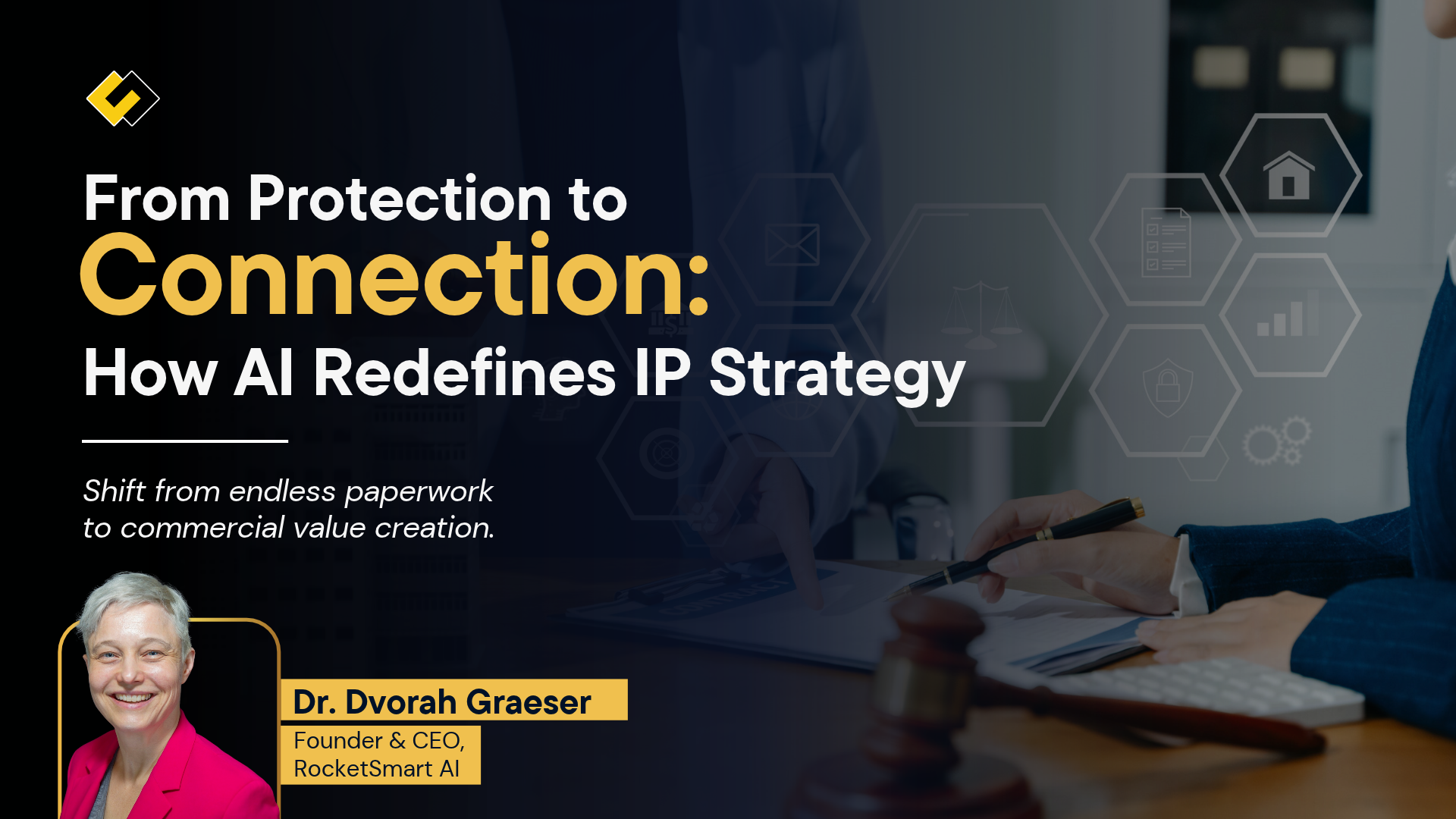
On November 19, I’m speaking on the IP track at LexTalk World in San Francisco: From Protection to Connection: Turning Your Practice Inside Out with AI. Stop by our booth to see Jack AI and House Steward live, and to try the licensing agent yourself. If you’re heading to San Francisco, let’s connect.
About the Author:
Dvorah Graeser | Founder & CEO, RocketSmart.io
Dr. D’vorah Graeser is founder and CEO of RocketSmart.io, an AI platform that helps universities and early stage innovators find the right people at the right corporate partners. A US Patent Agent for more than 30 years, she has been training AI models and hunting down their best use cases since 2015. RocketSmart’s consultancy arm helps clients choose the tools, models, and policies that fit them. As a ForHumanity Fellow, she works to bring stakeholder analysis and engagement into AI design, helping both AI builders and AI buyers create more responsible and inclusive systems. She teaches courses and workshops on AI for commercialization at universities internationally. She also wrote The AI Process Playbook for Business.