
 Taisa Loureiro
In-House Lawyer at Fator Seguradora S/A
Taisa Loureiro
In-House Lawyer at Fator Seguradora S/A 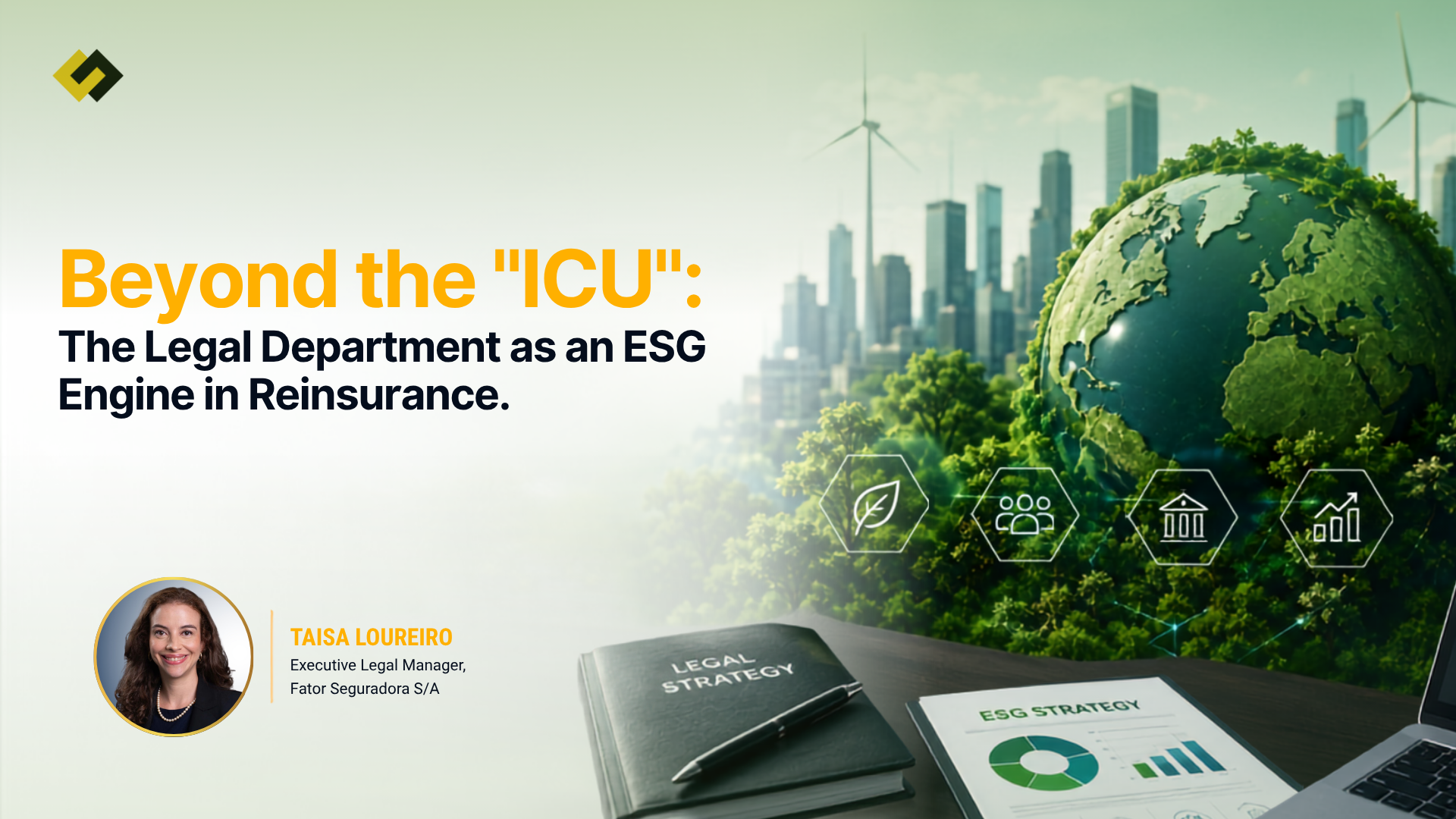
Legal Department and ESG in Brazil: The Strategic Role of Legal Teams
The legal department and ESG in Brazil are becoming increasingly important as the insurance and reinsurance market places greater emphasis on sustainability, governance, and long-term risk management.
The rise of the ESG (Environmental, Social and Governance) agenda has been redefining the way the entire insurance and reinsurance market operates in Brazil, demanding a posture that transcends the mere pursuit of selling insurance products in favor of sustainable longevity. In this scenario of transformation, the legal department has been moving away both from the image of an “intensive care unit”, called upon only when a problem has already materialized, and from the position of a mere validator of processes and contracts, to become a central agent in the strategic architecture of (re)insurers. The connection between Law and sustainability is not merely formal; it is intrinsic, since the Governance pillar constitutes the backbone upon which environmental and social practices are built and overseen. In my role as executive legal manager at a Brazilian insurance company, the clear perception of this transformation is what distinguishes reactive management from a performance that effectively adds value to the company’s business.
Worldwide, the insurance sector operates under the logic of long-term risk management, tied to mutualism — its fundamental pillar — making it naturally aligned with sustainability principles. Working in the legal department of an insurer requires a solid understanding of the company’s business and how its various areas operate, as well as deep technical knowledge of how the different types of insurance work. In this context, the in-house legal department acts as a kind of guardian of corporate trust, striving to ensure that risk analysis and underwriting occur within applicable legal and regulatory parameters, always aiming at the sustainability of the insurer’s operations and, ultimately, of the (re)insurance market.
For this performance to be truly transformative and valuable, the composition of the legal team is a determining factor. In my view, there is a rather outdated notion that legal departments should be composed of generalist lawyers or litigation specialists (under the argument that those who handle litigation can handle anything else, being, for example, able to work in advisory roles). However, this view has been losing ground in the face of the growing demand for multidisciplinary teams. In building a high-performance team, I have been prioritizing diversity of backgrounds and specialties, bringing together professionals who understand not only the Brazilian legal system but also risk management, sustainability metrics, and who demonstrate the continuous development of soft skills, such as: clear communication, active listening to understand internal demands, the ability to mediate between areas, and collaboration skills.[1] This plurality of perspectives allows the legal department to provide technical guidance more assertively, aiming at conducting business safely and in a balanced manner. It is worth noting that intellectual diversity within a legal department is an ESG practice, enabling richer discussions both within the department and with other areas of the company.
The relevance of this structure is heightened by the Brazilian regulatory environment. In Brazil, the insurance market is supervised by the Superintendence of Private Insurance (SUSEP), a regulatory body that has been proactive in implementing sustainability guidelines. In particular, Circular SUSEP No. 666/2022 establishes clear frameworks for the integration of ESG risks into the management of (re)insurers. In this context, the legal department, together with the risk and compliance team, assumes the role of guiding interpreter and implementer of the regulation in question, ensuring that the company’s board makes well-informed decisions focused on regulatory compliance or, where appropriate, on the conscious assumption of certain risks. The
[1] I have already discussed this in an interview published on the Revista Roncarati website: https://legismap.com.br/conteudos/colunistas/rodrigo-filgueiras/entrevista-com-taisa-loureiro-gerente-executiva-juridica-na-fator-seguradora
legal team’s technical and regulatory knowledge adds significant value by enabling the insurer to navigate well-informed and safely through a sea of regulatory requirements.
As can be seen, the legal department has already positioned itself as a decision-support hub for the company’s senior executives. It has thus been moving away from being a backoffice area and has begun to act as a true strategic advisor, providing the necessary substrate for strategic decision-making. The active participation of the legal department in the daily life of the board of directors ensures that the vision of risks and opportunities is present at every step of the insurer. When the legal department is heard as a voice of strategic leadership, corporate governance is strengthened against legal and reputational challenges.
Historically, many legal departments were called upon only as an “intensive care unit,” summoned to remedy problems or litigation that had already arisen. The current dynamic, however, demands that the legal team actively act as a partner to the business areas from the very first discussions and negotiations. For instance, Brazil has a new legal framework for the insurance market, Law No. 15,040/2024, which required, among other things, the adaptation of insurance policy wordings to the new rules in force. By working on the update of insurance products, in partnership with the Product, Underwriting, and Claims teams, our legal department contributed by presenting to the board a structured action plan for product adaptation, as well as identifying what needed to be changed in each product and wording that could raise questions in cases of litigated claim denials, among other issues.
In the field of litigation, the legal department’s performance has also been strategically impacted. The discussion and development of defense theories, whether in the judicial or administrative sphere, in conjunction with outsourced law firms, has been incorporating elements of sustainability and the social function of contracts. Currently, it is not merely about winning a lawsuit, but about building jurisprudence favorable to the Brazilian (re)insurance market, based on theories that reflect both the technical reality of the (re)insurance market and the importance of preserving mutualism for the very longevity of the market. The in-house legal department that deeply understands the company’s business is better equipped to present outside counsel with arguments that connect legislation, market-specific regulation, and the insurer’s operational reality. This, in turn, contributes to the development of more assertive, technical, and well-founded defense theories and strategies. This sophistication in legal disputes is essential to maintain the economic and financial balance of contracts.
As outlined above, the legal department has been consolidating itself as a major driver of the ESG agenda within Brazilian (re)insurers. By combining governance rules with legal expertise and an “eagle eye” for potential risks and social and/or environmental impacts to the company, the legal team ceases to be a containment and mere support department and becomes a true engine for business and innovation, always guided by ethics and legal certainty. At Fator Seguradora S.A., where I serve as executive legal manager, we understand that by acting as an ESG agent, we must always integrate these principles into every analysis, contract, legal theory, legal opinion, and strategic decision. Legal leadership in the ESG journey is no longer optional. It is necessary for the challenges of a market that increasingly demands security, responsibility, and a strategic vision for the future.
About the Author
Taisa Loureiro, In-House Lawyer at Fator Seguradora S/A
Taisa Afonso Loureiro serves as the Executive Legal Leader at Fator Seguradora, in São Paulo, Brazil, with deep experience in insurance law, governance, compliance, ESG, and data privacy. She works across Legal, Compliance, and Data Protection teams, supporting business decisions, structuring insurance products, and managing regulatory risks and strategic lawsuits. She holds a Master’s degree in Business Law from Fundação Getulio Vargas Law School in São Paulo, with a focus on Law and Technology, and is the author of a published thesis on the future profile of lawyers facing technological adoption in major Brazilian law firms.