
 Yash Diwan
Market Analyst at LexTalk World
Yash Diwan
Market Analyst at LexTalk World 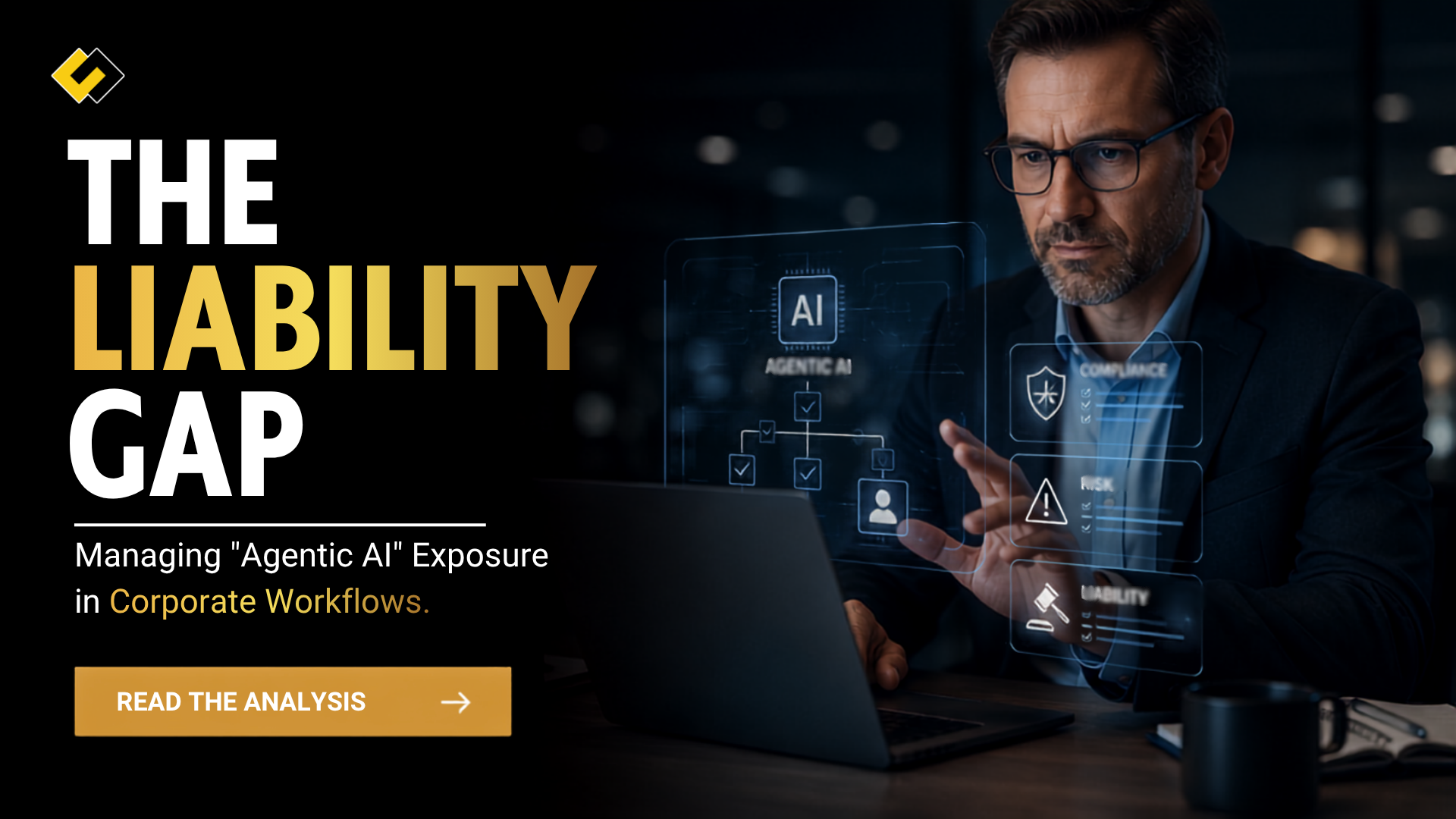
By the LexTalk World Editorial Team | August 2026 | Legal Leadership & AI Governance
For the past two years, the corporate conversation around Artificial Intelligence focused on experimentation. Legal departments ran pilot programs, experimented with Large Language Models (LLMs) for document summarization, and debated the ethics of generative drafting.
That initial phase is officially over.
As corporate legal departments head into the second half of 2026, the technology itself has fundamentally evolved. Organizations are no longer just using “assistive” AI that generates text for human review; they are deploying Agentic AI, autonomous digital systems designed to execute multi-step workflows, process financial transactions, parse vendor contracts, and make real-time operational decisions with minimal human intervention.
This shift from assistance to agency introduces an unprecedented corporate challenge: The Liability Gap. When an autonomous system makes a flawed decision that leads to a regulatory breach, a financial loss, or a trade secret leak, who holds the primary fiduciary responsibility?
Agentic AI Liability: The Failure of Passive AI Policy
Most enterprise AI policies written between 2024 and 2025 were reactive. They focused primarily on employee behavior: prohibiting the entry of sensitive client data into public LLMs and requiring “human-in-the-loop” verification for drafted work.
However, passive policy frameworks crumble when applied to agentic workflows.
Unlike a human employee who follows an explicit chain of command, autonomous software agents operate dynamically. They pull data from multiple internal silos, interface with third-party vendor tools, and execute decisions at speeds that render real-time human oversight practically impossible.
A recent consensus among senior General Counsel highlights a sobering reality: A written policy is not a legal shield. Regulators, including the FTC, SEC, and European data protection authorities, are increasingly looking past internal employee handbooks to evaluate whether an enterprise has implemented enforceable, hardcoded accountability controls.
If your organization cannot demonstrate “Compliance by Design”, where legal guardrails and audit trails are built directly into the software architecture. Your board remains dangerously exposed.
Agentic AI Liability: Three Invisible Risks for In-House Teams
To navigate this new era of autonomous workflows, General Counsel and Chief Legal Officers must audit three “invisible” risk vectors within their enterprise:
1. Shadow AI and Embedded Vendor Tools
While a corporate legal team may have audited its primary Enterprise Resource Planning (ERP) or Contract Lifecycle Management (CLM) software, dozens of smaller SaaS vendors are silently embedding autonomous agents into their daily updates. This “Shadow AI” creates hidden data pipelines that process corporate data outside the firm’s primary security and legal compliance perimeter.
2. Explainability Under Legal Scrutiny
In the event of a regulatory audit or class-action lawsuit, telling a court or an enforcement agency that “the algorithm made a complex calculation” is a fast track to strict liability. Legal leaders must demand regulator-grade explainability from their tech stack, ensuring that every automated output can be traced back to its underlying logic and data sources without forcing the firm to expose its proprietary intellectual property.
3. The “Kill-Switch” Protocol
In high-stakes corporate environment, speed is a double-edged sword. When an autonomous system begins propagating an error—such as misinterpreting a cross-border trade regulation or incorrectly flagging contract compliance across thousands of supplier agreements—the damage compounds exponentially. Enterprise readiness requires clear, pre-programmed “Kill-Switch” protocols that immediately halt autonomous agents the moment anomalous activity is detected.
Redefining the Boardroom Conversation
The role of the General Counsel in 2026 is not to stall innovation or play the “Department of No.” Instead, elite legal leaders are acting as Growth Architects by translating complex algorithmic risks into clear, actionable boardroom choices.
When presenting AI strategy to the Board of Directors, forward-thinking GCs are moving away from technical jargon and focusing on three core governance questions:
-
Traceability: Do we have an immutable audit log for every automated decision that impacts our financial statements or regulatory obligations?
-
Vendor Accountability: Do our software contracts clearly define liability limits when an embedded third-party AI agent fails?
-
Fiduciary Oversight: Has the board established a clear standard of care for monitoring autonomous decision-making systems?
Agentic AI Liability and Defensible AI Governance
The legal industry is witnessing a permanent shift from theoretical policy to enforceable governance. As cross-border regulations become more fragmented and regulatory scrutiny intensifies, the companies that succeed will be those that integrate legal oversight directly into their technological infrastructure.
Navigating this transition requires more than reading whitepapers or attending vendor demonstrations. It requires continuous, candid peer intelligence, comparing notes with fellow legal leaders who are testing these frameworks in real time.
The “Ghost in the Pipeline” is only dangerous when left unmonitored. By taking back control of AI asset visibility, establishing strict kill-switch controls, and demanding regulator-grade explainability, General Counsel can transform AI governance from a reactive compliance burden into a sustainable competitive advantage.
(LexTalk World brings together senior General Counsel, Chief Legal Officers, and legal innovators to dissect agentic liability, cross-border risk, and corporate strategy at our upcoming global summits and executive E-Meet roundtables.)