
 Karen Buralde
Legal Counsel at Trustly Brazil Software Ltda
Karen Buralde
Legal Counsel at Trustly Brazil Software Ltda 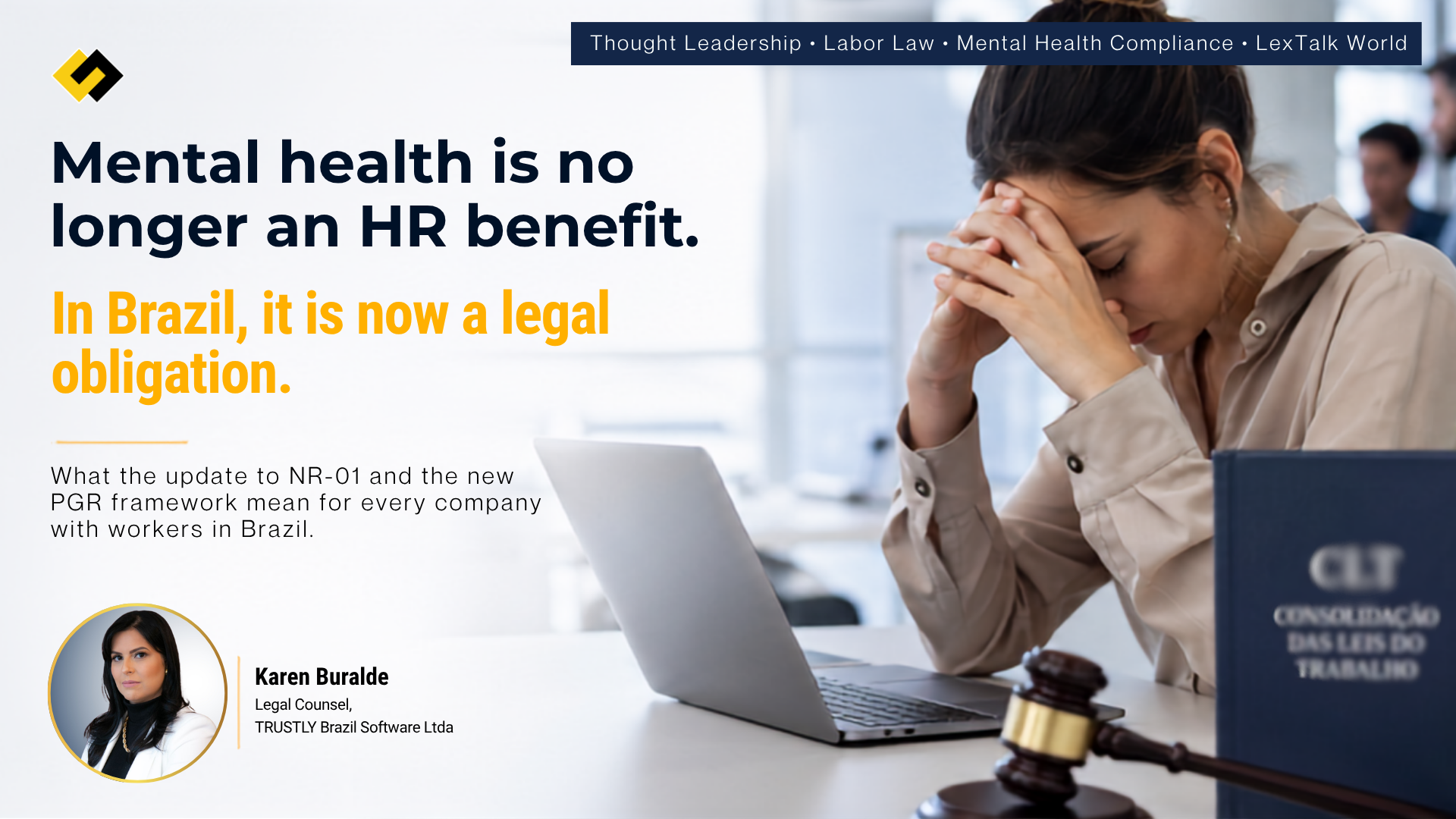
Brazil has a comprehensive regulatory framework for protecting the health and safety of its workforce. These rules are created and updated by the Ministry of Labor and Employment to prevent occupational accidents and illnesses. Known as Regulatory Standards (Normas Regulamentadoras – NRs), compliance is mandatory for any company employing workers under formal employment contracts (carteira assinada).
To use a game analogy, the NRs serve as the game’s rulebook, where the core objective is to protect workers’ health and safety. There are currently 38 active NRs covering a wide range of topics, such as safety standards for working at heights (NR-35), health services guidelines (NR-32), sanitary and comfort conditions in workplaces (NR-24), and protocols for handling explosives (NR-19), among others.
Recently, a highly significant shift occurred within this regulatory architecture. NR-01, which establishes the foundation for the entire occupational health and safety system in Brazil, outlines the general provisions, scope of application, definitions common to all NRs, and the guidelines and requirements for occupational risk management and preventive measures.
The Scope of Occupational Risk Management (GRO)
Recognizing the growing importance and complexity of mental well-being in workers’ daily lives, the updated NR-01 now explicitly integrates psychosocial risk factors into the scope of Occupational Risk Management (Gerenciamento de Riscos Ocupacionais – GRO). The GRO establishes a systematic framework for hazard identification, risk assessment, and control. It must be seamlessly integrated with other medical initiatives (such as the Occupational Health Medical Control Program – NR-07), accident analysis, and emergency preparedness. The primary objective of the GRO is the prevention and mitigation of workplace risks, and NR-01 mandates its implementation across all of an organization’s business establishments.
The core workflows of the GRO must be formalized into an Occupational Risk Management Program (Programa de Gerenciamento de Riscos – PGR), which is defined as:
“A coordinated set of actions by the organization designed to achieve occupational risk prevention and management objectives, formally documented.” — Subitem 1.5.3.1.1 of NR-01
Under these regulations, implementing a PGR is mandatory for each business location and must cover all activities performed there. At a minimum, it must include an occupational risk inventory, an action plan, and the criteria used for risk assessment within the GRO/PGR framework. To ensure full compliance with NR-01, organizations must also document additional supporting records, including:
-
Workplace accident and illness analysis reports (subitem 1.5.5.5.2);
-
Implementation logs for preventive measures (subitem 1.5.5.3.1);
-
Planned monitoring records for the performance of preventive measures (subitem 1.5.5.3.2);
-
Evidence of simulated emergency response drills (subitem 1.5.6.3.1);
-
Training and capacity-building records as prescribed by the NRs.
The operational flow of this documentation can be simplified into a continuous cycle: Identify risks – Assess – Control – Monitor.
The Transition from PPRA to PGR: Integrating Ergonomics and Psychosocial Factors
The most substantial update lies in the scope of the risk assessment. The former PPRA (the program replaced by the PGR) was strictly limited to environmental hazards (physical, chemical, and biological risks). However, under the updated NR-01, the PGR must also encompass risks stemming from ergonomic factors, which explicitly include work-related psychosocial risk factors.
This regulatory shift is milestone-heavy because it legally recognizes the central role of mental health in overall worker well-being. This alignment is further reinforced by NR-17, which embeds psychosocial risk factors directly into ergonomic management—the central focus of that standard. To achieve NR-17’s objective of adapting working conditions to the psychophysiological characteristics of workers, the standard mandates two complementary methodologies:
-
Preliminary Ergonomic Evaluation (Avaliação Ergonômica Preliminar – AEP): which is mandatory;
-
Ergonomic Workplace Analysis (Análise Ergonômica do Trabalho – AET): required only under specific operational circumstances.
Through the AEP, risk assessments for ergonomic and psychosocial hazards can be conducted using qualitative and participatory approaches, integrating them directly into the PGR’s baseline hazard identification process. This implementation must always be multidisciplinary and multi-professional. Crucially, workers must have a voice in this process. To facilitate open dialogue, companies must cultivate an environment of psychological safety and conduct surveys anonymously, ensuring employees do not feel intimidated by fears of exposure or reprisal.
The Organizational Roots of Psychosocial Risks
It is vital to emphasize that the root source of psychosocial risks does not reside within the individual worker, but rather within the organization of work itself. This includes deficiencies in task design, personnel management, and organizational workflows. Left unmanaged, these systemic issues trigger severe psychological, physical, and social health consequences, including workplace stress, burnout, Work-Related Musculoskeletal Disorders (WMSDs/DORT), and depression.
Consequently, identifying psychosocial risks requires evaluating work organization—meaning how tasks and activities are structured, distributed, and coordinated within the environment. When evaluating these factors, organizations must analyze which elements of the work activity act as stressors with the potential to cause injury or health deterioration. The focus is not on diagnosing individual symptoms or capturing subjective “moods,” but on auditing objective working conditions, identifying operational stressors, and evaluating environmental and systemic flaws.
Once psychosocial risks are identified, companies must assess and classify them. The risk level is calculated by combining the severity of potential injuries or health impairments with the probability of occurrence, as outlined in subitem 1.5.4.4.2 of NR-01. With the diagnosis complete, the necessary preventive measures must be integrated directly into the PGR Action Plan.
The Current Landscape: Compliance, Sustainability, and the Future of Governance
The urgency of this landscape—which was already alarming in 2021 when World Health Organization (WHO) data indicated that 359 million people globally suffered from anxiety disorders—has consolidated over the past five years as one of the defining corporate governance challenges of our time. In 2026, with the maturation of hybrid working models and accelerated technological transformation, it has become undeniable that mental well-being can no longer be treated as a purely individual responsibility or an auxiliary corporate benefit. It is, fundamentally, an outcome of organizational design.
Therefore, the inclusion of psychosocial risks within the PGR and NR-17 represents far more than a bureaucratic milestone; it is a definitive turning point for corporate compliance and ESG sustainability. By shifting the regulatory focus away from employee symptoms and toward workflow architecture, Brazilian labor law demands a proactive, multidisciplinary stance. Protecting the minds of the workforce today is synonymous with mitigating legal liabilities and safeguarding long-term business viability in a market that no longer tolerates toxic or depleting work environments.
About the Author:
Karen Buralde, Legal Counsel at Trustly Brazil Software Ltda
Karen Buralde is a Senior Legal Counsel with over 12 years of experience specializing in corporate labor law. She is recognized for providing strategic legal advice, managing complex litigation, and supporting senior leadership in multinational organizations. Karen has extensive expertise in legal operations, leveraging Legal AI tools and advanced case management systems to improve efficiency and governance. She also leads internal investigations, whistleblowing programs, union negotiations, and LGPD compliance initiatives within HR and labor contexts. Passionate about innovation and digital transformation, Karen combines legal strategy with technology to strengthen corporate governance, mitigate risk, and deliver practical, business-focused legal solutions.