
 Elizabeth Ceballos
Head of Financial Institutions at Bankaool, S.A.
Elizabeth Ceballos
Head of Financial Institutions at Bankaool, S.A. 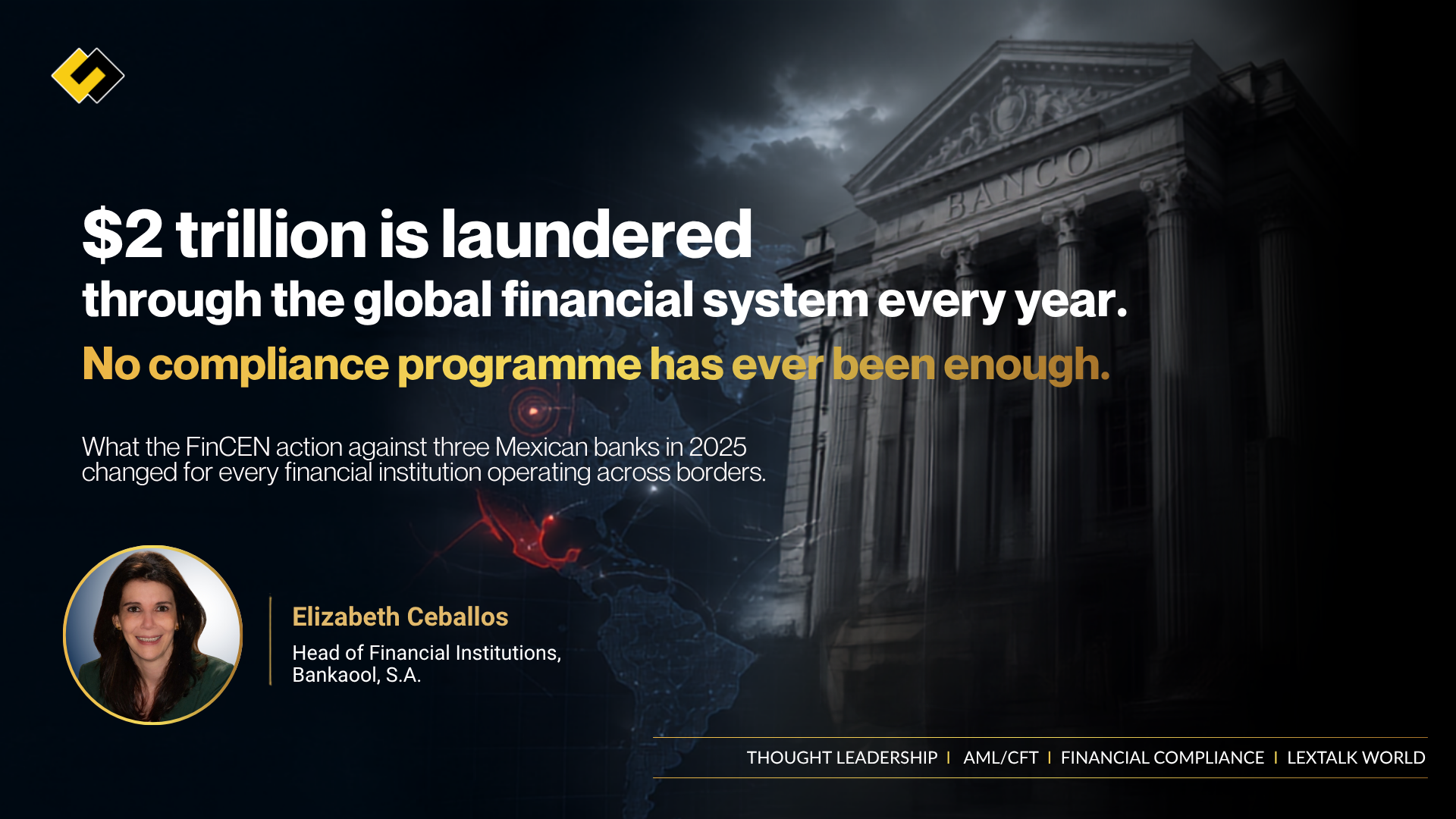
The financial services sector has suffered major disruptive changes in the past years, with the increasingly complex regulatory and compliance landscape, the accelerated advancement of technology, the constant evolution of cyber threats and each time more sophisticated money laundering schemes intended to deceive banking institutions. Billions of dollars from drug trafficking and illegal activities attempt to be laundered and recycled back to the economy through financial institutions, despite rigorous AML/CFT bank controls in place.
According to the United Nations Office on Drugs and Crime, the estimated amount of money laundered globally in one year represents 2 – 5% of global GDP, or $800 billion – $2 trillion in current US dollars. However, these figures may be underestimated due to the difficulties of detecting misuses of the financial system.
In this regard, US has issued several bills, directives and orders aimed at deterring drug-related financial crimes. Amongst them: i) The Fentanyl Sanctions Act (S.1044), enacted on December 20, 2019, decreeing the imposition of sanctions with respect to foreign traffickers of illicit opioids, ii) the Fentanyl Eradication and Narcotics Deterrence Off Fentanyl Act ( S.1271) enacted during President’s Biden administration, as part of a national security set of laws, iii) the Halt All Lethal Trafficking of Fentanyl Act (H.R. 27), passed during the current administration of President Trump, classifies fentanyl-related substances as Schedule I under the Control Substances Act, and iv) the Executive Order 14157 (E.O. 14157) enacted by President Trump, redefining international drug cartels as Foreign Terrorist Organizations (FTOs).
Within this context, on June 25, 2025, the U.S. Treasury’s Financial Crimes Enforcement Network (FinCEN) took an unprecedent action preventing U.S. covered financial institutions from engaging in fund transfers related to 3 mid-size Mexican financial institutions, cutting them off from the US financial system and thus, globally. These institutions posed serious money-laundering concerns. The effects were devastating for the 3 sanctioned entities; they were forced to enter liquidation or acquisition processes. Mexican authorities were able to contain a systemic risk while maintaining market stability.
The Department of the Treasury has the authority to take actions related to financial institutions, transactions, or types of accounts that (1) involve a non-U.S. jurisdiction, and (2) are of primary money laundering concern in connection with illicit opioid trafficking or terrorism.
Mexico’s banking industry has now learned that no compliance controls are ever enough. Preserving global financial integrity requires the undertaking of collective efforts by government agencies and other stakeholders, sharing experiences and best practices, join collaboration with industry peers, homologation of rules and standards and combat via evolving legislation and other preventive measures.
After the FinCEN order, most Mexican banks have reinforced their AML/CFT controls in alignment with US and Europe regulations. Bankaool’s incursion in the FX market surged after the FinCEN order, so the entity has always been aligned to such regulations and keeps close collaboration with both regulators and industry peers.
About the Author:
Elizabeth Ceballos, Head of Financial Institutions at Bankaool
Elizabeth Ceballos is a seasoned lawyer admitted to practice in 1987, with extensive experience in banking, energy, and public law. She currently serves as Head of Correspondent Banking at Bankaool, where she manages domestic and cross-border banking relationships, with deep expertise in KYC processes and international regulatory compliance. Previously, as Oil & Gas Global Leader at EY, she advised clients on complex regulatory and contractual matters related to Mexico’s Energy Reform and major energy projects. Her experience also includes public-private partnerships, investment projects, and contract negotiations, making her a trusted advisor in highly regulated and cross-border business environments.