
 Adriana Garcia Guzman, J.D.
Founder at Vellum Legal Tech
Adriana Garcia Guzman, J.D.
Founder at Vellum Legal Tech 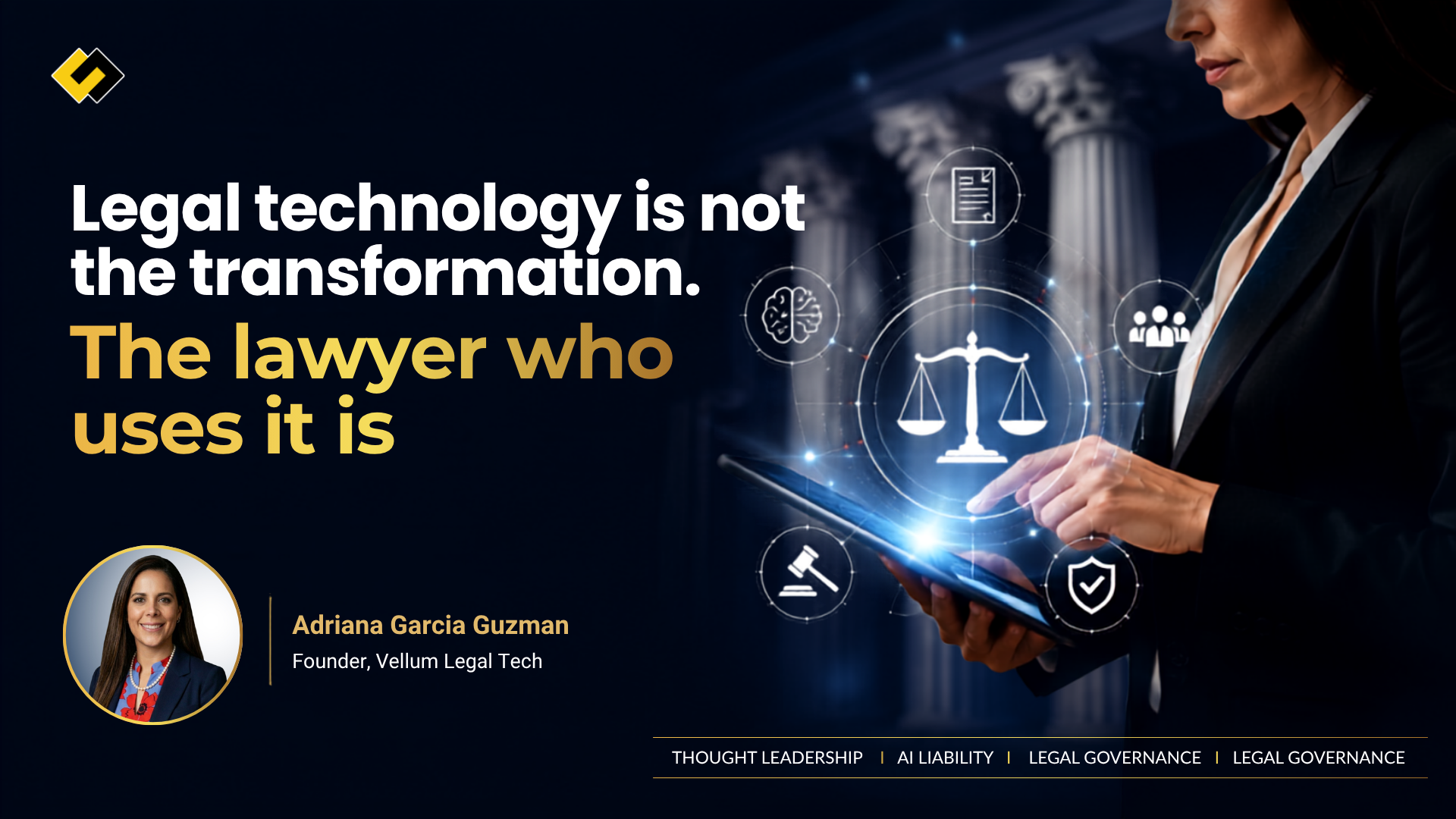
The Conversation That Started Everything
There is a conversation I have had more times than I can count. A business owner, a founder, an operations lead, someone running a real company with real employees and real clients, sits across from me and says some version of the same thing: “I know we probably should be doing more on compliance. We just don’t really know where to start.”
That sentence carries more than uncertainty. It carries the weight of a system that was never designed to explain itself to the people who need it most.
After years working inside Big Tech, where legal and compliance teams have the budgets, the headcount, and the institutional muscle to stay on top of regulatory change, I kept noticing something that troubled me. The companies getting into trouble were not the ones trying to evade the rules. They were the ones who genuinely did not understand them. Not because they were careless. Because no one had ever translated the rules into language they could act on.
That observation became a thesis: compliance failures stem from confusion, not dishonesty. And that thesis changed everything about how I think this problem should be solved.
The Gap Between Documentation and Protection
The traditional approach to compliance is built on documentation. Write the policy. Train the staff. File the record. Repeat annually. This approach was designed to produce what I would call regulatory defensibility, the ability to demonstrate, when an auditor or regulator comes knocking, that the right paperwork exists. And it works, in the sense that it produces paperwork.
What it does not always produce is genuine protection. The gap between having documentation and understanding what that documentation requires of your people, in real situations, in real time, is where most compliance failures live. A policy that no one has read, written in legal language for a legal audience, sitting in a shared drive no one visits, is not a compliance program. It is a file.
This distinction matters enormously for small and medium-sized businesses, which make up most of the productive economy across Latin America and everywhere else. These are companies that cannot staff a legal department. They cannot retain outside counsel for every regulatory question. They are running their businesses, and compliance sits somewhere on the to-do list between urgent and important, perpetually deferred until it becomes a crisis.
Why Templates Are Not the Answer
The standard response to this problem has been to offer simplified templates, generic checklists, or scaled-down versions of enterprise compliance programs designed for organizations ten times their size. None of these solve the problem, because the problem is not a lack of documents. The problem is a lack of clarity.
What a business owner needs is to understand what applies to them, specifically, and why. Not a survey of everything the law could theoretically require, but a clear answer to the question: given what my company does, where we operate, and how we are structured, what do I need to have in place? And then, once that question is answered, they need the actual documents. Not templates. Documents written for their business, their contracts, their risk profile, their industry.
Where Technology Changes the Equation
This is where technology changes the equation. Not because it replaces judgment, but because it distributes it. The analytical work that used to require a senior compliance attorney, the kind of thinking that synthesizes regulatory requirements across jurisdictions, identifies gaps in existing documentation, and builds a program around the specific needs of a specific organization, can now be done at a fraction of the cost and in a fraction of the time. Human judgment is still there. It is embedded in the design of the tools, in the questions the system asks, in the logic that connects a company’s answers to the outputs it receives. What changes is who can access it.
This is not the same as saying AI replaces lawyers. It does not, and it should not. Compliance at its core is judgment discipline. AI can review thousands of documents, flag anomalies, and surface risks faster than any human team. What it cannot do is read the room. It cannot weigh the context that turns a policy breach into a genuine mistake versus deliberate misconduct. It cannot understand why a particular employee made a particular decision under a particular kind of pressure. The most effective compliance programs are the ones that use technology to ask better questions and free up human capacity to focus on the conversations that matter.
Compliance as a Growth Foundation
What I have seen, both in Big Tech and in the conversations, I have had with SMB founders since, is that the companies that get compliance right are the ones that treat it as infrastructure, not as insurance. They do not build compliance programs to survive an audit. They build them because a clear, well-documented set of internal controls is what allows you to move faster, enter new markets with confidence, close deals without stalling in legal review, and build the kind of trust with clients and partners that is genuinely hard to replicate.
A business that can answer the question “how do you handle my data?” without hesitation is not just legally protected. It is commercially advantaged. A company that has its supplier agreements in order does not discover mid-contract that it has accepted liability it never intended to carry. A law firm that has built its quality management program to a defined standard does not scramble when an audit arrives. In each of these cases, the compliance infrastructure is doing something that goes far beyond regulatory compliance. It is enabling growth.
The Regulatory Landscape Is Not Waiting
The environment is also changing in ways that make this infrastructure more urgent. Ethics in AI is no longer a philosophical aspiration. It is becoming codified law. Across the European Union, across Latin America, and in jurisdictions where regulatory conversation is still developing, the obligations around how businesses use AI, how they protect data, and how they document their decision-making are expanding quickly. The organizations that build their compliance foundations now will not have to rebuild them under pressure later.
But none of this happens if the tools are not accessible. None of it happens if the language of compliance remains the exclusive property of a professional class that most business owners cannot afford to consult regularly. The democratization of compliance is not a nice idea. It is a precondition for any of these to work at scale.
A Different Way of Thinking About This
I did not start Vellum Legal Tech because I wanted to automate what lawyers do. I started it because I spent years watching the gap between what the law requires and what most businesses have in place, and I could not unsee it. The tools to close that gap exist. What has been missing is the commitment to design them around the user rather than around the regulatory framework.
Anyone can understand anything when the information is presented correctly. That is a belief I hold about compliance the same way I hold it about everything else. The rules are not too complicated to explain. We have simply not been disciplined enough about the work of explanation.
The future of compliance is not more documentation. It is more clarity. And clarity, once established, does not slow a business down. It is the foundation that makes everything else possible.
About the Author:
Adriana Garcia Guzman, J.D. | Founder, Vellum Legal Tech
Adriana García Guzmán is a lawyer, compliance strategist, and founder of Vellum Legal Tech, a Compliance as a Service platform powered by Agentic AI, serving businesses and legal professionals across 9 jurisdictions in the Americas and Europe.
Learn more at https://www.vellumlegaltech.com