
 María Concepción Stahl
Co-Founder at STAHL SWANSON Consulting
María Concepción Stahl
Co-Founder at STAHL SWANSON Consulting 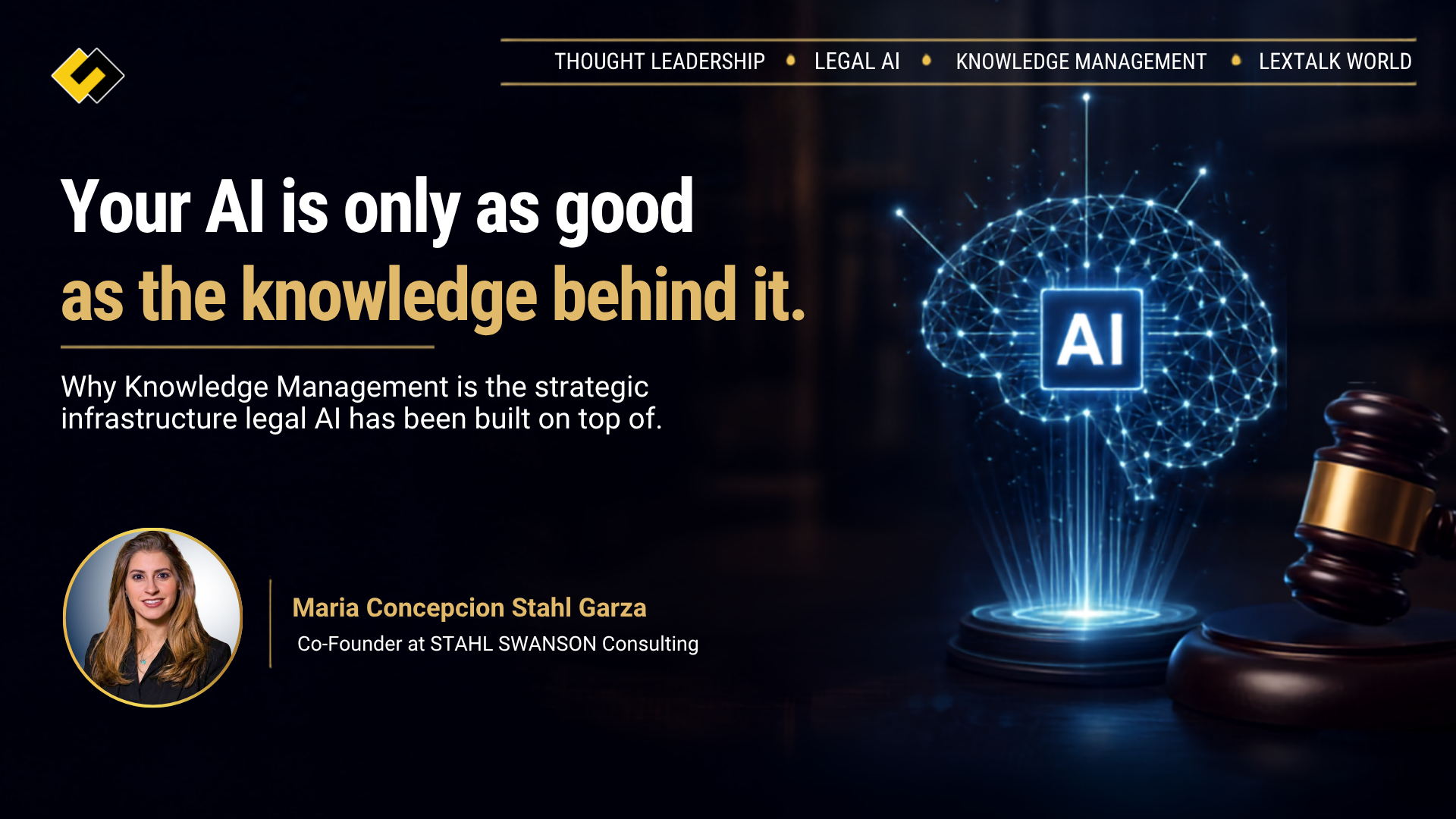
Rethinking Knowledge Management as Strategic Infrastructure
AI in Law is only as good as its knowledge foundations Rethinking Knowledge Management as Strategic Infrastructure Across law firms, in-house legal teams, and professional services organizations, AI adoption is accelerating rapidly. The promise is clear: faster work, improved efficiency, and enhanced competitiveness. Tasks are automated, documents are generated in seconds, and access to information appears instantaneous.
Yet, outcomes remain inconsistent. Outputs vary, and quality still depends on human validation, requiring professionals to review, correct, and question machine-generated results. The issue is not technological capability, it is the absence of a reliable foundation.
Artificial intelligence does not create knowledge, it processes it, recombines it, and scales it. Its effectiveness depends entirely on the quality and structure of the information it draws from. In law, where precision, consistency, and context are essential, this dependency is decisive.
The implication is clear: AI is only as good as the knowledge behind it.
Most legal organizations already hold vast amounts of knowledge: contracts, precedents, internal guidance, and accumulated expertise. However, possessing knowledge does not mean using it correctly. Much of it remains fragmented across systems, duplicated across teams, or embedded in individual experience.
The problem is not lack of expertise, it is lack of structure. This inefficiency is often invisible. Information exists but is difficult to locate, validate, and leverage. When AI is introduced into such environments, it amplifies these gaps. Inconsistent inputs lead to inconsistent outputs, forcing professionals to spend time verifying rather than trusting results. This does not eliminate the need for human review. However, when the knowledge that feeds AI is accurate and well-structured, outputs become more consistent, require fewer revisions, and significantly reduce the risk of hallucinations.
The difference is not the technology, it is the knowledge environment that supports it. This requires a shift in how Knowledge Management is understood. Traditionally positioned as a support function useful but secondary; in the era of AI, KM is not about storing documents, it is about transforming institutional knowledge into an operating asset.
When this foundation is in place, the impact extends beyond efficiency and reshapes how work is performed. Repetitive tasks decrease, and drafting becomes faster and more consistent. Information is available when needed, allowing professionals to focus on higher-value work like strategy, client relationships, negotiation, and decision-making.
This is where value is created: not in doing the same work faster, but in enabling a different use of expertise. Organizations that recognize this shift do not view AI as a cost-reduction tool. They see it as a capability enabler, one that scales expertise, standardizes quality, and creates operating efficiencies.
Achieving this, however, requires deliberate action. Knowledge does not organize itself. It must be structured, governed, and continuously maintained. Organizations need clarity on what is aligned, what is current, and what can be reused. This requires common language, clear taxonomies, standardized templates, and disciplined content lifecycle management.
The starting point is not technology, but questions: What knowledge do we have? Where does it reside? Is it consistent and current? Can it be trusted? Is it structured for AI to use effectively?
These are not technical questions, they are strategic ones. They lead to initiatives such as knowledge audits, content rationalization, and governance frameworks. While less visible than AI tools, they are foundational. With them, AI becomes trustworthy.
There is also a critical human dimension. Legal organizations have traditionally been built on individual expertise. AI shifts this dynamic, creating value from shared, well-organized knowledge rather than isolated experience. This requires cultural alignment, supported by leadership and incentives that promote knowledge sharing. Without it, even the best systems fall short.
The legal industry is at a defining moment. AI adoption continues to accelerate, and experimentation is widespread. It is easy to focus on tools. However, tools alone do not determine outcomes.
Structure does, clarity does, knowledge does.
AI capabilities will continue to evolve, but one principle will remain constant: results ultimately depend on the quality of the knowledge that underpins them.
Rethinking KM as strategic infrastructure is no longer optional.
The question is no longer whether to adopt AI, but whether the organization’s knowledge is ready for it.
Those that address this foundation will not only move faster. They will operate with greater coherence, reliability, and ultimately, greater impact.
About the Author
María Concepción Stahl, Co-Founder at STAHL SWANSON Consulting
María Concepción Stahl is an attorney with international law firm experience, graduating cum laude from Universidad Autónoma de San Luis Potosí and holding a Master’s in Corporate and Business Law from Université Paris II Panthéon-Assas. With over a decade of experience, she specializes in dispute resolution, corporate law, intellectual property, and legal innovation.
She served as Knowledge Management Manager at Baker McKenzie Mexico, leading strategic initiatives across the firm. She is now Co-Founder at STAHL SWANSON Consulting, advising on knowledge management, innovation, and AI adoption.
Recognized for legal transformation, she has received global awards and is a Chief AI Officer and member of AMCID.