
 Leonardo Benadretti
Legal and Risk Control Manager for Chile and Peru at Sungrow Renewables
Leonardo Benadretti
Legal and Risk Control Manager for Chile and Peru at Sungrow Renewables 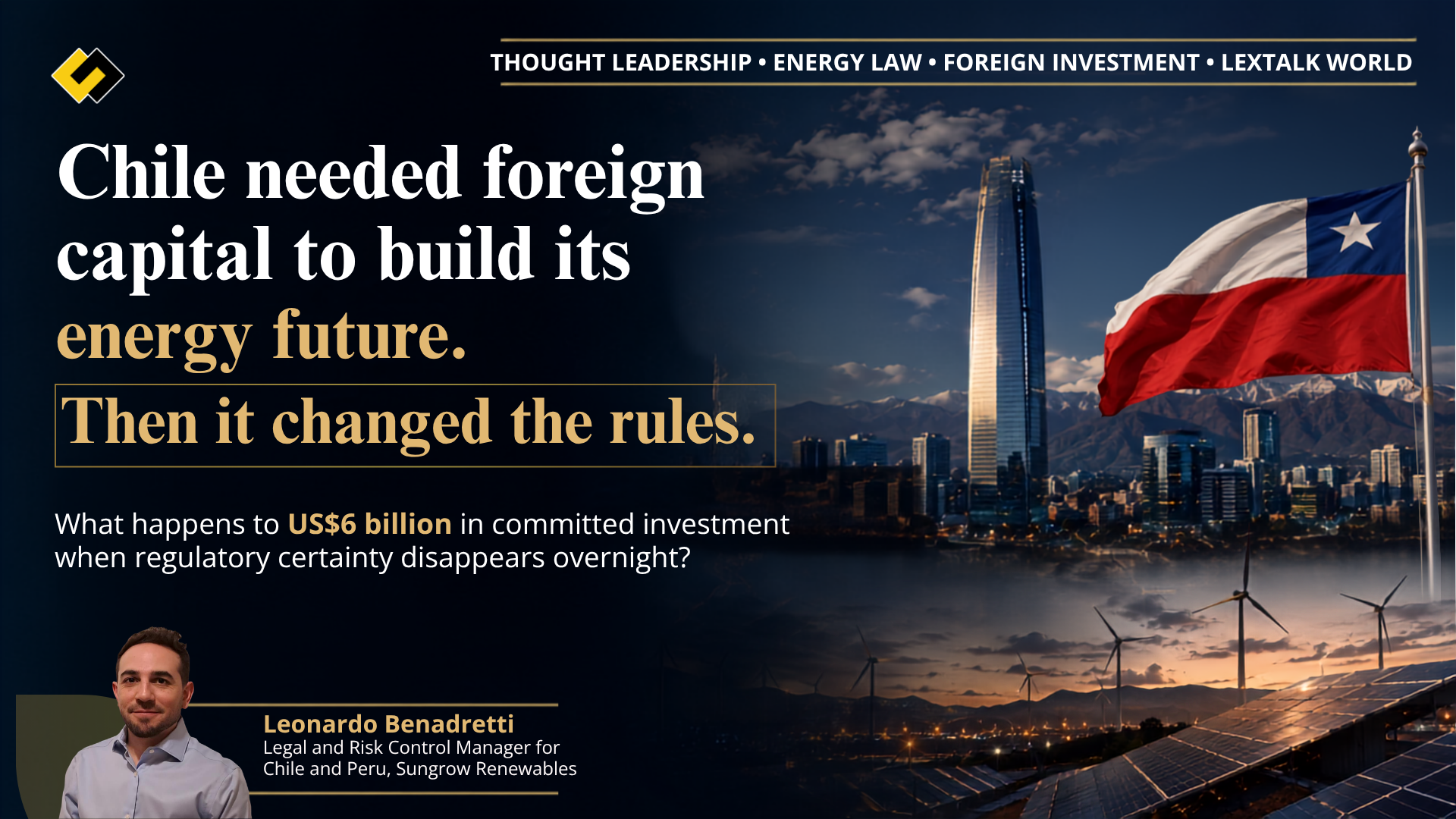
I. The Pivotal Role of Foreign Investment in Energy Transition
For over four decades, Chile has stood as the undisputed reference for institutional stability in Latin America. Following the pioneering privatization of its electricity sector in 1982, the State established a robust and predictable regulatory framework. Lacking deep liquidity within its domestic banking sector, Chile relied on Foreign Direct Investment (FDI) as the primary engine to construct its modern energy infrastructure. This is why one of the main purposes of this institutional design was to promote foreign investment by assuring investors of regulatory certainty and the protection of their capital.
This strategy was wildly successful. In recent years, Chilean installed capacity has successfully pivoted toward non-conventional renewable energy (NCRE), transforming Chile into a global benchmark in the energy transition to carbon neutrality and investments in this sector.
Special Laws for Non-Conventional Renewable Energy No. 20,257 (2008) and No. 20,698 (2013) established concrete measures to increase NCRE: they defined renewable energies and mandated power generation companies to supply at least a minimum percentage of their energy injections through NCRE, either directly or indirectly, with severe fines for non-compliance. The purpose was to increase the participation of this kind of generation within the energy matrix by achieving an injection of 20% of NCRE by the year 2025. This goal was wildly surpassed.
Today, over 60% of the country’s installed capacity comes from clean sources (solar, wind, and hydro), and for the year 2050, the Decarbonization Plan has set the goal of 100% of the energy produced to be from clean sources. BloombergNEF has consistently ranked Chile among the top ten emerging markets for renewable investment.
And this was achieved thanks to political will. The bill through which Law No. 20,698 (which increased the injection of NCRE into the energy matrix up to 20%, as described above) was introduced to Congress explicitly recognized that:
“Reaching 20% of NCRE in the electric systems implies strong investments and the development of a series of new technologies that need legal certainty to achieve it. Only with a clear legal framework is it possible to achieve it.”
However, regulatory stability is not always consistent. In recent years, we have witnessed important regulatory changes affecting the dynamics of international project financing. For market participants, the question is obvious: How to introduce regulatory changes and at the same time maintain legal certainty?
II. NCRE and the Structural Friction on the Chilean Electrical System
The rapid boom of renewable energy brought structural friction to the Chilean electrical grid. While clean generation soared, residential electricity tariffs failed to decrease. Concurrently, the national transmission system became severely congested. The massive solar portfolios built in the northern Atacama Desert found themselves structurally isolated, unable to transport power to major consumption centers in the south, triggering energy curtailment.
Another relevant point of friction has been the rapid development of Pequeños Medios de Generación Distribuida (PMGD)—small-scale distributed generation projects under 9 MW, which connect directly into the distribution system and benefit from priority dispatch rules and a “stabilized price” regime that protects PMGDs from spot market volatility. This regulatory framework was designed to promote the development of small-scale projects near consumption centers by giving certainty about future income. The result was an explosion of foreign investment in this kind of project.
Today, PMGDs represent a formidable 10% of Chile’s net installed capacity, of which 77% is solar.
However, their rapid expansion stressed the system’s operational and economic functioning. Large-scale centralized generators began fiercely alleging price discrimination and unfair dispatch priority, targeting the specific “stabilized price” regime. Also, the National Electrical Coordinator started to detect negative impacts on the market’s competition.
Under the objective of correcting these “systemic distortions,” a regulatory change was set in motion. What began as a technical debate rapidly mutated into a legitimate expectations dilemma for international financiers.
III. The Chronology of Legal Uncertainty
The first structural blow landed in 2024 with the debate surrounding the Electricity Tariff Stabilization Law. Seeking to subsidize vulnerable households, the government proposed draining future revenues directly from PMGD projects to fund the state subsidy. Although this specific mechanism was ultimately rejected in Congress after intense pushback, the mere threat of revenue skimming paralyzed the sector. Millions of dollars in planned investment vanished during the legislative debate.
The regulatory discussion resurfaced in 2025. The Ministry of Energy and the National Energy Commission (CNE) initiated modifications to Supreme Decrees 88 and 125, fundamentally altering the stabilized price formulas and tightening operational coordination rules for distributed assets (which limits their energy injections, thereby affecting their revenue streams). Once again, international banks and infrastructure funds simply pulled out of the Chilean market, freezing credit lines until the administrative uncertainty settled.
These shifts recently materialized into binding regulations under the current administration in 2026.
The financial fallout has been evident. Since the discussion of the Electricity Tariff Stabilization Law until the recent publication of normative amendments to the PMGD regulatory framework, investments in the sector have been paralyzed. Recently, the Association of Independent Power Producers of Chile (GIE A.G.) estimated that the regulatory changes may put over US$ 6 billion in committed investments at immediate risk.
IV. A Market Participant’s Perspective
From my perspective as Legal Counsel managing foreign-backed energy assets, this debate over the regulatory framework reflects a brutal corporate reality. During this multi-year normative erosion, I witnessed investors completely halt the development and construction of two major PMGD portfolios valued at over US$ 300 million. And that’s just me.
The collateral damage of a frozen investment pipeline has several consequences. It is a rapid chain reaction of contractual liquidations:
- The immediate termination of Engineering, Procurement, and Construction (EPC) contracts.
- The collapse of advanced Share Purchase Agreements (SPAs) and active M&A processes.
- The termination of long-term land lease agreements.
- The abrupt cancellation of local supply and consulting contracts, forcing domestic vendors to shutter operations.
- The strict review of existing credit agreements with regard to the allocation of future cash flows and the ability to cover the debt.
The distributed generation market in Chile, once a vibrant hub of international capital deployment, has been pushed into some sort of hibernation.
V. Consequences for Foreign Investors’ Legitimate Expectations
These regulatory amendments bring us to the issue of affecting legitimate expectations—a cornerstone of the Fair and Equitable Treatment (FET) principle in international investment law.
It is well established that foreign investors prefer macroeconomic stability, legal certainty, availability of infrastructure, and the qualification and adaptability of labor from the recipient country, rather than the granting of specific, isolated benefits. Since 1982, the State of Chile through its agents has tended to strongly promote and encourage foreign investment in the energy sector by ensuring investors regulatory certainty and the protection of their capital.
In principle, this encouragement plus the regulatory framework could be interpreted as the generating source of legitimate expectations or legitimate trust for investors to allocate capital in Chile rather than somewhere else. Upon making their investment, legitimate expectations dictate that the applicable regulation to their activities would not change overnight.
When international investors choose an emerging market over alternative global jurisdictions, they do so based on the state of the law at the moment the investment is made. The promotional frameworks, statutory guarantees, and technical decrees issued by the Chilean State were the primary representations that generated the legitimate trust required to lock in 20- to 30-year capital models.
Altering the economic assumptions of structured Project Finance through subsequent legislative discussions and administrative decrees severely affects this trust. It shifts the benchmark of country risk, driving up the cost of capital for the financing of projects.
While it is within a sovereign state’s police powers to regulate its internal markets, it is an evident truth that by doing so they may compromise its international image. Chile has mended local market distortions, which is legitimate, but doing so has sent a message: regulations are dynamic, and this dynamism may not always respect the principles of graduality, proportionality, and legal certainty.
The question that arises, then, is whether these regulatory changes effectively breach the principle of legitimate expectations of foreign investors. While it is not the purpose of this article to answer that question, what has become clear is that in Chile the rules of the game can change, increasing credit risk and therefore making project financing more expensive.
Have we shot ourselves in the foot? We need FDI for the sector to grow, but at the same time, we have undermined investor confidence.
VI. The Next Steps
The global transition to renewable energy is, fundamentally, a global race for capital. If the rules of the game can be rewritten overnight by administrative decree, the prize for country risk will structurally leave behind the natural advantages of sun and wind.
Chile now faces the urgent challenge of rebuilding this trust. To unlock the stagnant billions required for the next phase of the energy transition—including utility-scale battery storage (BESS) and transmission expansion—the state must return to institutional predictability. Regulatory adjustments must be forward-looking, transparent, and respectful of grandfathering principles.
About the Author:
Leonardo Benadretti, Legal and Risk Control Manager for Chile and Peru at Sungrow Renewables Development Co., Ltd
Leonardo Benadretti is a legal specialist and strategic manager with over 10 years of experience in corporate law, economic regulation, and risk management. As Legal & Risk Control Manager at Sungrow Renewables Chile, he supports renewable energy investments through regulatory compliance, contract negotiation, and strategic legal oversight. His expertise spans the full lifecycle of utility-scale and PMGD energy projects, including project financing, stakeholder negotiations, and dispute resolution. A graduate of Universidad Adolfo Ibáñez with a Master’s in Economic Regulation, Leonardo is recognised for combining legal expertise with business strategy to drive sustainable growth and informed decision-making in the renewable energy sector.